During the latest wave of attacks against Ukraine, a Russian Geran-2 drone hit an apartment building in Romania, near the border.
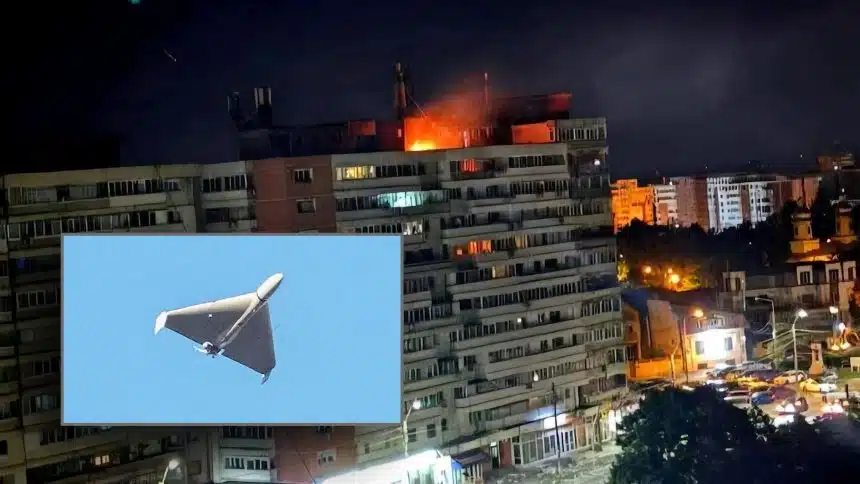
A Russian drone hit an apartment building in Romania, near the border with Ukraine, in the intervening night between May 28 and 29, 2026, causing a fire and injuring two people. The drone apparently went stray during the latest wave of Russian attacks against Ukraine.
Among the targets was Izmail, home to the largest Ukrainian port on the Danube River and near the border. One of the drones reached Galati, which sits on the border between Romania, Ukraine and Moldavia.
Drone strike was over 8 miles (13 km) from the Ukrainian border.
Geo: https://t.co/VWKs4Wvuij pic.twitter.com/HqJ76ahzuf
— OSINTtechnical (@Osinttechnical) May 29, 2026
Romania’s Ministry of National Defense (MND) said this is not the first time a Russian drone breaches Romanian airspace, as it already happened 28 times since the beginning of attacks on ports across the Danube River. However, this is the first time a Russian drone struck a populated area and caused injuries.
The MND identified the drone as a Geran 2, the Russian copy of the Iranian-made Shahed 136. According to the statement, the entire warhead exploded upon impact on the building, reportedly on the roof.
Wreckage found at the site of a drone strike tonight on an apartment building in Galați, Eastern Romania, which injured several civilians, appears to confirm that the building was indeed struck with a Russian Geran-2/Shahed-136. pic.twitter.com/nL7dgJUWzw
— OSINTdefender (@sentdefender) May 29, 2026
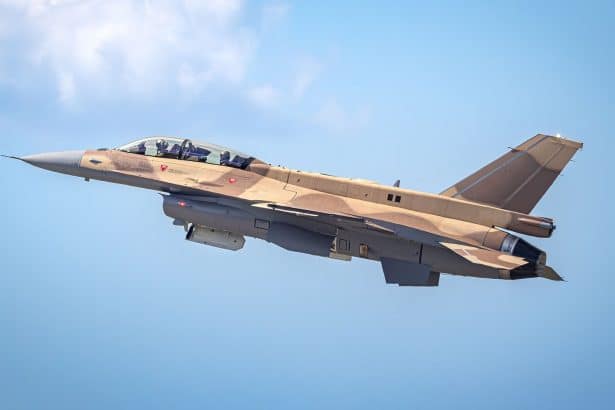
Two F-16 Fighting Falcon fighters and an IAR 330 SOCAT helicopter of the Romanian Air Force were also scrambled after the drone was detected. Romanian Brigadier General Gheorghe Maxim said the drone flew in Romania’s airspace for only four minutes and at low altitude.
While pilots were authorized to engage the drone, its low altitude made it difficult for radar to detect the target. Additionally, a U.S. Counter-UAS system Merops – which uses interceptor drones was operational in Romania, however its use over the densely populated area was deemed too risky.
Romania’s MOD confirms that a Russian drone hit Romanian territory, with its radars tracking the incoming raid. https://t.co/N6Zhkz5RuO pic.twitter.com/o3eD06hdYq
— OSINTtechnical (@Osinttechnical) May 29, 2026
“The Ministry of National Defense firmly condemns the irresponsible actions of the Russian Federation and emphasizes that they represent a new challenge to regional security and stability in the Black Sea area,” further reads the statement. “Such incidents demonstrate the Russian Federation’s lack of respect for the norms of international law and endanger not only the safety of Romanian citizens, but also the collective security of NATO.”
NATO and the European Union also condemned the incident, with Ursula von der Leyen, President of the European Commission, saying that Russia “crossed yet another line.” Similarly, a NATO spokesperson posted on X “We condemn Russia’s recklessness, and NATO will continue to strengthen our defences against all threats, including drones.”
Stray drones in the Ukraine-Russia war
It is not the first time drones used in the war in Ukraine went off course, and this problem was experienced by both sides. The causes are often attributed to either malfunctioning or the effects of electronic warfare.
Early this morning, an apartment building in Romania was struck by a drone as Russia attacked Ukrainian infrastructure near the border. @SecGenNATO is in touch with Romanian authorities. We condemn Russia’s recklessness, and NATO will continue to strengthen our defences against…
— NATO Spokesperson (@NATOpress) May 29, 2026
Recently, on May 19, 2026, a Ukrainian drone entered Estonian airspace during an attack against Russia. “Conditions of heavy electronic warfare, including GPS spoofing and jamming, by Russia” were reported, which possibly sent the drone off course.
Romanian F-16s currently deployed to Lithuania as part of the NATO Baltic Air Policing mission were tasked to intercept and shoot down the drone. Ukraine later issued a public apology for the incident, calling it “unintended” and saying the drone was redirected in the Baltic region by electronic warfare.
Following an overnight incident in Romania SACEUR spoke today to @CHOD_ROU. pic.twitter.com/Wxu9hPF289
— SHAPE – NATO Allied Command Operations (@SHAPE_NATO) May 29, 2026
The incident follows last year interceptions over Poland, when F-16s and F-35s intercepted and shot down Russian drones which violated its airspace during a large-scale strike on Ukraine. The incident happened in the night between Sep. 9 and 10, 2025.
On that occasion, according to Polish Prime Minister Donald Tusk, a “huge number” of Russian drones crossed into Polish skies during the assault. He added that the drones posing an immediate threat were neutralized by fighter jets, with no casualties reported.