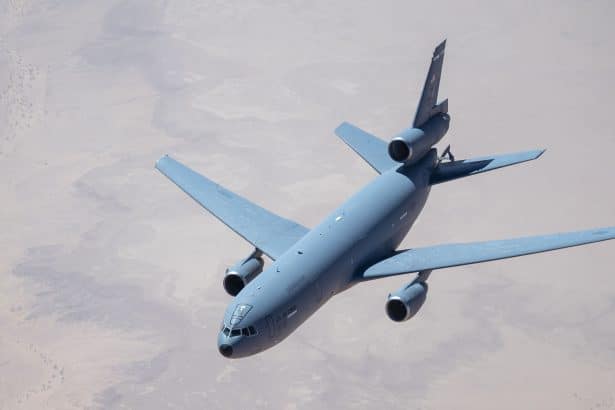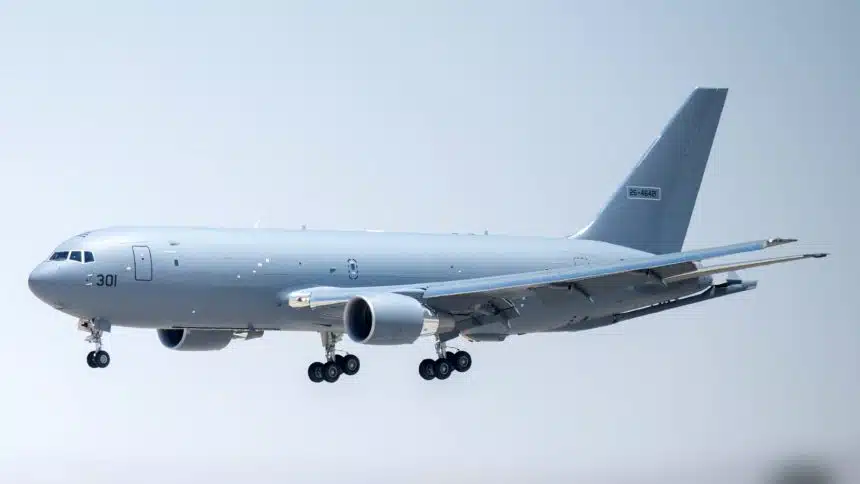
The first KC-46 “Gideon” tanker for the Israeli Air Force has been delivered less than one month after its first flight was announced.
The Israeli Air Force received its first KC-46 at Nevatim Air Base on May 27, 2026. The tanker, designated as “Gideon” by the Israeli military, was delivered less than one month after the Israeli Ministry of Defense had announced its first flight on LinkedIn on May 4, 2026.
Today, the Israeli Air Force is adding the capabilities of the “Gideon”, the most advanced operational refueling aircraft in the world.
Its arrival marks a true leap forward in the Israeli Air Force’s ability to expand its operational range, extend the duration of operational… pic.twitter.com/LII80CKF30
— Israeli Air Force (@IAFsite) May 27, 2026
The aircraft is the first of six KC-46s that are being procured by Israel and, according to the statements of the Israeli MOD, it “will be equipped with Israeli systems and adapted to the operational requirements of the Israeli Air Force, enabling it to extend operational range and maintain air superiority across all theaters.”
The Israeli Air Force says the “Gideon” is “the most advanced operational refueling aircraft in the world.”
🇮🇱 A historic day for the IAF, which took delivery of its first KC-46A “Gideon” multi-mission aerial refueler.
Additional IDF photos of the aircraft’s arrival at Nevatim Air Force Base earlier today: https://t.co/OdlRcG6Bvn pic.twitter.com/qZZByIcULM
— Guy Plopsky (@GuyPlopsky) May 27, 2026
The first aircraft, flying as RCH301 (“REACH 301” – a callsign typically used by U.S. Air Force aircraft assigned to the Air Mobility Command), could be tracked online.
ברייקינג: מטוס התדלוק החדש של חיל האוויר הישראלי, פגסוס KC-46A “גדעון” (301), נחת לפני זמן קצר בישראל. הראשון מתוך 6 (ועוד 2 כאופציה) https://t.co/GaY76dCS7U pic.twitter.com/C2ka2HrlCh
— איתי בלומנטל 🇮🇱 Itay Blumental (@ItayBlumental) May 27, 2026
The U.S. State Department approved a Foreign Military Sale (FMS) of the KC-46 Pegasus tanker to Israel in 2020. The approval included up to eight tankers for an estimated price of $2.4 billion.
In 2021, the Israeli government approved the acquisition, clearing the way for the negotiations. A year later, Boeing was awarded a contract worth $930 million for the first four KC-46s, with deliveries expected by 2026.
Reports in 2025 mentioned that Israel was looking to increase the order, and thus two more KC-46 were procured. At this stage, it is unclear if the KC-46 will be further increased or it will remain at six airframes. Some Israeli media outlets reported the full order includes eight aircraft, whereas others still say the order is just for six ones.
The KC-46 will replace Israel Boeing 707 “Re’em” tankers that have been operating for around 60 years. According to available information, six 707s are currently in service with the Israeli Air Force, making the KC-46 acquisition, at least, a one-for-one replacement.
The delivery of the first Israeli Air Force KC-46 is certainly good news for Boeing, as it puts the troubled Pegasus under the spotlight again with the induction into active service by an important customer. Moreover, the news comes shortly after another customer, Italy, which had originally decided to replace its current fleet of four KC-767 tankers with the KC-46, halted the procurement of the Pegasus and eventually signed a deal with Airbus for the procurement of six A330 MRTT (Multi-Role Tanker Transport) aircraft.
The arrival of the first Gideon follows also the announcement jointly made by the U.S. Air Force and Boeing of a new plan to improve the readiness of the Pegasus tanker fleet and accelerate the delivery of long-awaited upgrades. In fact, the tanker has reportedly suffered from boom-related issues, including the stiffness of the telescoping actuator, which affected its ability to refuel some types of receiver aircraft, as well as fuel system leaks, delivery pauses and quality issues.
Among the upgrades that will be made available soon, there’s the one concerning the Remote Vision System 2.0, or RVS 2.0.
The system provides high-definition stereoscopic imagery to the vision goggles attached to a sort-of flight helmet worn by the boomer during the air-to-air refueling, replacing the so-called “direct view technology” used by the USAF in KC-135 and KC-10 legacy tankers, where the boom operator looks directly through a window at the receiver aircraft, lies face-down in a rear-mounted pod and uses a manual control stick with their right hand to “fly” the boom.
RVS 2.0 replaces the original remote camera and display architecture (RVS 1.0) used by KC-46 boom operators, introducing fixes to the image washout and 3D distortions affecting the original KC-46 RVS 1.0 design, especially under certain lighting conditions. These issues, some of the most persistent problems affecting the Pegasus since its entry into service, have been classified among the KC-46’s Category 1 deficiencies.
Boeing initially agreed to the Air Force’s demand in April 2020 to redesign the entire RVS and introduce the RVS 2.0 at no additional cost to the government. However, a series of technical, critical design reviews and certification for commercial off-the-shelf camera hardware kept pushing the RVS 2.0 delivery beyond 2026. As of late 2025, the service-wide retrofit was said to be expected in 2027, when RVS 2.0 would finally be certified and approved for delivery.