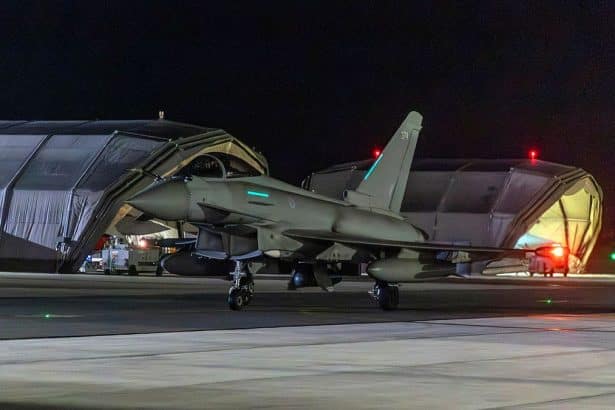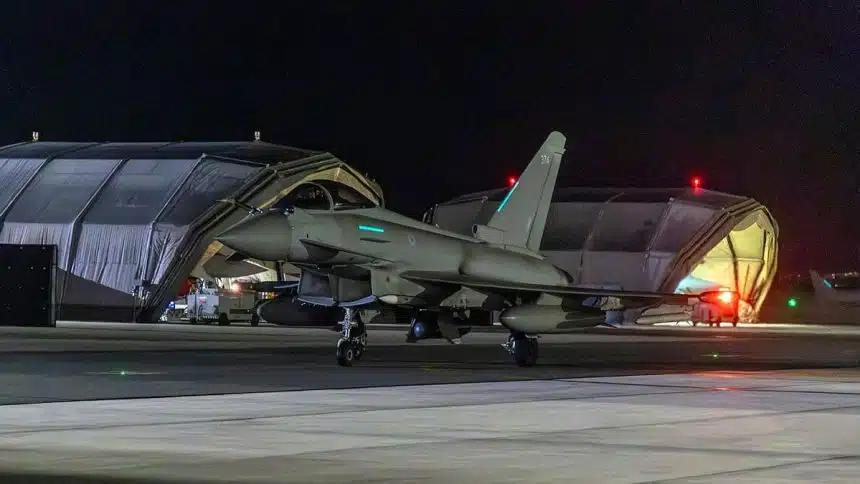
The United Kingdom is sending an undisclosed number of Typhoon FGR4 fighter jets to Saudi Arabia to assist them in shooting down Houthi missiles and drones.
The RAF will deploy the aircraft for defensive counter air missions against Houthis strikes on Saudi Arabia’s critical national infrastructure and their major population centres. The statement on British participation expresses that these aircraft will operate purely in a defensive role as they did whilst operating over Qatar, Jordan and Kuwait earlier this year, during the U.S. war against Iran.
As such, these aircraft will not be conducting offensive strikes against the Houthis, in any capacity.
The Typhoons will be joined by an RAF A400M Atlas to provide support for the movement of defence materiel around Saudi Arabia, alongside a deployment of UK military advisers to support Saudi staff officers in the defence of their country. The RAF had previously deployed a Voyager tanker to Saudi Arabia to provide additional refueling capacity to Saudi Typhoons operating in the air defence role, as a result of the Houthi crisis.
However, the situation has continued to deteriorate with regular strikes on key Saudi Arabian infrastructure, including high profile strikes on multiple civilian airports in Riyadh, with one attack on King Khalid international airport killing 12 people.
RAF Completes 20th Aerial Refuelling Mission in Support of Defending Saudi Arabia’s skies
The UK Royal Air Force’s Airbus A330-MRTT “Voyager” tanker aircraft have completed their 20th mission a short while ago, supporting air defence operations in Saudi Arabia which has come under repeated attack from the pro-Iran Houthi group’s UAVs and missiles launched from Yemen.
At present, the 20 sorties flown account for around 187 flying hours, with airframes ZZ334 currently the most flown from RAF Akrotiri for this purpose.
@MATA_osint @UKDefJournal @UKForcesTracker @flightradar24
https://t.co/3mw8y8jqFc
— DefenceGeek 🇬🇧 (@DefenceGeek) October 19, 2026
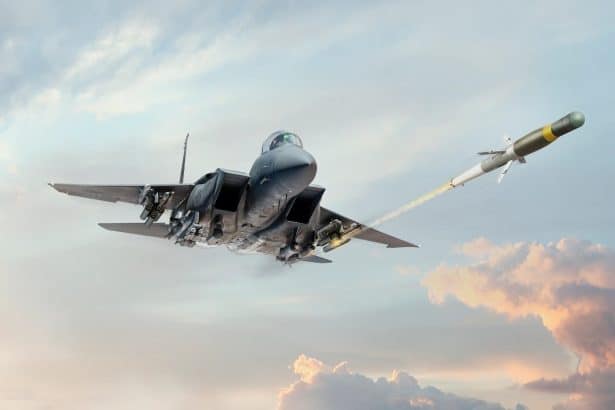
The UK had previously sent air defence equipment to Saudi Arabia during the Iran war, with a deployment of a Sky Sabre medium-range air defence system in late March. The deployment of fighters gives the UK more range with which to deal with drones and cruise missiles, with the newly equipped APKWS laser guided rockets allowing the RAF to shoot down said weapons at a lower cost than with Land Ceptor missiles fired by Sky Sabre.
Continued deployment of critical air defences overseas is also under a lot of media scrutiny, following the UK’s opposition party’s plans for a £10 million air defence program earlier this month.
About the deployment, UK Defence Secretary Wes Streeting stated:
“The continuing attacks from the Houthis on our ally Saudi Arabia are absolutely despicable. The targeting of the airport in Riyadh in particular shows the lengths the Houthis are going to escalate the situation in the region.
That’s why today I have approved further UK military support. RAF Typhoons will fly defensive air missions to help protect Saudi airspace from drones and missiles. This builds on the UK equipment and personnel we already have in the country to defend against Houthi air attacks.”
Currently the number of aircraft to be deployed and their deployment location has not been disclosed by the British government.
So based on the available public flight tracking data, there is currently 4-8 Typhoons already at RAF Akrotiri or in Qatar (with 3 others having returned to the UK on 9th October). Will be interesting to see if the existing deployed jets are used or if others are sent out in the coming days…
— DefenceGeek 🇬🇧 (@DefenceGeek) October 20, 2026
The Italian Air Force had previously deployed four F-2000 Typhoon fighter jets to Saudi Arabia in March to provide air defence assistance to the country, following the beginning of the Iran war. One of these aircraft was recently hit on Sept. 18 in a Houthi missile strike on Al Taif Air Base/King Fahd Air Base.
It is unknown exactly how extensive the damage to the aircraft is, but it was at a dispersed area of the air base when the missile impacted. The other three Typhoons and the Gulfstream E-550A CAEW used for aerial surveillance and reconnaissance, that were also housed at the base, were undamaged in the attack.
The Italians had previously seen an MQ-9A Reaper destroyed and another Typhoon damaged in an Iranian attack on Ali Al Salem Air Base in Kuwait on Mar. 15, 2026. The deployment of RAF Typhoons carries similar risks, as any aircraft based on the ground could be susceptible to missile attacks.
However, this depends on where they are based, and what air defence systems are put in place to protect them. As the RAF has Voyager tankers in theatre it is likely that deployed aircraft would be based further from Yemen than the Italians were at King Fahd Air Base.

The Royal Saudi Air Force also saw one of their Typhoons damaged whilst operating in Yemen, with the Houthis subsequently releasing footage of the attack. Multiple RSAF Tornados and other aircraft have been shot down whilst fighting against the Houthis highlighting the capability of the militia force, even after almost a decade of fighting with the Saudis.
The RAF previously participated in strikes against the Houthis across 2024 and 2025 following their attempts to shut down the Red Sea. These aircraft operating out of RAF Akrotiri supported American airstrikes against the militia, before a ceasefire was put in place last year.
British-Saudi Defence Relationship
The United Kingdom and Saudi Arabia have a long standing defence partnership stemming from the establishment of Saudi Arabia as a modern nation state in the aftermath of the First World War. Despite Saudi Arabia’s status as a non-democratic state led by an absolute monarchy, the two nations have been solid allies for many decades.
The most high profile example of this relationship was seen in August 1990, following Iraq’s invasion of Kuwait. The UK was one of the first nations to deploy military equipment to defend Saudi Arabia, with 12 Panavia Tornado F3 aircraft sent to Dhahran to enhance the country’s air defences.
These aircraft operated similarly to the way Typhoons operate in 2026, however with a much reduced capacity and no ability to deploy air to ground munitions. The deployed Tornado F3s were drawn from No. 5 and No. 29 Squadrons, who were at the time of the invasion attending an Armament Practice Camp at RAF Akrotiri. Aircrew would be sourced from both of these squadrons alongside four from No. 11 Squadron in the UK, but multiple crew rotations would take place during the war.
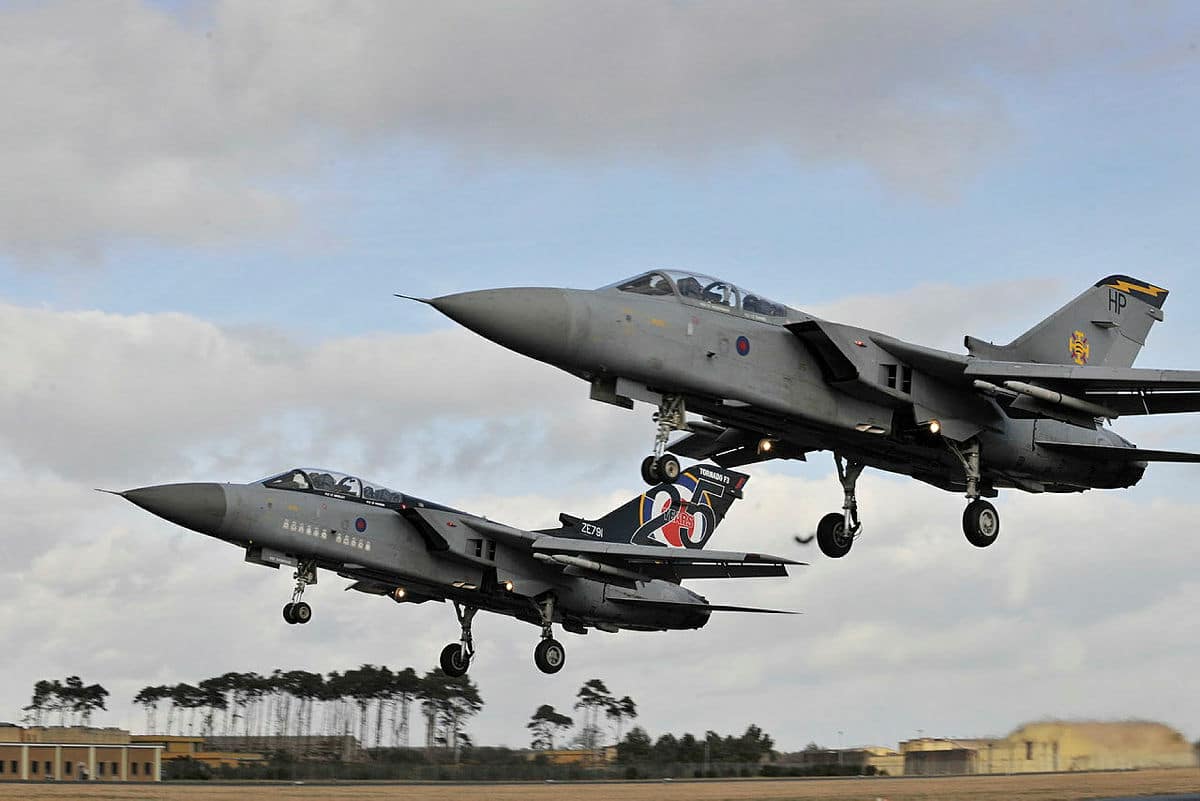
All 12 aircraft arrived on Aug. 11, 1990, and were immediately in the air for training combat air patrols (CAPs) and theatre familiarisation sorties. They would begin full CAPs on Aug. 17, when effective rules of engagement were introduced across the RAF, the Saudi Air Force and the U.S. Air Force.
Six reinforcement aircraft would be set to join the initial 12 from September all the way until the end of the war. In total, RAF Tornado F3s flew 7,785 hours and 2,666 sorties during Operation Granby (the British name for Operation Desert Shield and Desert Storm), with 2,129 operational CAP sorties flown over Iraq, Kuwait and Saudi Arabia.
RAF Tornado and Jaguar behind the tanker during Desert Storm – great picture, source unknown. #avgeeks http://t.co/JOQOfDPfYH
— Guillaume Steuer (@G_Steuer) July 29, 2015
For much of their time in theatre, the F3 was beset with issues related to its original design as an air defence variant of a low level fast attack bomber. The aircraft was not suited to high altitude turn and burn engagements, and as a result it was not moved into the offensive counter air role, as was seen with the American F-15C.
Instead, the F3 was confined to defensive duties well behind the front line, in part also due to its lack of suitable identification friend or foe equipment. This meant that visual confirmation was needed to engage Iraqi fighters, which would have severely hampered operational effectiveness in an air battle.
The F3 would be joined by a larger fleet of British jets including Tornado GR1s, SEPECAT Jaguars and Blackburn Buccaneers, which were deployed to later liberate Kuwait.
RAF Historian Sebastian Ritchie highlights a key moment for the F3’s deployment to Saudi Arabia, where on Mar. 6, 1991, two F3s on CAP over Kuwait joined formation with a Swissair DC-9 carrying the last of the coalition prisoners of war to freedom. These POWs contained a number of Tornado GR1 aircrew at the time, who were more than pleased to see their fellow pilots.
Today’s deployment of RAF Typhoons to Saudi Arabia puts this relationship into a new context, with it undertaken following 2017’s Military and Security Cooperation Agreement, which promotes greater cooperation between the two countries across the Defence and Security sectors. Though, the relationship has been strained due to allegations of corruption surrounding the Al-Yamamah I and II deals to supply multiple Tornado aircraft to Saudi Arabia in the 1980s and 1990s.
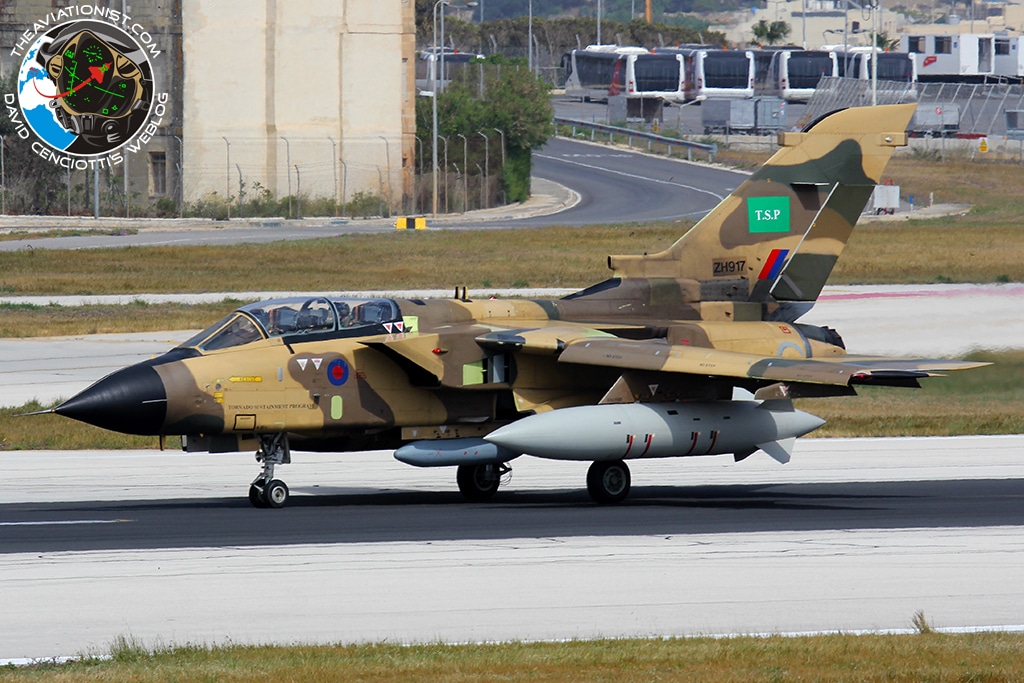
The British company BAE Systems would also receive the contract for the Saudi Tornado upgrade programme, which saw 80 Saudi jets sent to the UK for upgrades.
The relationship also became strained following allegations of possible war crimes committed by Saudi Arabia in its first intervention against the Houthis, which saw British made planes and weapons used during strikes that killed a large number of civilians. This culminated in a lawsuit against the government which temporarily ended sales to Saudi Arabia in 2019, before a subsequent review found that these were “isolated incidents” of possible violations allowing continued sales.
Ever since, the UK has been trying to sell Saudi Arabia an additional 48 Typhoons to supplement the 72 ordered in the early 2000s, but this defence deal has stalled. Now the Saudis are expressing interest in joining the Global Combat Air Programme alongside Britain, Italy and Japan, but the outcomes of this interest remain to be seen.