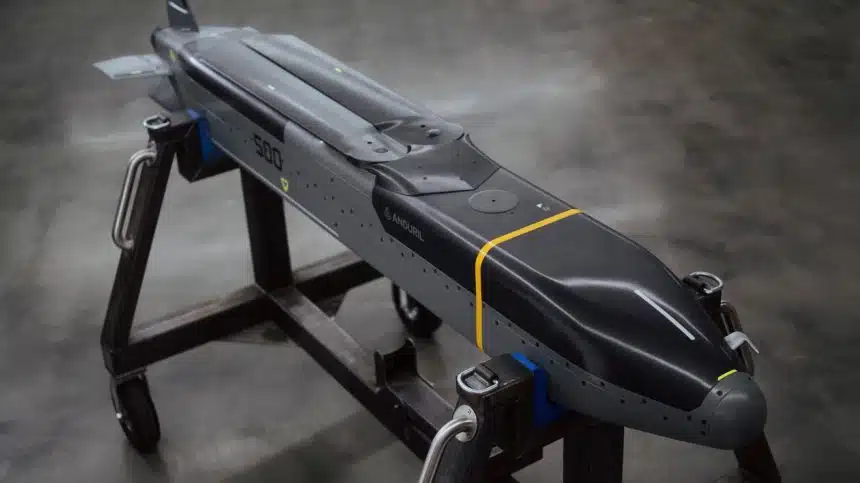
A four-day independent trial by the AFRL’s Munition Open Architecture Test and Evaluation Laboratory assessed 14 weapons-systems domains to verify the compliance of Barracuda-M.
Anduril’s Barracuda-M family of autonomous jet-powered cruise missiles has been certified to be compliant with the U.S. Air Force Weapons Open Systems Architecture (WOSA) standard, the Air Force Research Laboratory (AFRL) announced on Sept. 28, 2026. A four-day assessment at the AFRL’s Munition Open Architecture Test and Evaluation Laboratory (MOATEL) verified 14 weapon-systems domains, says the service.
Anduril said the Barracuda has become the “first weapon system in large-scale production to complete MOATEL’s independent WOSA verification process.” Both AFRL and Anduril identified the following capabilities and components that the MOATEL tested: Mission Autonomy, Seeker, Inertial Measurement Unit, Global Positioning System, Air-Data Sensor, Propulsion, Airframe Control, Target State Estimator, Altimeter Aiding Navigation, Clock, Autopilot, Guidance, Navigation and Munitions Data Bus (MDB).
AFRL described the milestone as an advancement of the government’s new weapons development practice to allow rapid fielding and technological innovation. Anduril says it validates its industrial approach to develop scalable, inexpensive yet effective weapons that trade exquisiteness for simplicity.
🚀The @AFResearchLab verified that Anduril’s Barracuda-M family of cruise missiles meets the @usairforce‘s Weapon Open Systems Architecture standard, a framework intended to help weapons remain adaptable as technology, threats and mission needs change.https://t.co/JBFSyaEXB4 pic.twitter.com/vE0bBDPVFi
— U.S. Air Force Materiel Command ✈️ (@HQ_AFMC) September 30, 2026
WOSA-compliant Barracuda-500M
The AFRL release quoted Department of the Air Force (DAF) Technology Executive Officer and AFRL commander Brig. Gen. Douglas Wickert, who said WOSA helps “new technology [rapidly progress] into adaptable warfighting capability.”
“By validating that open systems work at scale, we are fundamentally changing how we transition technology and enabling the rapid integration and fielding of new innovations faster than the threat evolves,” Wickert added.
AFRL project manager and creator of WOSA Jonathan Shaver said “open architecture is only meaningful when it can be independently verified […] instead of accepting vendor self-assessment.” WOSA verification at MOATEL makes “new sciences […] ready for a weapon, showing open architecture can scale beyond prototypes.”
The four-day verification at MOATEL assessing 14 WOSA domains “demonstrated modularity between Anduril’s internal and external MDB implementations, enabling rapid technology refresh of WOSA-compliant software.” Additionally, “it also verified that Anduril’s software architecture met the WOSA requirements for the domains under test,” AFRL added.
The statement explained that “Barracuda-M’s assessment represents a production-scale example of the verification process AFRL will continue to apply as additional weapons programs move through development and production.”
@anduriltech Unveils Barracuda-M Family of Cruise Missiles
The Barracuda family of AAVs consists of Barracuda-100, Barracuda-250, and Barracuda-500. Each increment offers increasing size, range and payload capacity, but all Barracudas are compatible with a host of payloads and… pic.twitter.com/NW1RvpUI6W
— Global Defense Insight (@Defense_Talks) September 12, 2024
Anduril’s vice president of Advanced Effects Pat Morris said the challenge is to actually prove modularity and open architectures in an independent assessment, rather than to “talk about” it. “AFRL and MOATEL’s verification validates one of the fundamental design decisions behind Barracuda: build the weapon around a simple, modular architecture so that programs can integrate new technology without redesigning the entire system,” he explained.
Open Systems Architecture capability and Anduril
Open systems architecture, which allows hardware and software modularity, has become a new cornerstone of the Department of War’s acquisition doctrine, particularly in the Collaborative Combat Aircraft (CCA) program, where Anduril is the prime contractor for the FQ-44 Fury.
This approach can prevent vendor lock-in, potentially helping to mitigate cost overruns and acquisition delays while supporting mass producibility and scalability to meet protracted conventional wars, as well as allowing third-party component and software modification to meet various mission needs.
🇺🇸 Anduril (@anduriltech) announced a production agreement for Surface-Launched Barracuda-500M with U.S. Department of War (@DeptofWar).
“Under the agreement, Anduril will scale production to deliver a minimum of 1,000 all-up rounds per year, with the first tranche of… pic.twitter.com/V4fNSYiK7c
— Counter Unmanned Systems (@CUAS_NEWS) May 13, 2026
Anduril has long touted a different industrial model than the legacy companies. It favors simple designs, engineering decisions and proven components from existing supply chains for its weapons. These can be produced using non-specialized manufacturing equipment and tooling on reconfigurable factory lines, supporting both weapons modifications and flexible production rates.
Barracuda family of weapons
Anduril describes the Barracuda family as a series of Autonomous Air Vehicles (AAV) consisting of three variants: the Barracuda-100, Barracuda-250 and Barracuda-500. The ‘M’ suffix represents the kinetic effect variant of the munition.
The company designates the ground-fired version as the Surface Launched Barracuda (SLB). The U.S. Army contracted 3,000 SLB-500Ms in May 2026 for its Program Acquisition Executive FIRES (PAE FIRES) effort.
Anduril will deliver thousands of air-launched cruise missiles per year under a new 7-year agreement with the @DeptofWar.
This framework establishes a clear pathway to move the pallet-and lug-launched Barracuda-500M from development and prototyping into large-scale production.… https://t.co/H1pa4lW1jE pic.twitter.com/TLyplb9TTt
— Anduril Industries (@anduriltech) July 15, 2026
Anduril puts the air-launched Barracuda-500M’s range at more than 500 nautical miles and claims an approximate speed of 190 to 500 knots. In September 2025, the U.S. Air Force designated the Barracuda-500M as the AGM-189A.
Anduril is also expanding internationally. It has tied up with Brazilian aerospace company Embraer to integrate the Barracuda-500M on the C-390 Millennium for palletized launches.
Additionally, An MoU with Polska Grupa Zbrojeniowa S.A. (PGZ) covers the weapon’s localized production in Poland. The agreement concens the surface launched variant of the Barracuda-500M.
Another potential European customer is Latvia. President Edgars Rinkēvičs visited Anduril and posted about his visit on X on September 25.
“It was great to visit Anduril to meet with Palmer Luckey and to witness signing of memoranda of cooperation with MOD of Latvia and Origin Robotics Looking forward to complete acquisition of Barracuda long-range missiles and [Latvian-U.S.] defense industry cooperation,” said Rinkēvičs. The class of Barracuda missile, the number of weapons Latvia aims to buy, the cost and the delivery timeline are not known.
It was great to visit @anduriltech to meet with @PalmerLuckey and to witness signing of memoranda of cooperation with MOD of Latvia and @OriginRobotics. Looking forward to complete acquisition of Baracuda longe range missiles and 🇱🇻 🇺🇸 defense industry cooperation pic.twitter.com/JafnNy5RAe
— Edgars Rinkēvičs (@edgarsrinkevics) September 25, 2026