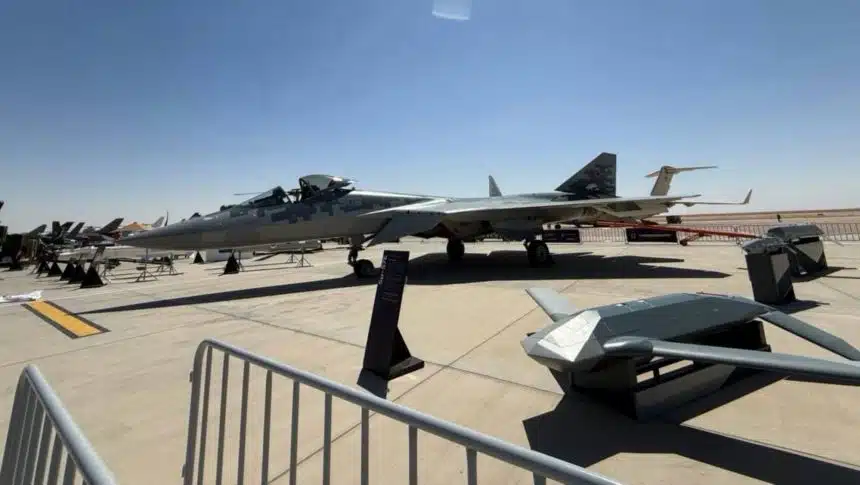
The new munitions blur the line between low-cost attack drones and cruise missiles, with some apparently derived from the S-71 family.
At the El Alamein Airshow in Egypt, which kicked off on Sep. 8, 2026, Russia unveiled a series of stealthy air-launched effects meant to be employed by the Su-57E fifth generation fighter. Rostec, the state-owned holding company of all Russian defense enterprises, had previously announced unveiling the one-of-a-kind weapons, as the country aggressively pushes the Su-57 for foreign sales.
While the S-71M Monochrome, S-71K Carpet and a not officially identified munition were displayed publicly for the first time, the S-71 family has been known for some time. The third weapon is being identified as the Banderol is a known low-cost missile that first emerged in 2025.
The weapon was previously identified by Ukraine as the S8000 Banderol, although it is unclear if the S8000 designation is being used by Russia. Additionally, another image of the Banderol mounted on the starboard (right-side) stub wing of the Mi-28NM attack helicopter also emerged from Russian social media and ‘mil bloggers’ on Telegram.
Images of Russian aircraft, including the Su-57 prototype (T-50-9) and Yak-130M, and air-launched munitions displayed in the static exhibition area at the El Alamein International Airshow. https://t.co/4JVLMHpRA0 pic.twitter.com/Vjf0HQTxyz
— H. Memarian (@HEMemarian) September 7, 2026
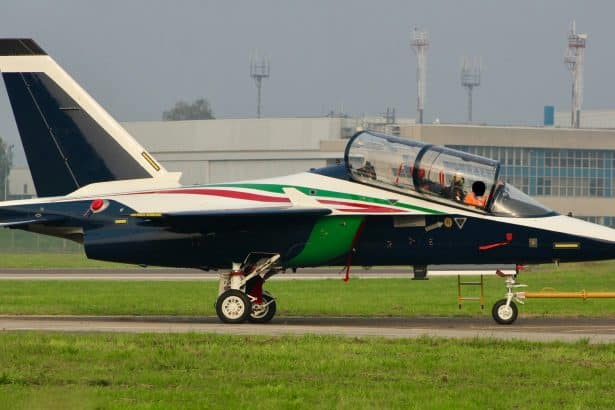
The munitions were displayed around the parked Su-57 (T-50-09) and a company-operated Yak-130M light fighter aircraft. The Yak-130M was transported, with its wings disassembled, inside an Ilyushin Il-76TD.
Following the UAV “Orion” and the ground launch system, information has been confirmed regarding the Mi-28N as a carrier for the new small-sized cruise missiles “Banderyol”. pic.twitter.com/cI153W7l9x
— Drone Wars (@Drone_Wars_) September 6, 2026
The Su-57 also conducted a rehearsal flight on Sep. 7, ahead of the flying displays during the airshow that kicked off on Sep. 8. The aircraft was seen once again with its weapon bays open during the flight.
T-50-9 in El-Alamein, opening both main weapon bays. Two, presumably, Kh-69 can be seen in the front one.
Source: @ T汪汪T pic.twitter.com/f6csKc6Y9D
— George N. (@GeorgeN28581) September 8, 2026
The S8000 Banderol
An unofficial image from early 2025 showed an Inokhodets/Orion UCAV, roughly analogous to the Predator-1, carrying the Banderol on its centerline. Ukraine’s Main Intelligence Directorate (HUR) identified it as the S8000 Banderol, assessing a speed of 400-500 km/hour and 120-140 kg warhead. It was used in missile barrages sporadically throughout the year.
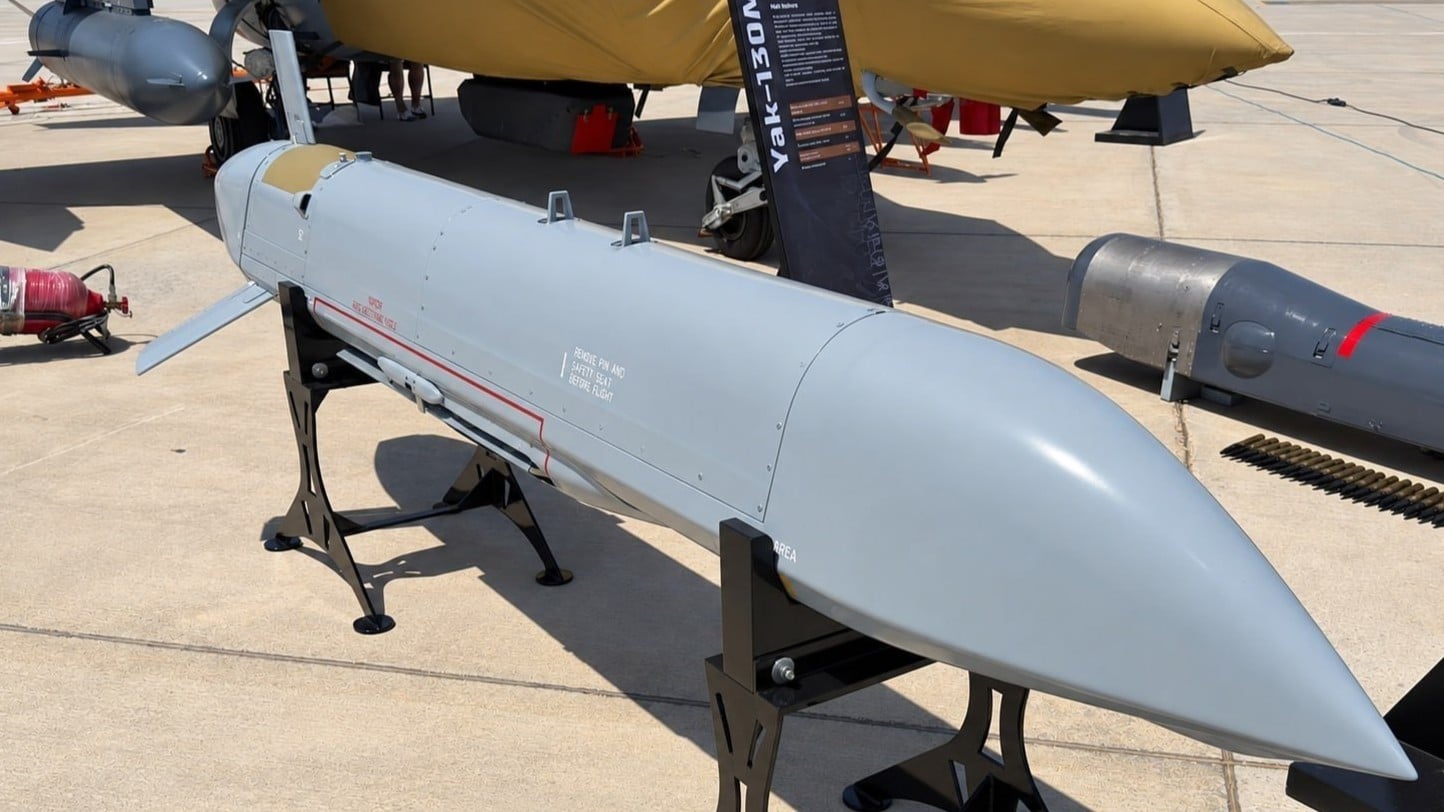
Russia’s Kremlin-aligned Telegram channels like ‘Fighter-Bomber’ have also called the Banderol the ‘Dan-T’, describing it as an advanced version of the Banderol. The name is similar to the Dan-M target drone-turned cruise missile that was shot down by Ukraine over the Black Sea on May 29, 2025.
Photos reportedly showing the remains of a new, small-sized cruise missile that Russia used in southern Ukraine in recent days.
The Ukrainian TG channel “Polkovnik GSh” (Colonel of the General Staff), which posted the photos, described it as similar to, but distinct from,… https://t.co/3JHWam7H6t pic.twitter.com/oQe51cvjbk
— John Hardie (@JohnH105) August 10, 2025
Russian state media later officially showed the Banderol in a July news feature, being mounted under an Orion UCAV. Fighter-Bomber and other Russian Telegram milbloggers have said these munitions may also be launched by platforms like the Su-25 Frogfoot and the Mi-8 tactical utility helicopter.
Based on the limited information available, it appears to fall into the same broad category of low-cost, long-range powered munitions as Lockheed Martin’s CMMT or even Anduril’s Barracuda family. These weapons blur the lines between stand-off One-Way Attack (OWA) drones and cruise missiles.
Interesting post https://t.co/j3UH6Oo1CB
— John Hardie (@JohnH105) July 13, 2026
The new stealthy munitions at El Alamein
Although both belong to the S-71 family, the two systems follow noticeably different design philosophies: the S-71M is more missile-like, while the S-71K has a broader, more aircraft-like low-observable planform.
The S-71M Monokhrom (Monochrome) is the more missile-like of the two S-71 designs displayed at El Alamein. It has an elongated, highly faceted low-observable body with a relatively large internal volume, mid-body swept wings and canted tail surfaces. Seen from the side, its shape is noticeably deeper and bulkier than the S-71K, with a conventional powered-munition layout optimized around internal volume and reduced radar signature rather than a flying-wing planform. The dorsal side features two fairings marked with question mark-shaped symbols, which may indicate attachment points for external carriage, although this remains unconfirmed.
The S-71K Kovyor (Carpet) is visually much more aircraft-like, with a broad, flattened central body and swept surfaces that give it an almost flying-wing or small UCAV-like appearance. Its sharply faceted nose incorporates an electro-optical sensor under the chin, while the broad planform, low-profile fuselage and canted tail surfaces all appear shaped with low observability in mind. Compared with the S-71M, the Kovyor looks less like a conventional cruise missile and more like an air-launched unmanned effect or one-way attack vehicle. Four attachment lugs are also visible on the airframe, although it is still unclear whether these are intended for external carriage by the Su-57.
The third munition is a smaller, stubbier system with four tail fins in an X-tail configuration, mid-mounted fold-out wings, dorsal air intake and an optical sensor under the chin.
The Russians have announced presentation of the Su-57E fighter with previously undisplayed, “fundamentally new weapons” at the El Alamein International Airshow 2026 in Egypt, September 8-10.https://t.co/K3OHdXY7bS
Could these be S-71 air-launched effects? pic.twitter.com/HSOWd50uM0
— Piotr Butowski (@piotr_butowski) September 3, 2026
Russian statements
It is currently unknown whether these weapons will be carried internally or externally by the Su-57. However, Rostec had officially announced on Sep. 3 that it would unveil new weapons at the El Alamein Air Show, meant to be launched from the Su-57.
The state corporation Rostec clarified that it is referring to multi-functional stealth drones designed to be launched from the Russian fifth-generation fighter. Rostec further said: “The Russian fifth-generation aircraft complex, the Su-57E, will be showcased in its export configuration at the El Alamein International Airshow 2026 in Egypt, featuring fundamentally new weaponry that has never been demonstrated before, either in Russia or abroad.”
ايضا طائرة التدريب المتقدم ياك-130م https://t.co/mQqftoLya3 pic.twitter.com/HNXSk92YAR
— Arab-Military (@ashrafnsier) September 7, 2026
In a subsequent post, Rostec delved a little into the description, suggesting the munitions are essentially long-range effects to be fired from the Su-57 against surface targets, and particularly air-defense threats.
“The unmanned platforms have low visibility, long range, and high speed,” said the company. “In modern armed conflicts, drones have become not only ‘eyes’ for other combat systems, but also one of the main means of attack. Rostec specialists have created a family of universal platforms designed for use with fifth-generation fighters and capable of performing a wide range of tasks.”
In its Telegram post on Sep. 7 with pictures of the flying displays, the United Aircraft Corporation (UAC) named the Yak-130M, the Su-57E and the “latest S-71M warhead delivery platforms and the S-71K aviation bomb for 5th generation fighters.” The release quoted UAC CEO Vadim Badekha, who highlighted the unveiling of the weapons at the El Alamein Airshow underscored the importance of North Africa for promoting Russian products.
“The latest aviation strike weapons have no analogues in the world,” Badekha said in the release. “Interest” in UAC products, “particularly in Africa and the Middle East, has significantly increased as a result of the successful use of aircraft in real combat conditions.”
التقارب بينهم يبلغ ذروته
فبعد انتهاء مناورات Eagles of Civilization مع الصيني التي استمرت نصف شهر..تدعم #الصين 🇨🇳 معرض #مصر 🇪🇬 El Alamein بنشر أخطر طائراتها للسيادة لأول مرة فيه
على غرار KJ-500 وYY-20A، الـJ-16 حاضرة
فاتتني فرصة رؤية هذه التحفة عن قرب💔pic.twitter.com/YjH5bXzzam
— HALIM | حـليـم (@shadowh55543098) September 7, 2026
China’s participation
The emergence of North Africa, and Egypt in particular, as the new geopolitical arena for competing superpowers is already reflected in the consistently advancing Eagles of Civilization 2025 and 2026 air drills between the Egyptian Air Force (EAF) and China’s People’s Liberation Army Air Force (PLAAF).
As for China, it has dispatched to the airshow one YY-20A Multi-Role Tanker Transport (MRTT), a J-16 fighter, a KJ-500 AEW&C aircraft and a Z-20 helicopter. Notably, official imagery provided by China showed an Egyptian flag on the YY-20A’s tail, which however has been found to be digitally added.
— China Military Bugle (@ChinaMilBugle) September 8, 2026
There is also a full-scale model of the Wing Loong-10B (WL-10B) UCAV, shown with a host of air-to-air and air-to-ground munitions. Small-scale models cover the L-15 trainer, J-35A stealth fighter, the J-10C, Z-10 attack helicopter, the Y-9E four-engine turboprop tactical transport, the Y-20B strategic airlifter, the WL-6, WL-X and WL-20 UCAVs.