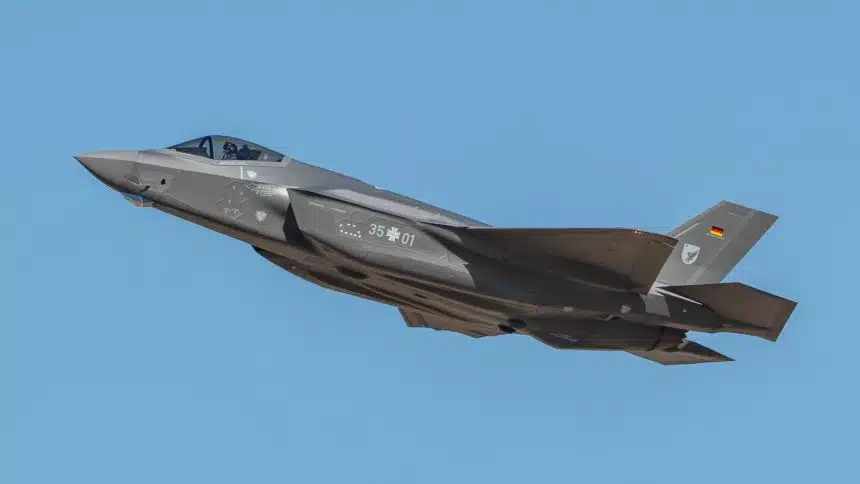
The German Air Force’s first F-35A Lightning II conducted its maiden flight from Lockheed Martin’s Fort Worth facilities, ahead of the official rollout later this month.
Germany’s F-35 Lightning II program achieved a new milestone with the maiden flight of the country’s first F-35A on Sept. 8, 2026. The aircraft flew from Lockheed Martin’s Fort Worth facilities, days after being rolled out of the assembly line and receiving its final livery.
Local aviation photographer Eric Kilpatrick captured photos and videos of the historic first flight and kindly shared them with us.
Visualizza questo post su Instagram
Germany’s first F-35
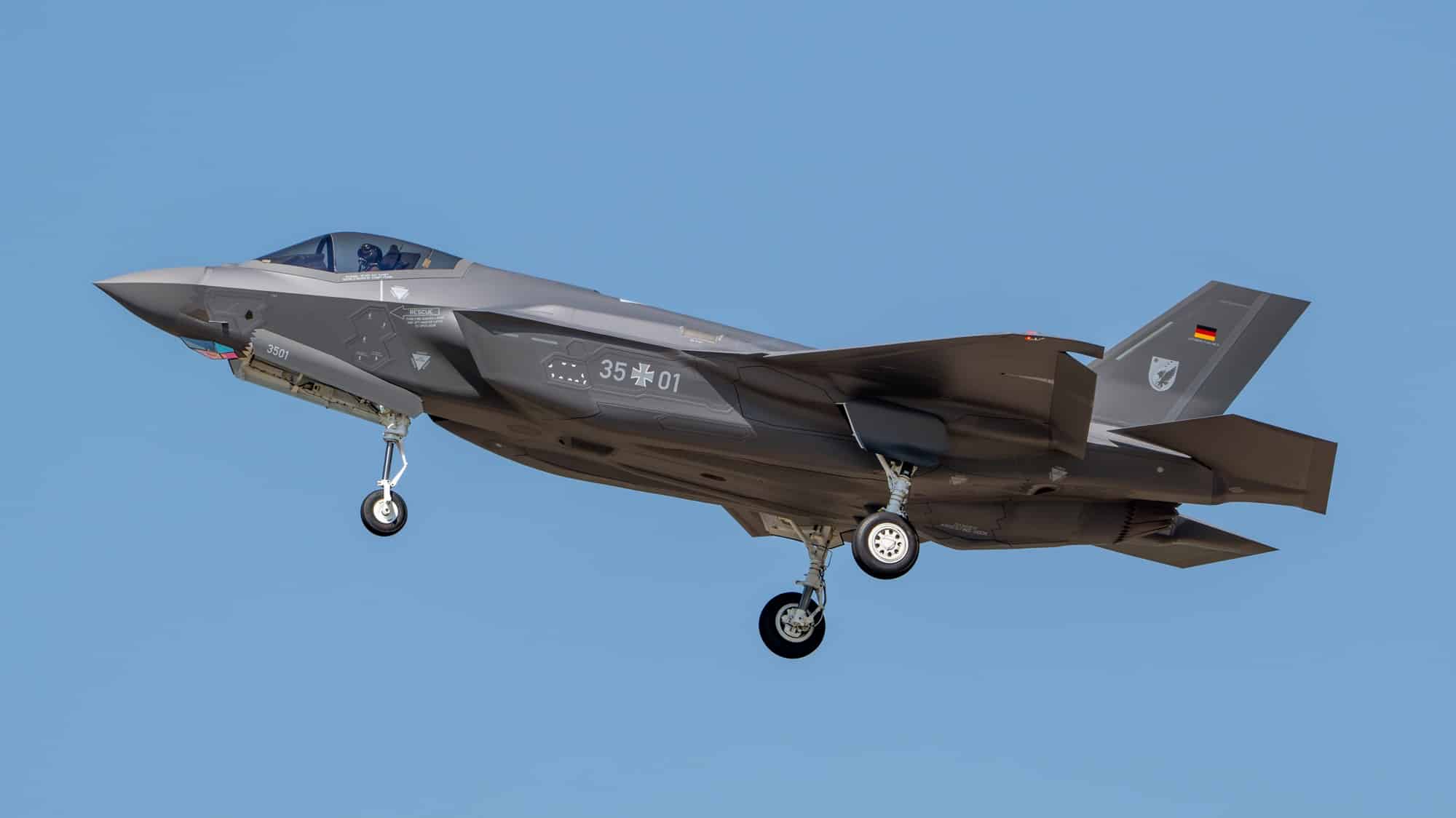
The German Air Force’s first F-35 has received the codes ‘35+01’ on the fuselage, as well a full-color German flag and the Tactical Training Command/USA (GAFTTCOM USA) on the tail. The command oversees the German flight training in the USA, which will soon include eight German F-35s at Ebbing Air National Guard Base in Arkansas.
Back in June, Lockheed Martin announced that an official rollout ceremony for the first German F-35 will be held on Sept. 18.
Germany, your F-35 moment is set. 🇩🇪 ⚡
On September 18, 2026, the first German F-35 will be celebrated in an official rollout ceremony — marking a bold new chapter for the Luftwaffe. pic.twitter.com/RslNEqwIxV
— F-35 Lightning II (@thef35) June 12, 2026
The company provided constant updates regarding the program, including its arrival at the final assembly station in March, the mating with the F135 engine and the arrival into Aircraft Final Finishes for painting in August.
Power installed. Progress underway. 🇩🇪
Germany’s first F-35 completed engine install in May, marking another major step as the aircraft moves through production. pic.twitter.com/zKwlWGDd1p
— F-35 Lightning II (@thef35) June 4, 2026
Not your average garage. 👀
A look back at Germany’s first F-35 making its way into Aircraft Final Finishes. Consider these the “before” photos. 🇩🇪 pic.twitter.com/ikVj7Ufh9U
— F-35 Lightning II (@thef35) August 31, 2026
The aircraft will be delivered in the next few months, allowing to train the initial cadre of German F-35 pilots. In approximately a year, the first F-35s will be delivered to Tactical Air Wing 33 in Büchel.
The unit currently operates the Tornado, which is also used as part of NATO’s Nuclear Sharing Agreement. The role will be inherited by the F-35 once in service, utilizing the B61-12 nuclear bomb.
Visualizza questo post su Instagram
German Air Force and F-35
Germany selected the F-35 in 2022 after a lengthy process which saw the German Air Force evaluating a first plan of a Eurofighter-only fleet, then a mixed Eurofighter and Super Hornet/Growler fleet and, in the end, a mixed Eurofighter and F-35 fleet. At the time, the deal had an estimated total cost of USD 8.4 billion.
The F-35 was chosen because is considered the most suitable replacement for Germany’s retiring Tornado aircraft fleet in support of NATO’s nuclear sharing mission. In fact, the F/A-18 Super Hornet and the Eurofighter Typhoon would have required longer times because they need to be certified for the B61 nuclear bombs.
Initially, Germany requested the procurement of 35 aircraft, together with a package of AIM-120C-8 AMRAAM and AIM-9X Block II Sidewinder air-to-air missiles, as well as GBU-31 JDAM bombs with BLU-109 warheads and GBU-54 Laser JDAM, and AGM-158B/B2 JASSM-ER air-launched cruise missiles.
In 2025, German media reported that the Ministry of Defense is planning to increase the fleet to 50 aircraft with the procurement of 15 more F-35s. The information was included in documents submitted to the Bundestag’s Budget Committee, with an estimated budget of €2.5 billion.
The German Air Force is planning to declare an Initial Operational Capability (IOC) in 2028, a year after the arrival of the fist F-35s at Büchel air base. The base is already undergoing works to prepare the infrastructure for the new fighter jet.
Regarding the production, Germany decided to have its aircraft built at Lockheed Martin’s production facility in Fort Worth, Texas, instead of the Final Assembly Check Out facility in Cameri, Italy, but still using major components from across Europe, including Germany, UK and Italy.
Thanks again to Eric Kilpatrick for the photos he sent us, you can find more of his work on Instagram at @kpaviationphotography and X at @KpAviationPhoto.