In a response to an MP’s written question, Defence minister Luke Pollard said that the RAF’s existing aerial refueling force will be complemented by the development of a boom refueling capability.
The news comes following our previous article, which reported on rumors from anonymous officials that a boom refueling option was being ‘looked at’. Confirmation from Luke Pollard MP, who is Minister of State for Defence Readiness and Industry, suggests that such a move has now been approved at a governmental level.
In response to a question from opposition MP Ben Obese-Jecty, the Minister said: “The Royal Air Force currently operates a probe and drogue air-to-air refuelling system and will complement this with the development of a boom system. This will ensure we have a sovereign air-to-air refuelling capability for the future Royal Air Force fleet that enhances interoperability with NATO Allies and partners.”
For the first time we have a Minister confirming the Boom is coming to Royal Air Force tankers, although the when and the how currently remain very much up in the air.
Still significant to have it through government voices and not just through the RAF itself. pic.twitter.com/esRN7NVoPy
— Gabriele Molinelli (@Gabriel64869839) September 2, 2026
While a boom refueling system, like the type operated by the U.S. Air Force and many NATO forces, has been frequently put forward as a matter of urgency for the Royal Air Force due to the service’s operation of boom-refueled aircraft like the P-8 Poseidon MRA1, RC-135 Rivet Joint, and C-17A Globemaster III, as well as future operation of the F-35A Lightning II and E-7A Wedgetail MRA1, the change in policy is likely motivated by another factor.
A French air force A330 MRTT refueled 🇺🇸 and 🇬🇧 RC-135 aircraft over France for the first time, demonstrating a significant step in allied air-force integration.
It is interesting to note that the Royal Air Force is not able to refuel its own RC-135W Rivet Joint aircraft, as it… pic.twitter.com/YK2tR4zbme
— Tom Antonov (@Tom_Antonov) August 12, 2026
The design of the resulting sixth generation fighter from the Global Combat Air Programme, or GCAP, is known feature a receptacle for boom refueling. While a retractable probe might be able to be fitted to the aircraft, there is suspicion that with the exceptional size of the fighter this lower capacity refueling system might not be able to deliver an adequate flow of fuel for timely refueling.
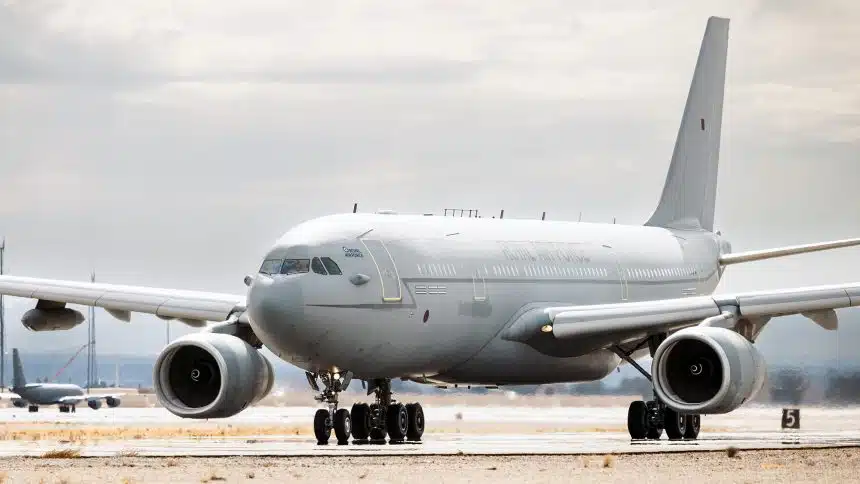
Other operators of the A330 MRTT, known as Voyager in RAF service, have fitted their aircraft with a flying boom system, but the RAF relies solely on hose and drogue units. As written in our previous article:
Although the A330 MRTT is used across the world with a flying boom system, the RAF’s examples, known as Voyagers – owned by the AirTanker consortium and leased to the RAF through a private finance initiative (PFI) – are fitted for hose and drogue refueling operations only. Voyager KC2 aircraft are configured with two wing-mounted Cobham 905E hose and drogue units while Voyager KC3 aircraft additionally feature a Cobham 805E Fuselage Refueling Unit (FRU) in the rear fuselage with the option for a higher fuel transfer rate for larger aircraft like the Airbus A400M.
It is unknown at this stage whether a boom refueling capability is planned to be considered as an upgrade for the RAF’s existing Voyagers or whether new aircraft – potentially from Airbus’ upgraded MRTT+ line – are being proposed. These details may yet to be decided within the MoD. The current fleet is technically owned by AirTanker and provided to the RAF under a private finance initiative (PFI) which is due to expire in 2035. After this date, the aircraft are apparently due to fall under RAF ownership, though they will also be older than almost all other MRTTs in operation worldwide.
Notably, though the RAF’s examples are not currently configured for this, the A330 MRTT is also exclusively able to be refueled by the flying boom system, so adoption of the boom could allow a return to tanker-to-tanker refueling in the RAF. Such a capability was lost with the retirement of the VC10 and TriStar, which were both adapted with refueling probes.