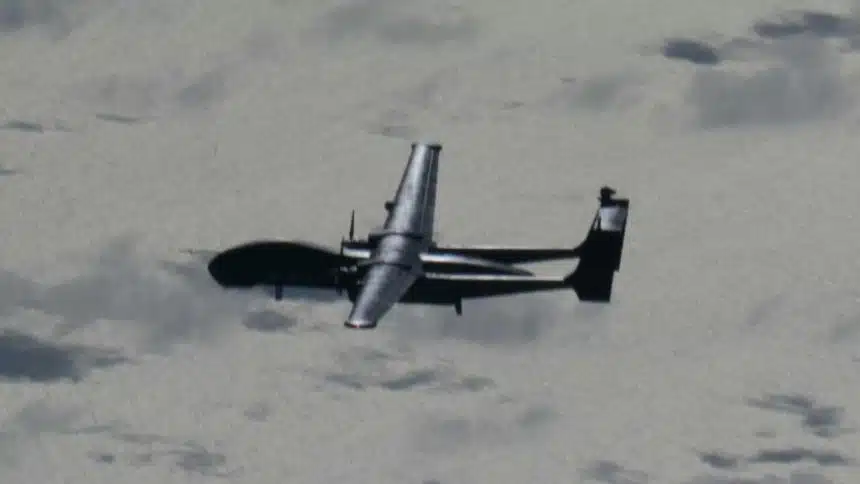
The TB-001 was intercepted alongside a Y-9Z electronic warfare aircraft as Chinese and Russian aircraft continue to operate in Japan’s Air Defense Identification Zone.
Japan has said China’s Tengden TB-001 “Twin-Tailed Scorpion” surveillance-strike drone has been probing its airspace, triggering scrambles by Japan Air Self-Defense Force (JASDF) fighter jets. The Tengden TB-001 is a large Chinese Unmanned Combat Aerial Vehicle (UCAV) capable of carrying a substantial weapons payload that first appeared in 2022.
On Aug. 18, 2026 and a month prior on Jun. 12, the Japan MoD’s Joint Staff photographed and officially identified the Unmanned Combat Aerial Vehicle UCAV alongside an accompanying Y-9Z “High New” Signals Intelligence (SIGINT) and Electronic Warfare (EW) aircraft over the East China Sea (ECS), off western Japan. Japan’s Minister for environment and nuclear emergencies Shinjiro Koizumi called the Jun. 12 interception of the TB-001 the “first time” the UCAV was intercepted around Japanese waters.
令和8年8月18日(火)中国軍の情報収集機(Y-9)及び、偵察/攻撃型無人機(TB-001)が、長崎県男女群島沖から沖縄本島沖にかけて東シナ海上を飛行したことを確認し、これらに対して航空自衛隊 の西部航空方面隊等の戦闘機を緊急発進させ対応しました。 https://t.co/A6KtLEM6fj pic.twitter.com/8MlskzueNj
— 防衛省・自衛隊 (@ModJapan_jp) August 19, 2026
The Y-9Z has been periodically intercepted lately, with the latest incident being on Aug. 19, and before that on Jul. 6 and Aug. 12. The first time the Y-9 SIGINT aircraft was encountered around Japan was in August 2024.
The intervening period also saw interceptions of Russian Ilyushin Il-20 Coot-A SIGINT aircraft on Jul. 24 and Aug. 10, continuing a consistent pattern of Russia’s individual and joint patrols with Chinese aircraft around Japan.
令和8年8月19日(水)中国軍の情報収集機(Y-9)が、長崎県男女群島南方から沖縄本島沖にかけて飛行したことを確認し、 これに対して #航空自衛隊 の南西航空方面隊等の戦闘機を #緊急発進 させ対応しました。 pic.twitter.com/PqLIqKl4u3
— 防衛省統合幕僚監部 (@jointstaffpa) August 19, 2026
The intercepts
On both occasions, the TB-001 flew various patterns in a north-south direction off the Nagasaki and Okinawa Prefectures. The Japan MoD said about the Aug. 18 interception:
“On August 18 we confirmed that a Chinese military information-gathering aircraft (Y-9) and a reconnaissance/attack-type unmanned aerial vehicle (TB-001) flew over the East China Sea from off the Goto Islands in Nagasaki Prefecture to off the main island of Okinawa, and in response, we scrambled fighter aircraft from the Air Self-Defense Force’s Western Air Defense Force and other units.”
中国軍のTB-001偵察/攻撃型無人機が東シナ海上空を飛行することを確認・公表したのは今年度初めてです。
この無人機は、長距離・長時間飛行能力を有し、対艦・対地ミサイルを搭載可能な機種と指摘されています。
引き続き警戒監視と対領空侵犯措置に万全を期してまいります。 https://t.co/GEwxwAMQmX
— 小泉進次郎 (@shinjirokoiz) June 13, 2026
Regarding the Jun. 12 interception, the Joint Staff similarly had named both the aircraft and identified their route as coming “over the ECS from the south of Nagasaki Prefecture’s Danjo island to off the coast of Okinawa’s main island.” The tracks showed that on both occasions the Y-9 turned west towards China after heading north, while flying circular routes at some point in its journey.
Both their routes were very close and overlapped briefly. While the available data do not establish whether the two aircraft were operating as a manned-unmanned teaming (MUM-T) pair, their overlapping flight paths are notable. The U.S. and Australia have already demonstrated larger special mission aircraft like the E-7A Wedgetail and P-8A Poseidon could be used to control drones like the MQ-28A Ghost Bat and the MQ-4C Triton.
Koizumi said about the Jun. 12 TB-001 intercept, while calling it a “reconnaissance/attack-type” UAV: “This unmanned aerial vehicle is noted as a model that possesses long-range and long-endurance flight capabilities and can be equipped with anti-ship and surface-to-surface missiles. We will continue to maintain utmost vigilance in surveillance and take all necessary measures against airspace violations.”
🇨🇳China mostró los UAV TB-001 Twin-Tailed Scorpion en su nueva configuración de dron bombardero
(Imágenes vía wb/前站起飞) pic.twitter.com/zdysRAfMI8
— Drones de guerra 💥war drones💥 (@dronesdeguerra) December 6, 2022
TB-001
The Tengden TB-001 is a twin-tail boom and a tri-turboprop heavy drone, with the third rotor being a pusher propeller. It has a reported payload of 1.2 to 3 tonnes, and an endurance of 40 hours, according to available data.
🇨🇳важковик БПЛА TB-001 Twin-Tailed Scorpion з бомбовим навантаженням понад 3000 кг, дальністю до 8000 км і макс. часом польоту 36 год pic.twitter.com/BXsXzrNfuT
— Злий Конопляний Джмелик (@DimSel007) December 6, 2022
However, it must be noted that Japan’s official in-flight images of the TB-001 reveal some differences from the drone’s known configuration. In fact, the aircraft features an antenna atop the starboard (right-side) vertical stabilizer and has a visible flight-data probe.
1/4
🇨🇳Tengden TB-001 “Twin-Tailed Scorpion” MALE UCAV high quality photo thread in Zhuhai Air Show 2022.
Laser guided FT-9 & FT-7A (250kg) bombs & JK-2K missile & BA-7B & CM-502KG bombs
Could also carry AR-4, AR-3, FT-8D & FT-10 missiles (not in photo)
(via wb/能量机动工作室) pic.twitter.com/eOrsTW4sra
— Jesus Roman (@jesusfroman) December 27, 2022
Officially emerged in 2022 and unveiled in the 2022 edition of the Zhuhai Air Show, the drone captured attention owing to the massive representative payload of air-to-ground munitions it has been displayed and flown with. The TB-001 also has a large electro-optical ball turret.
I know I’m a “bit famous” for being a nerd 🤓 on PLA serial numbers and even if the latest imagery for the Tengden TB-001 “Twin-Tailed Scorpion” revealed a PLAAF-style serial number 20403, I’m sure it is not yet in PLAAF service nor is this a true serial.https://t.co/7Wl1fEP1fa pic.twitter.com/89Q0fFokHV
— @Rupprecht_A (@RupprechtDeino) June 28, 2023
Y-9 intercepts
The Y-9Z that was intercepted on Jul. 6 flew a circular north-south circuit. On Aug. 12, it flew a one-way north-to-south, according to the tracks.
The four-engine turboprop Shaanxi Y-9 is a popular Chinese carrier aircraft for special mission roles like Airborne Early Warning and Control (AEW&C) and Anti-Submarine Warfare (ASW). Observers have classified the as a Y-9-based SIGINT aircraft part of a family of progressively improved systems, beginning with the Y-9G.
The Y-9Z features large rectangular arrays on the rear fuselage (likely related to the EW/SIGINT payload), a canoe-like ventral fairing on the underside and a dome-shaped sensor under the chin (usually hosting maritime radars with synthetic radar imaging capabilities), as well as another dorsal fairing on the spine just behind the wings (possibly a SATCOM antenna).
令和8年8月12日(水)中国軍の情報収集機(Y-9)が東シナ海を飛行し、 これに対して航空自衛隊の西部航空方面隊等の戦闘機を #緊急発進 させ対応しました。 pic.twitter.com/sW2zHAKr4O
— 防衛省統合幕僚監部 (@jointstaffpa) August 12, 2026
There is another unidentified fairing on top of the horizontal stabilizer. Pipe-shaped sensors across the front-side fuselage and blade-shaped antennas along the spine, above the cockpit and the underside usually are related to encrypted radio communications and the communications intelligence (COMINT) role.