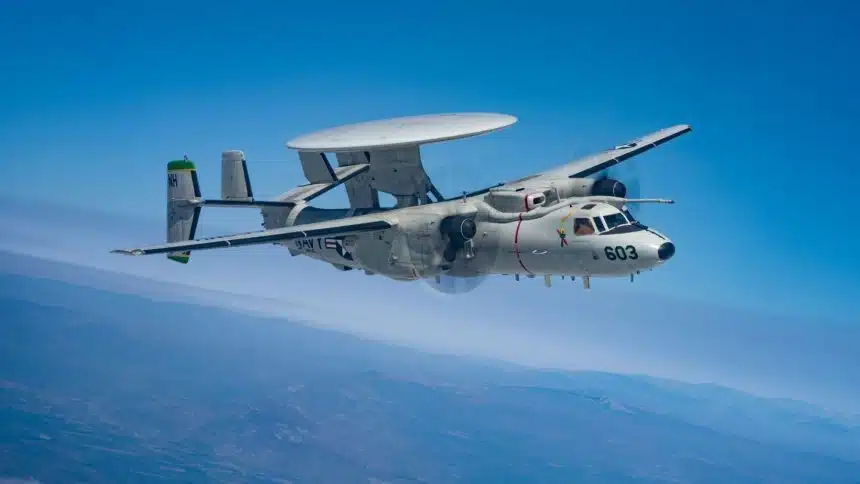
The Block II’s open architecture for the E-2D’s mission systems, computers and displays enhance cockpit functionality, support future upgrades and improve sensor fusion.
The U.S. Navy’s E-2D Advanced Hawkeye Airborne Early Warning and Control (AEW&C) aircraft’s Block II upgrades have completed the Critical Design Review (CDR), Northrop Grumman and the U.S. Navy announced on Aug. 18, 2026. The Navy completed the CDF in May, but announced the milestone only now. Flight testing of the Block II-configured aircraft is scheduled to begin in Fiscal Year 2029.
This milestone follows a Jul. 22, 2026, U.S. Navy contract worth $1.2 billion awarded to Northrop Grumman for three E-2D Advanced Hawkeyes, which are scheduled for delivery by 2031. Naval Air Systems Command (NAVAIR), the contracting authority, initially obligated $583 million in FY2026 Navy aircraft procurement funds for the award.
The Block II upgrade introduces an open systems software architecture, an upgraded cockpit architecture, improved battlespace management, increased computing power and modular interfaces intended to support future upgrades. Northrop Grumman says the CDR has cleared the path for integration, testing and delivery of Block II-configured aircraft by 2030. Existing E-2D Advanced Hawkeyes will also receive the Block II upgrades.
Our E-2D Advanced Hawkeye Block II upgrade held the critical design review, a pivotal step in bringing the most significant upgrades in the platform’s history. Learn more: https://t.co/kbcQMZ1zhr pic.twitter.com/c1iymeRHHU
— Northrop Grumman (@NGCNews) August 18, 2026
As of December 2025, the Navy had a total of 86 E-2 Hawkeyes of the C and D variants, including 62 E-2Ds delivered by the end of 2024. The service’s stated requirement is for 86 E-2Ds.
The Navy initially planned to end the procurement of the aircraft with the Fiscal Year 2024 budget request, but resumed acquisition in FY2026, with Congress approving funding for three aircraft. In the FY2027 budget request, the Navy has requested six additional E-2Ds, with plans to operate the type well into the 2040s.
Improved situational awareness, crew efficiency and future proof
Northrop Grumman has described Block II as the “most significant upgrade” in the E-2D’s development, saying it will improve situational awareness and crew efficiency while preparing the platform for future upgrades. The company says that “using a modular open systems approach and commercial off-the-shelf products, Block II reduces costs and supports long-term fleet sustainment and modernization.”
Why is the E-2D Advanced Hawkeye one of the coolest things made in Florida?
✅Advanced radar and sensors
✅Real-time battle management
✅Proven command-and-control for U.S. and allied forces
Vote E-2D: https://t.co/VwHDgjH6MV https://t.co/48jYWL1cWT pic.twitter.com/en0WAaQHwl
— Northrop Grumman (@NGCNews) June 29, 2026
Northrop Grumman will integrate the Block II upgrade into the production line for new E-2Ds while also retrofitting aircraft already in service. The E-2/C-2 Airborne Command & Control Systems Program Office (PMA-231) said that Block II upgrade is centered on providing the “software foundation for rapid capability insertion.”
“This modernization introduces state-of-the-art cockpit architecture, increased computing power, an Open Mission Systems framework and robust cybersecurity,” said the Navy. “By integrating an Open Mission Systems architecture, the program resolves current and future parts obsolescence and enables rapid, non-proprietary technology insertion.”
The service further explained that the modernized cockpit and flight systems are also expected to “significantly reduce pilot workload and elevate situational awareness, allowing crews to focus on complex battlespace management.”
Our technology led the way at Valiant Shield 2026. See how we’re enabling forces to sense, connect and command the battlespace with speed and precision. https://t.co/7Kz3rD3ne6 pic.twitter.com/7AoaiJ7Qzr
— Northrop Grumman (@NGCNews) July 2, 2026
A May 2025 Northrop Grumman release provided further details, stating that the “E-2D’s next-generation mission computers and displays are being designed to support open mission systems architecture, which will allow for flexible and rapid future incorporation of containerized capabilities.”
PMA-231 added its joint team with Northrop Grumman “rigorously assessed the finalized system Product baseline” during the CDR, transitioning the Block II upgrades “out of the design phase and into physical aircraft retrofits and flight-testing phases.”
E-2D upgrades so far
The E-2D’s primary sensor is the AN/APY-9 Active Electronically Scanned Array (AESA) radar, which provides detection and tracking of aerial and maritime targets. The Block II upgrades form part of the Delta System Software Configuration 6 (DSSC-6), that introduces new open-systems software, flexible interfaces, improved computing and data processing capabilities.
The modular architecture is also intended to support future Artificial Intelligence-Machine Learning (AL-ML) technologies, as well as new sensors and additional upgrades. A new cockpit architecture is designed to reduce pilot workload and support battlespace management.
We’re keeping the E-2D mission-ready, using AR and VR tech to cut repair times by up to 75%, getting aircraft back in the air faster. https://t.co/yviiMa0JA9 pic.twitter.com/4jqrbbBO0r
— Northrop Grumman (@NGCNews) May 21, 2026
The Navy received the first E-2D in June 2007, while the final production contract was awarded in March 2013. According to a September 2024 report by DoW’s Office of the Inspector General, Operational, Test and Evaluation (OT&E) by the Navy’s Operational Test and Evaluation Force (OPTEVFOR) since July 2014 has informed successive Delta System Software Configurations. DSSC-1 included upgrades to the radar, mission computer display and communications system.
The Navy received its first E-2D in June 2007, while the final production contract was awarded in March 2013. According to a September 2024 Department of Defense Office of Inspector General report, operational testing by the Navy’s Operational Test and Evaluation Force (OPTEVFOR) since July 2014 has informed successive Delta System Software Configurations.
DSSC-1 introduced upgrades to the radar, mission computer display and communications system. DSSC-2 added satellite communications and an Identification Friend or Foe (IFF) system. DSSC-3 improved target-tracking functionality, while DSSC-3.1 upgraded radio communications and aerial-refueling capabilities. DSSC-4 introduced improvements to data fusion, the satellite navigation (SATNAV) system, beyond-line-of-sight (BLOS) communications and sensor integration, as well as a tactical targeting network capability.
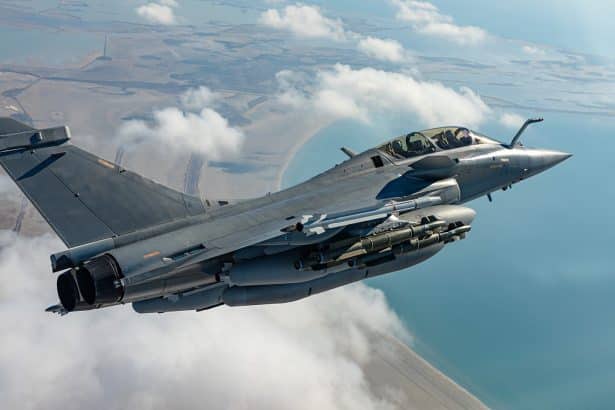
E-2D Breakthrough! The E-2D Advanced Hawkeye successfully refueled mid-air from 3 French tankers (Rafale, MRTT, A400M)—a historic first! This extends its range for continuous surveillance, boosting joint #Lethality & #Readiness. #Warfighting #NavalAviationhttps://t.co/UlvPjHqjSV pic.twitter.com/lkXjZ0DPsU
— NAVAIR (@NAVAIRNews) September 27, 2025
At the time, DSSC-5 and DSSC-6 were planned to be incorporated by FY 2025 and FY 2026, respectively. DSSC-5 included upgrades to the sensors and counter-electronic attack capability, while DSSC-6 would include “readiness and reliability upgrades paired with architecture improvements.”
This year has seen several developments for the E-2D Advanced Hawkeye. In January, the U.S. Navy awarded a contract to BAE Systems to establish a dedicated depot for the maintenance of the E-2D’s AN/APX-122A IFF system, worth $62 million.
In April, Lockheed Martin and Northrop Grumman completed flight testing of the Digital Receiver Exciter Recorder, a new radar subsystem. The same month, Northrop Grumman selected Green Hills Software’s real-time operating system for the Hawkeye’s GPS-modernized Embedded GPS/Inertial Navigation System.
A @USNavy E-2D Advanced, BU #169870 CAG LIVRY from VAW-117 the #WALLBANGERS , CVW-9, based at @NBVCCalifornia w/ an amazing 13 SHAHED-129 KILLS & 4 Cruise Missile KILLS. WOW! #HAWKEYEPOWER shot recovering during #GrayFlag2025 #FLYNAVY 09-17-25 pic.twitter.com/fRCfYfJaTj
— Matt Hartman (@ShorealoneFilms) September 18, 2025
E-2D Advanced Hawkeye relevance
The E-2D Advanced Hawkeye is currently operational with eight of the nine deployable U.S. Navy Airborne Command and Control Squadrons (VAW) assigned to the Carrier Air Wings (CWV). The aircraft played a vital role in the West Asia conflict in 2024, tracking Shahed-type One-Way Attack (OWA) drones.
France, Egypt and Taiwan are the international users of the E-2C Hawkeye. The French Navy is scheduled to transition to the E-2D in 2027, while the U.S. Navy will transition its last E-2C squadron.