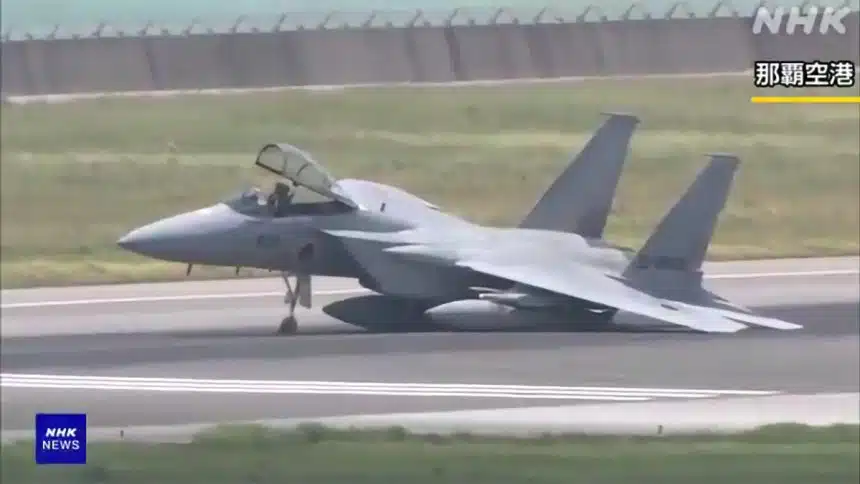
The main landing gear of a JASDF F-15 collapsed during landing, causing the aircraft to slide on the runway and turn 180 degrees as it slowed down.
An F-15 of the Japan Air Self Defense Force appears to have suffered a left main landing collapse while landing at Naha Airport on Aug. 18, 2026. The jet tilted, sliding on the runway while leaning on the left wingtip and external fuel tank, before turning 180 degrees as it slowed down and stopped facing backwards.
According to NHK News, the pilot was able to safely leave the aircraft without injuries. The runway was closed for four hours while the aircraft was removed with a crane and the scene was cleaned up, leaving Naha with only a runway active.
沖縄 那覇空港で自衛隊機トラブルか
▼詳しい記事はこちら▼https://t.co/SXKczBrway#nhk_video pic.twitter.com/sJKVpRlhTQ
— NHKニュース (@nhk_news) August 18, 2026
The airport, on the island of Okinawa, shares its runways with Naha Air Base. The base is home to two F-15J squadrons, a support flight which shares T-4 jet trainers with the two squadrons and an E-2C squadron.
The runway closure reportedly affected a total of 40 passenger flights, which suffered delays of up to 35 minutes. Okinawa Gov. Denny Tamaki described the incident as “gravely disappointing,” calling for an investigation.
According to The Mainichi, the aircraft was returning from a Quick Reaction Alert (QRA) mission. The Japan Joint Staff, which usually reports scrambles on its channels, has not yet released information, with the latest reported scramble being on Aug. 17.
The F-15J
F-15J is a license produced variant of the F-15C/D Eagle, locally built by Mitsubishi in Japan. First flying in 1980, and introduced into service in 1981, the fighter has been a mainstay of the JASDF for well over four decades.
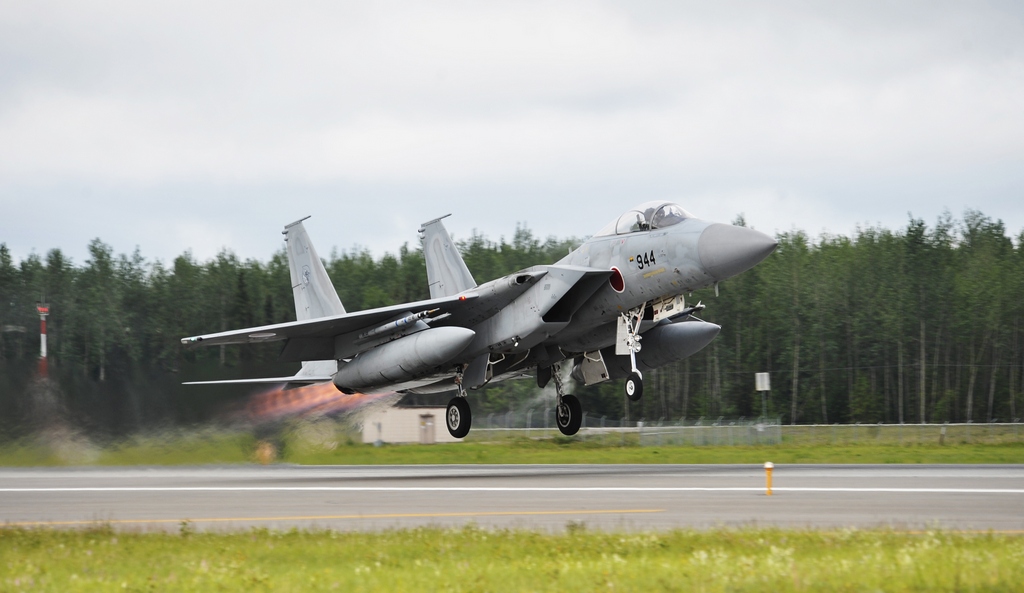
The JASDF acquired 223 aircraft trough the “Peace Eagle” program, with 203 being single seaters and the remaining ones twin seaters. The aircraft were later upgraded through the Multistage Improvement Program (MSIP), similarly to U.S. Air Force F-15s.
New investment, with the goal of creating a “Japanese Super Interceptor,” will see around half of the current F-15J fleet upgraded with the Raytheon APG-82(v)1 AESA (Active Electronically Scanned Array) radar alongside the AN/ALQ-250 EPAWSS (Eagle Passive Active Warning Survivability System). Moving beyond the air superiority role, the upgrade also includes the capability to deploy precision air-to-ground weaponry for the first time.
The JSI program, which will be worked on in Boeing’s St. Louis plant, Missouri, and Eglin Air Force Base, Florida. Japan’s MHI (Mitsubishi Heavy Industries), will carry out upgrade work locally once the upgrade package is done.
Upgraded aircraft will field the AGM-158B JASSM-ER (Joint Air-to-Surface Standoff Missile-Extended Range), providing both a long-range land attack role. The Japanese government procured the weapon trough two different Foreign Military Sales (FMS) cases.
Tokyo plans to upgrade only around half of its F-15J fleet, with the rest being replaced with 105 F-35As as outlined in the Medium Term Defense Program.