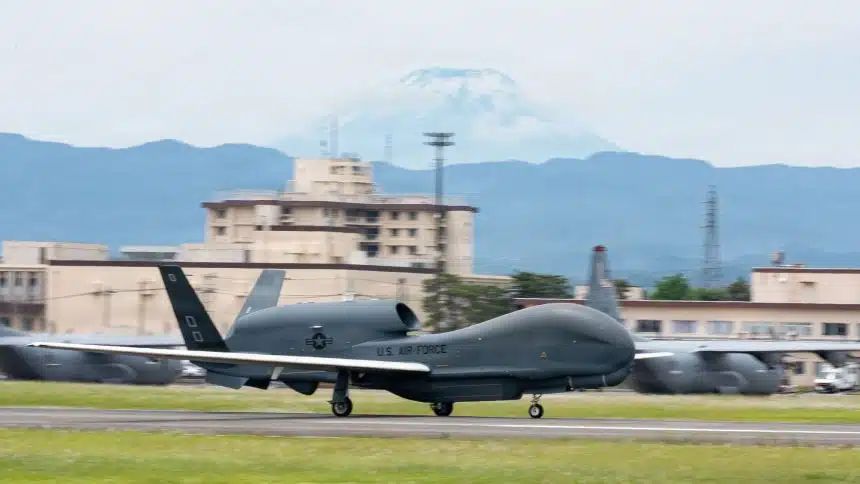
The RQ-4Bs operated by the 4th Reconnaissance Squadron permanently relocated to Yokota AB, where they already deployed every year during the typhoon season.
The U.S. Air Force permanently relocated its RQ-4B Global Hawks from Andersen Air Force Base (AFB), Guam, to Yokota Air Base, Japan, the 374th Airlift Wing announced on Jun. 15, 2026. The aircraft are operated by the 4th Reconnaissance Squadron (4th RS), a geographically separated unit of the 319th Reconnaissance Wing (319th RW).
The aircraft moved there to Japan between May 25 and 27, based on the images released on the DVIDS network. The unit routinely conducted a summer move to Yokota to find more favorable weather during typhoon season, however this time it was decided to make the move permanent to offer a persistent in-theater Intelligence, Surveillance and Reconnaissance (ISR) support to U.S. and Allied forces in the region.
The 374th AW is the host unit at Yokota AB, which operates C-130J Super Hercules with the 36th Airlift Squadron and C-12J Huron with the 419th Airlift Squadron. The already oversees unmanned aircraft with the MQ-9 Reapers of the 319th Expeditionary Reconnaissance Squadron based at Kadena AB.
As mentioned earlier, the three RQ-4B Block 40 Global Hawks of the 4th RS are a well known presence at Yokota AB because of their summer deployments. The unit has also been conducting Agile Combat Employment (ACE) deployments to various locations throughout Japan, mentions the 4th RS official page.
U.S. Pacific Air Forces has permanently relocated the 4th Reconnaissance Squadron’s RQ-4 Global Hawks from Guam to Yokota Air Base. The move improves weather resiliency during typhoon season & enhances intelligence, surveillance & reconnaissance support across the Indo-Pacific. pic.twitter.com/OCZpVf0q5O
— Yokota Air Base (@TeamYokota) June 16, 2026
The latest press mentions that the relocation is timed with favorable weather in Japan’s Kanto region during the typhoon season, which affects Guam harder. Compared to Yokota, Andersen is further east into the western Pacific.
“This ensures persistent reconnaissance in a region where challenges to a free and open Indo-Pacific continue to increase,” the statement said, referring to the strategic confrontations with China. PLA Navy and PLA Air Force activity have largely concentrated in the First Island Chain right outside its shores around Japan, Taiwan, Vietnam and the Philippines with whom Beijing has several conflicting maritime claims.
RQ-4Bs in the Pacific
The statement outlined the Global Hawk’s mission to support the broad range of ISR collection missions for American, friendly militaries and joint forces in “worldwide peacetime, contingency, and crisis operations.” Commander of the 4th RS Lt. Col. Adam Otten praised Yokota’s facilities for both the deployment and their families.
“Yokota Air Base is the right location to support current and future RQ-4 operations in the theater, while upholding the quality of life of our Airmen and families,” Otten said. He also thanked Guam and the Andersen AFB community for hosting the Global Hawk in the past sixteen years. “We are excited to be here, and we are confident that the unit will thrive alongside Team Yokota,” Otten added.
The release described the Global Hawk as a high-altitude, long-endurance (HALE)-class Remotely Piloted aerial reconnaissance system that provides “persistent, day and night, high resolution, all weather imagery of large geographic areas with an array of integrated sensors and cameras.”
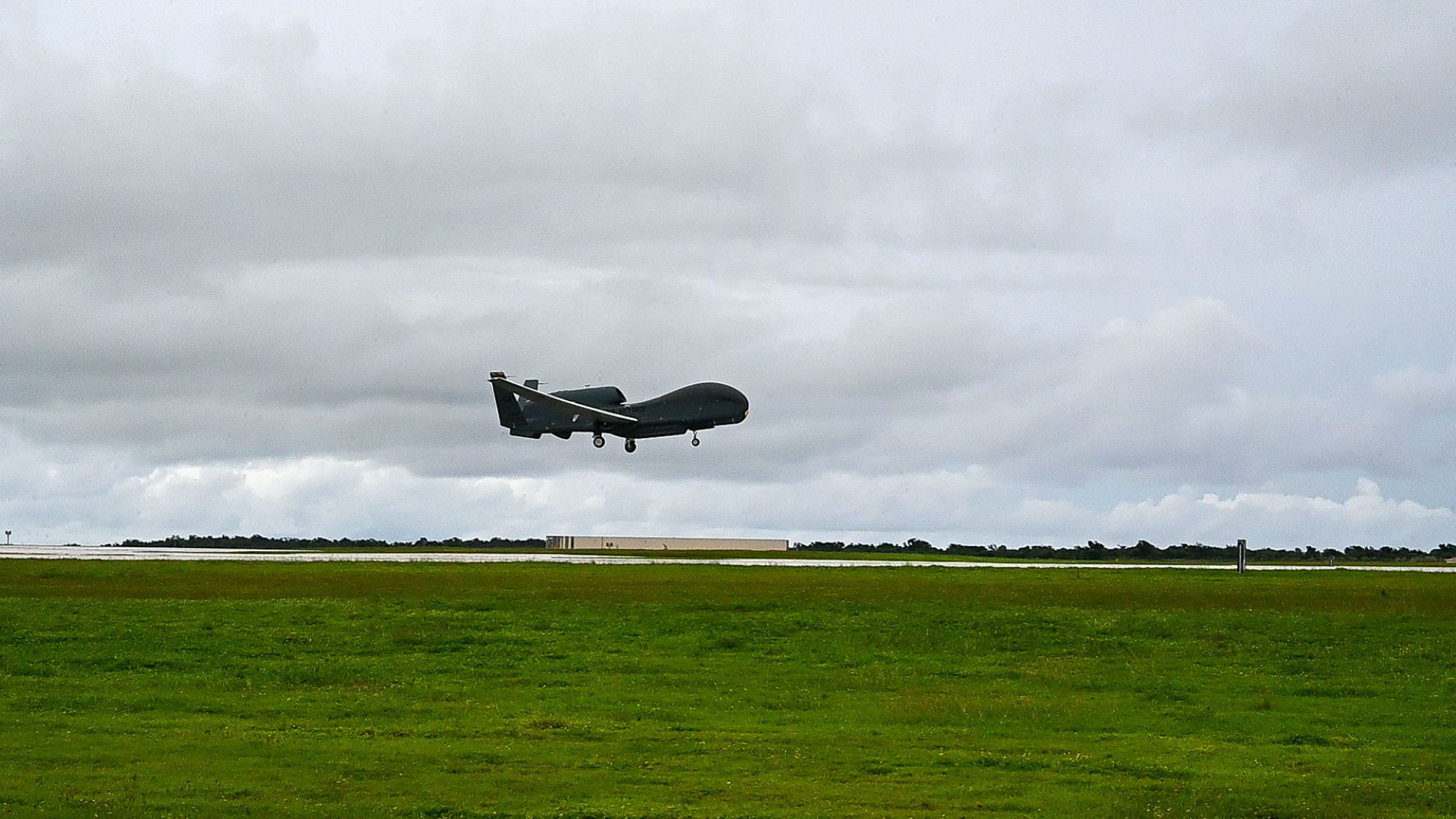
The aircraft can fly at an altitude of 60,000 feet for at least 24 hours and has Synthetic Aperture Radar (SAR) and Ground-Moving Target Indicator (GMTI) sensors to be used as an Intelligence, surveillance, target acquisition, and reconnaissance (ISTAR) platform. This is further enhanced by a satellite-enabled Beyond Line of Sight (BLOS) control link.
The 4th RS’s RQ-4Bs are controlled by the 319th Operations Group, home-based at Grand Forks AFB, North Dakota. The aircraft are launched and recovered by personnel at the deployed location, with mission control at Grand Forks taking over subsequently, the 319th OG had explained in a September 2024 release about RQ-4B operations from Andersen AFB.
The U.S. is not the only operator of the drone in the region, as the service also announced on Mar. 12, 2022, the first arrival of an RQ-4B at Japan’s Misawa Air Base, which was one of the three RQ-4B Block 30 acquired by the Japan Air Self-Defense Force (JASDF). “The addition of this aircraft to the Japan Air Self-Defense Force’s inventory directly supports the defense of Japan and peace and stability in the Indo-Pacific region,” said the service.
#KeenSword25 | Misawa Elephant Walk
Four USAF F-16 Fighting Falcons, four JASDF F-35A Lightning II Joint Strike Fighters, four JASDF F-2s, a JASDF E-2D Hawkeye, a JASDF RQ-4B Global Hawk, a U.S. Navy C-12 Huron, & a U.S. Navy P-8 Poseidon performed an Elephant Walk at Misawa AB. pic.twitter.com/CfANXoEb3G
— U.S. Forces Japan (@USForcesJapan) November 4, 2024
INDOPACOM becomes PACOM again
Interestingly, the development comes as the Department of War announced the restoration of the Indo-Pacific Command (INDOPACOM) theater command’s original designation, the Pacific Command (PACOM). President Donald Trump’s first administration introduced the INDOPACOM designation in 2018, capturing India’s partnership in the overall confrontation with China and encompassing the Indian Ocean Region (IOR).
While the RQ-4B’s move to Yokota might just be coincidental, the reversal to the original designation is perceived as being influenced by the developments in the West Asia conflict. India’s subdued yet official protests over the death of its three merchant mariners aboard the MV Settebello in a U.S. strike marks a sudden tension in ties.
Department of War Restores U.S. Pacific Command Designation.
CAMP H.M. SMITH, Hawaii — The Department of War announced today that the U.S. Indo-Pacific Command (USINDOPACOM) will officially restore its name to the U.S. Pacific Command (USPACOM).
Originally established on… pic.twitter.com/ZL0EL3q6Ph
— U.S. Pacific Command (@USPACOM) June 16, 2026
The PACOM however mentioned India as one of the regions within its Area of Responsibility (AoR). “USPACOM’s vast area of responsibility – spanning from the waters off the West Coast of the United States to the western border of India – remains exactly the same. The command’s fundamental mission and its unwavering commitment to maintaining a free and open theater alongside regional allies and partners are unchanged,” said the Command said on X.