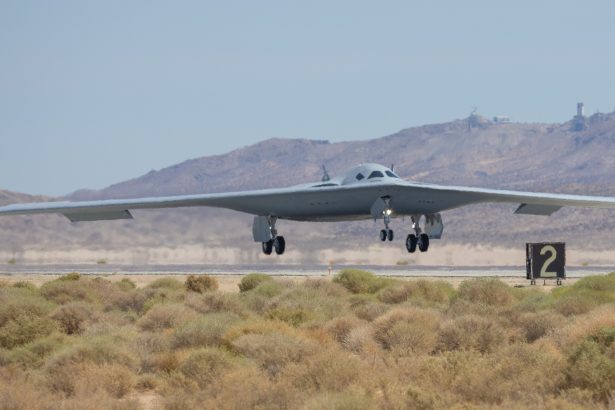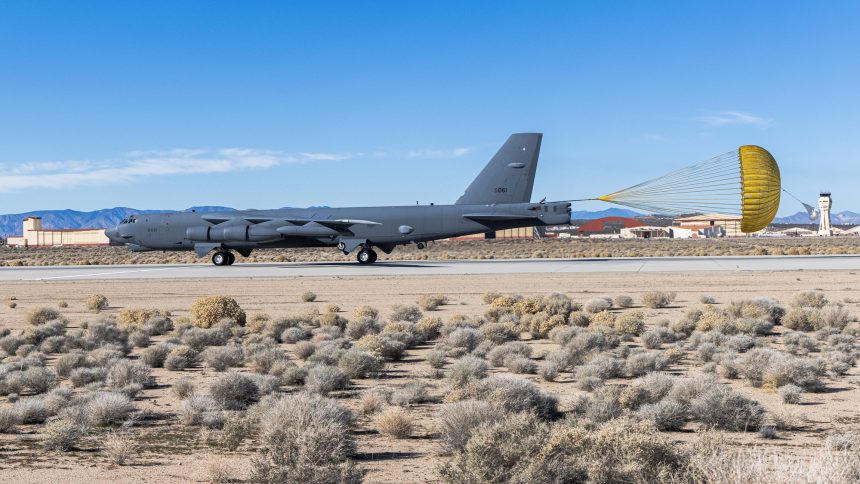
Images posted online show a massive plume of black smoke rising from Edwards Air Force Base, before the base confirmed an ongoing B-52H Stratofortress mishap.
A U.S. Air Force B-52H Stratofortress bomber has crashed shortly after takeoff at Edwards Air Force Base, California, on June 15, 2026. The base confirmed the mishap on its social media channels after images appeared online showing a massive plume of black smoke rising from the location.
The status of the crew is currently unclear. The base said that the emergency crews are currently on scene.
Here is the full statement by the service:
“A United States Air Force B-52 Stratofortress crashed shortly after takeoff on the Edwards airfield at 11:20 a.m. Emergency crews immediately responded to the scene and the situation is ongoing. More information will be provided as it becomes available.”
Images of the mishap, apparently captured from within the base, first appeared on the popular ‘Air Force amn/nco/snco’ page on Facebook. Although unconfirmed, the page claimed the aircraft involved is B-52 60-0061, the same aircraft currently used to test the new AESA radar.
The smoke was visible also at a distance, fueled by the bomber’s full tanks at takeoff. According to the service, the B-52H has a fuel capacity of 312,197 pounds (141,610 kilograms).
Something blew up in Edward’s AF base @airforce @Breaking911 pic.twitter.com/aU3olZHL4q
— Richh (@RichhdaRuler) June 15, 2026
Update 22:15 UTC
Edwards AFB has released a new update about the mishap, saying that the B-52 was flying with eight people on board. The bomber’s usual crew includes five people.
While emergency services are still on scene and working to account for all personnel, the statement adds that “initial indications are that the crash was not survivable.” The causes of the incident are still unclear, and the service says it has already launched the investigation.
Meanwhile, news outlets released images showing the crash site. Emergency vehicles can be seen moving near the scattered wreckage to put out the fire.
BREAKING: A U.S. Air Force B-52 bomber crashed shortly after takeoff at Edwards Air Force Base, triggering an emergency response.
Emergency crews rushed to the scene as thick black smoke billowed from the wreckage scattered across the desert airfield.
More details, including… pic.twitter.com/JRx3R4ElJW
— Fox News (@FoxNews) June 15, 2026
The airbase is currently closed, with all imbound traffic diverted to other locations, in order to allow the installation to focus entirely on emergency response operations.
Previous crash
The one on Jun. 15, 2026, is the first B-52 crash in 10 years.
The previous occurred on May 19, 2016, when a B-52H (tail number 60-0047) belonging to the 69th Bomb Squadron, 5th Bomb Wing, from Minot AFB, North Dakota, overran the end of the runway during an aborted take off at Andersen AFB, Guam. The aircraft crashed and burned but all the 7 crew members managed to egress the plane safely. The B-52 was deployed to Andersen from Minot AFB, North Dakota, as part of the Washington’s continuous bomber presence mission in the Pacific.
According to the reports, during the takeoff procedure, the crew noticed birds flying over the runway. Noticing indications that the four engines on the right wing were losing power, the crew believed the aircraft had suffered bird ingestion and initiated an aborted takeoff, bringing the engines back to idle, deploying the air brakes and activating the drag chute. However, the parachute failed to inflate correctly and, with only 2,500 feet of runway remaining, the aircraft could not be stopped. It overran the paved runway surface by 300 feet. The crew evacuated safely and were treated for minor injuries, while the aircraft was completely destroyed by fire, resulting in a loss of $112 million (equivalent to about $167 million today).
“The Accident Investigation Board (AIB) President found by a preponderance of the evidence the cause of the mishap was the MP [Mishap Pilot] analyzed visual bird activity and perceived cockpit indications as a loss of symmetric engine thrust required to safely attain flight and subsequently applied abort procedures after S1 timing. The AIB President also found by a preponderance of the evidence the following factors substantially contributed to the mishap: drag chute failure on deployment and exceeding brake-energy limits resulting in brake failure.”
This is a developing story, we will update the article as more details emerge.