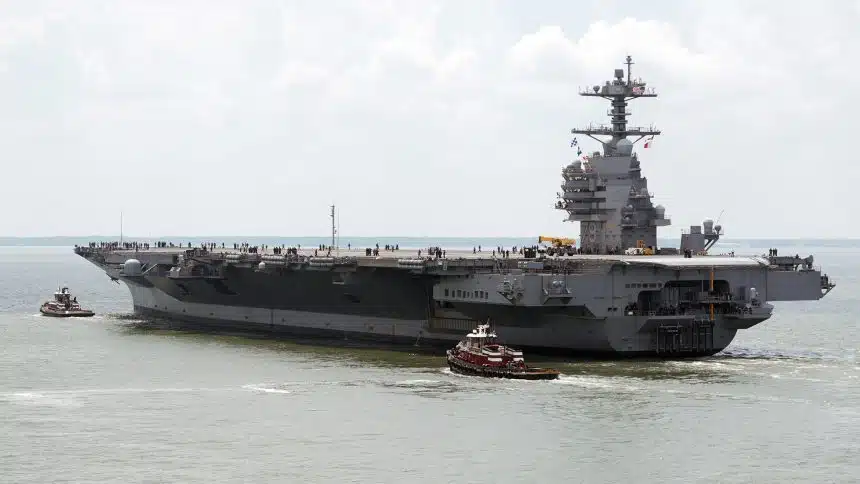
The John F. Kennedy, the second Gerald R. Ford class nuclear-powered aircraft carrier, left Newport News on Aug. 12 to commence acceptance trials before its handover to the U.S. Navy.
Pre-Commissioning Unit (PCU) John F. Kennedy, soon to be the USS John F. Kennedy (CVN 79) will now have its systems and equipment evaluated in these final manufacturer trials to prove it is up to specification before delivery.
Previously scheduled for delivery in 2025, the 100,000 ton aircraft carrier was delayed by issues with the new Advanced Arresting Gear (AAG) as well as its Advanced Weapons Elevators (AWE). It first set sail in January 2026 for initial manufacturer trials.
Today, our nation’s newest aircraft carrier, John F. Kennedy (#CVN79), departed our #NewportNewsShipbuilding division to begin acceptance sea trials. These trials will test and evaluate important ship systems and components at sea. (1/2) pic.twitter.com/6dD0i1y7h2
— HII (@WeAreHII) August 12, 2026
In between the two trials periods, U.S. Navy personnel have been busy at work on board the ship conducting drills and ensuring both the vessel and its crew are fit to sail.
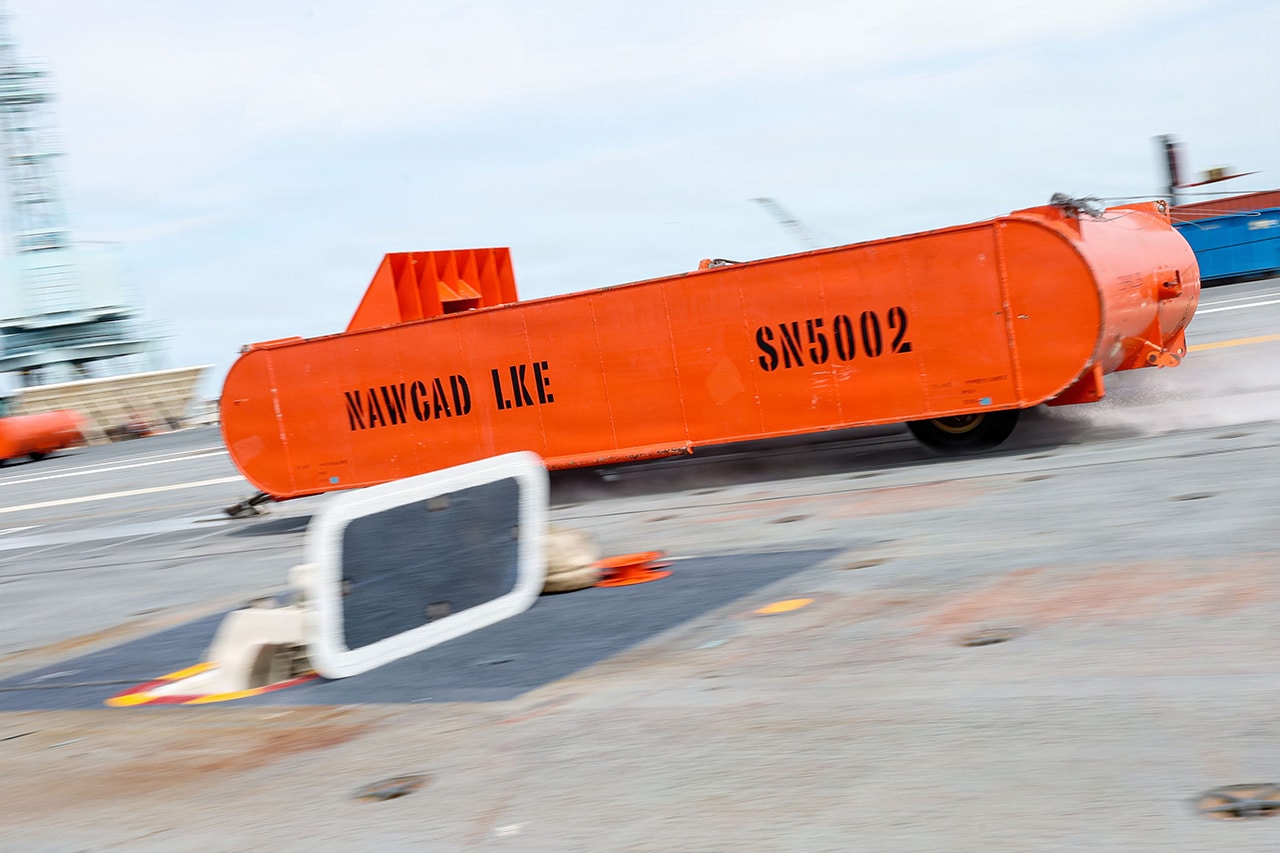
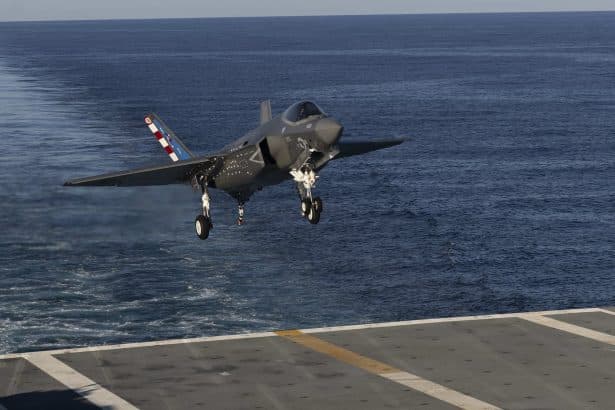
Unlike the Gerald R. Ford, the Kennedy will – thanks to Congressional intervention, and delays – be delivered to the Navy ready and able to operate the F-35C Lightning II. Modifications necessary include reinforcement of the jet blast deflectors, as well as the addition of specialised equipment and systems used to maintain the fifth gen stealth fighter.
2nd voyage for sea trials for the future USS John F. Kennedy (CVN 79) more than 4 months after its first.
The Kennedy is set to enter active service in March. https://t.co/xaSOXecGlK
— TheIntelFrog (@TheIntelFrog) August 12, 2026
After entering service, the Kennedy is due to be homeported at Naval Base Kitsap-Bremerton in the state of Washington. This will make it the first Ford class based on the U.S. West Coast, ideally positioned for regular deployments to the Indian and Pacific Oceans. Under current plans the carrier will arrive there no earlier than 2029. A $145 million overhaul of the naval port’s facilities – focused on electrical infrastructure – ahead of the Kennedy’s arrival began in May 2025.
USS Enterprise CVN-65 is currently tied up next to PCU USS John F Kennedy CVN-79. You can see the outline change from the oldest aircraft carrier to the newest. #ussenterprise #cvn65 #boneyardsafari #aviationsafari #navalsafari pic.twitter.com/xR7yNrMSad
— Boneyard Safari (@Boneyardsafari) March 29, 2026
The carrier will supplant the veteran USS Nimitz (CVN 68) which is on the cusp of being decommissioned. A short reprieve has been granted, partially in order to fulfil the U.S. Navy’s legal mandate to operate at least eleven aircraft carriers, though it is unlikely to ever sail on an extended operational deployment ever again.
Commissioning of the new carrier is pencilled in for March 2027, though it should be noted that this will not mean the ship will then be ready for active operational service from this point.
As well as the requirement to be able to operate F-35s from delivery, the John F. Kennedy was also chosen to be the first Ford class carrier with the new AN/SPY-6(V)3 Enterprise Air Surveillance Radar (EASR). This is a fixed panel version of the radar system already retrofitted to several Nimitz class carriers.
An illuminator radar is visible on the port quarter of CVN-79 John F. Kennedy. While all ships belong to the U.S. Navy’s Ford-class aircraft carriers, CVN-78 Gerald R. Ford remains the only unit equipped with the Dual Band Radar (DBR) suite, comprising the SPY-4 phased-array… https://t.co/l5gzHxhFAb pic.twitter.com/4yoRJthPeT
— 笑脸男人 (@lfx160219) January 30, 2026
The Gerald R. Ford itself is instead fitted with the AN/SPY-4, and due to various issues and high costs encountered with the system it will likely remain the only ship to carry this type of unit. AN/SPY-4 was developed to work in tandem with the AN/SPY-3, forming the Dual Band Radar (DBR) system for the Zumwalt class and the Gerald R. Ford class. None of the three Zumwalt class destroyers were ever fitted with their AN/SPY-4 panels.
After the Kennedy, the next aircraft carrier to enter U.S. Navy service is due to be the USS Enterprise (CVN 80). Under current plans, the Enterprise will commission in 2031.
Future USS Enterprise (CVN 80) Gerald R. Ford-class aircraft carrier penultimate aft hull section being lifted into place in Newport News, Virginia – posted March 12, 2025 #ussenterprise #cvn80
SRC: YT- HII pic.twitter.com/0crloJkNUM
— WarshipCam (@WarshipCam) March 13, 2025
In 2034, the Enterprise will be joined by the USS Doris Miller (CVN 81), named for a U.S. Navy sailor who, after carrying wounded sailors to safety during the 1941 attack on Pearl Harbor later manned a machine gun and – without any prior experience – downed at least one attacking Japanese aircraft. He became the first ever black man to receive the Navy Cross, which was bestowed by Chester Nimitz in 1942. Miller was killed in action the following year on board the USS Liscome Bay.
After the Doris Miller, the only Gerald R. Ford class currently due to be named for someone other than a former President, the next two named vessels are the William J. Clinton and the George W. Bush, both yet to begin construction.