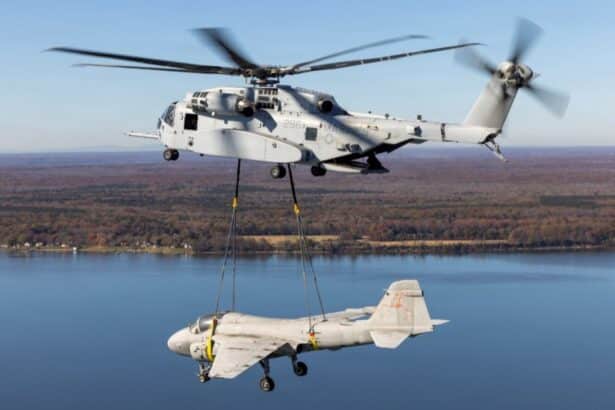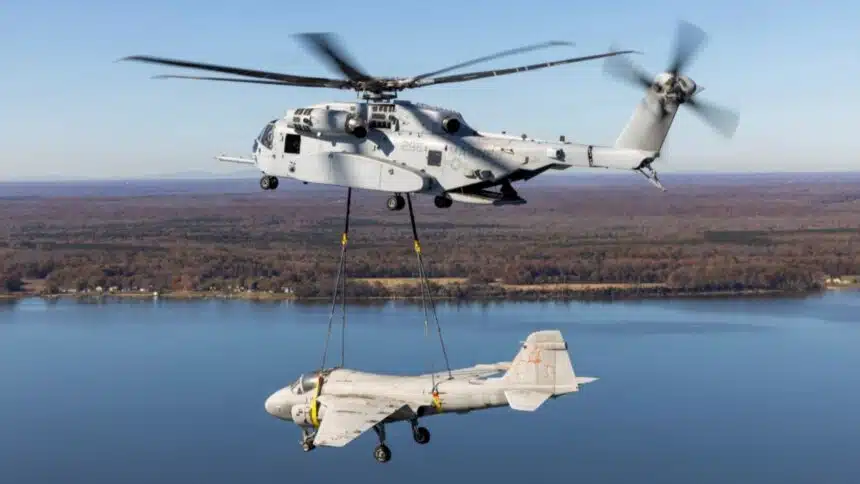
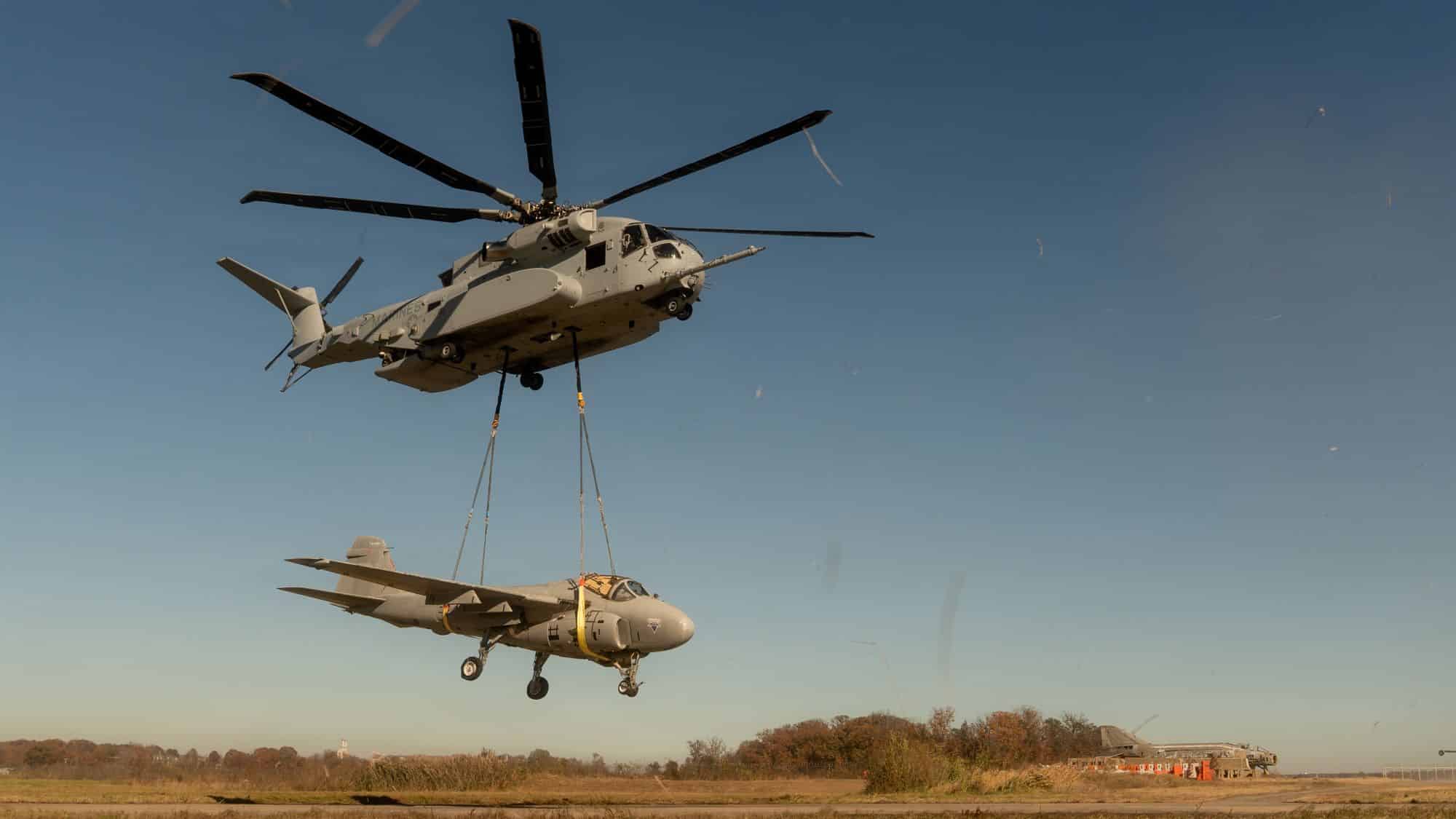
The A-6 Intruder was transported as an external load by a CH-53K from Naval Support Facility Dahlgren, Virginia, to Marine Corps Air Facility Quantico, a few dozen miles away.
A U.S. Marine Corps CH-53K King Stallion lifted and transported a retired U.S. Navy A-6 Intruder from Naval Support Facility Dahlgren, Virginia, to Marine Corps Air Facility (MCAF) Quantico on Nov. 18, 2026. Carrying the A-6 as an external load, the CH-53K from the Marine Heavy Helicopter Squadron 461 (HMH-461) “Ironhorse” made the approximately 18 mile (29 km) journey northwest, with parts of the route passing over the Potomac River.
Sharing images on the DVIDS network on Nov. 20, NSF Dahlgren, MCB Quantico and the 2nd Marine Aircraft Wing (2nd MAW) – whose Marine Aircraft Group (MAG 26) oversees HMH-461 – said that the A-6 was “repositioned” to MCAF Quantico “for further use in training.” NSF Dahlgren added that the A-6 was one of the many airframes divested in 1997 that “remained [at the facility] to support test operations.”
MCB Quantico, however, mistakenly identified the aircraft as an EA-6B Prowler – the predecessor to the current F/A-18 Super Hornet-based E/A-18G Growler. The Prowler is distinguished by an extended cockpit and a bulbous sensor on top of the vertical stabilizer to support the Electronic Warfare (EW) mission.
A #MarineCorps CH-53K King Stallion with the 2nd Marine Aircraft Wing lifts an EA-6B Prowler aircraft during an external lift training mission at Marine Corps Air Facility Quantico on Marine Corps Base Quantico, Virginia, Nov. 18, 2026.
Marines with HMH-461 and MCAF Quantico coordinated the external lift training mission to safely reposition the retired EA-6B Prowler aboard MCAF Quantico for further use in training.
#USMC #MarineAviation #Military
— U.S. Marines (@USMC) November 21, 2026
MCAF Quantico, located within MCB Quantico, is also home to the Presidential Helicopter Squadron (HMX-1). The facility routinely hosts exercises like Aircraft Rescue and Firefighting Training and Helicopter Evacuation Exercise, but the specific training role for which the A-6 will be used remains unclear.
CH-53K lifts A-6 Intruder
MCB Quantico said that it coordinated the “external lift training mission” with HMH-461 to “safely reposition” the retired A-6. An image released by the 2nd MAW showed a King Stallion pilot from the HMH-461 conducting pre-flight checks inside the helicopter’s cockpit at Stafford Regional Airport, Virginia. This suggests the helicopter staged there before flying to NSF Dahlgren to pick up the A-6 and subsequently transporting it to MCAF Quantico.
Another picture, from the same set captured at Stafford airport, showed three Marines from the 2nd Distribution Support Battalion (2 DSS), assigned to the Combat Logistics Regiment 2 (CLR 2) and the parent 2nd Marine Logistics Group (2 MLG), inside the helicopter.
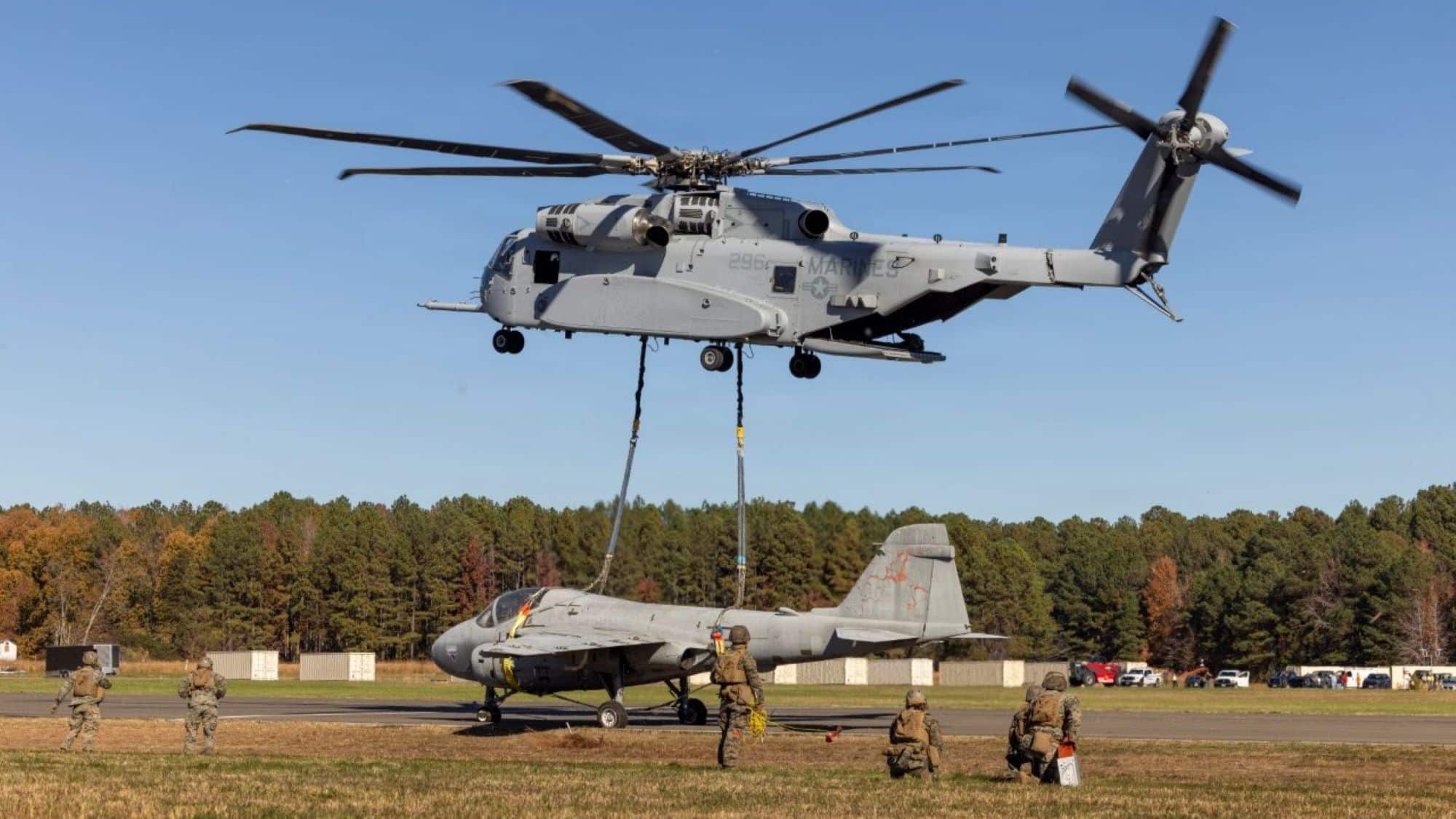
At NSF Dahlgren, other logistics Marines attached the chains and straps to the A-6 Intruder and prepared the static line for the external lift. One picture shows the CH-53K lifting the A-6, while eight Marines are on the ground.
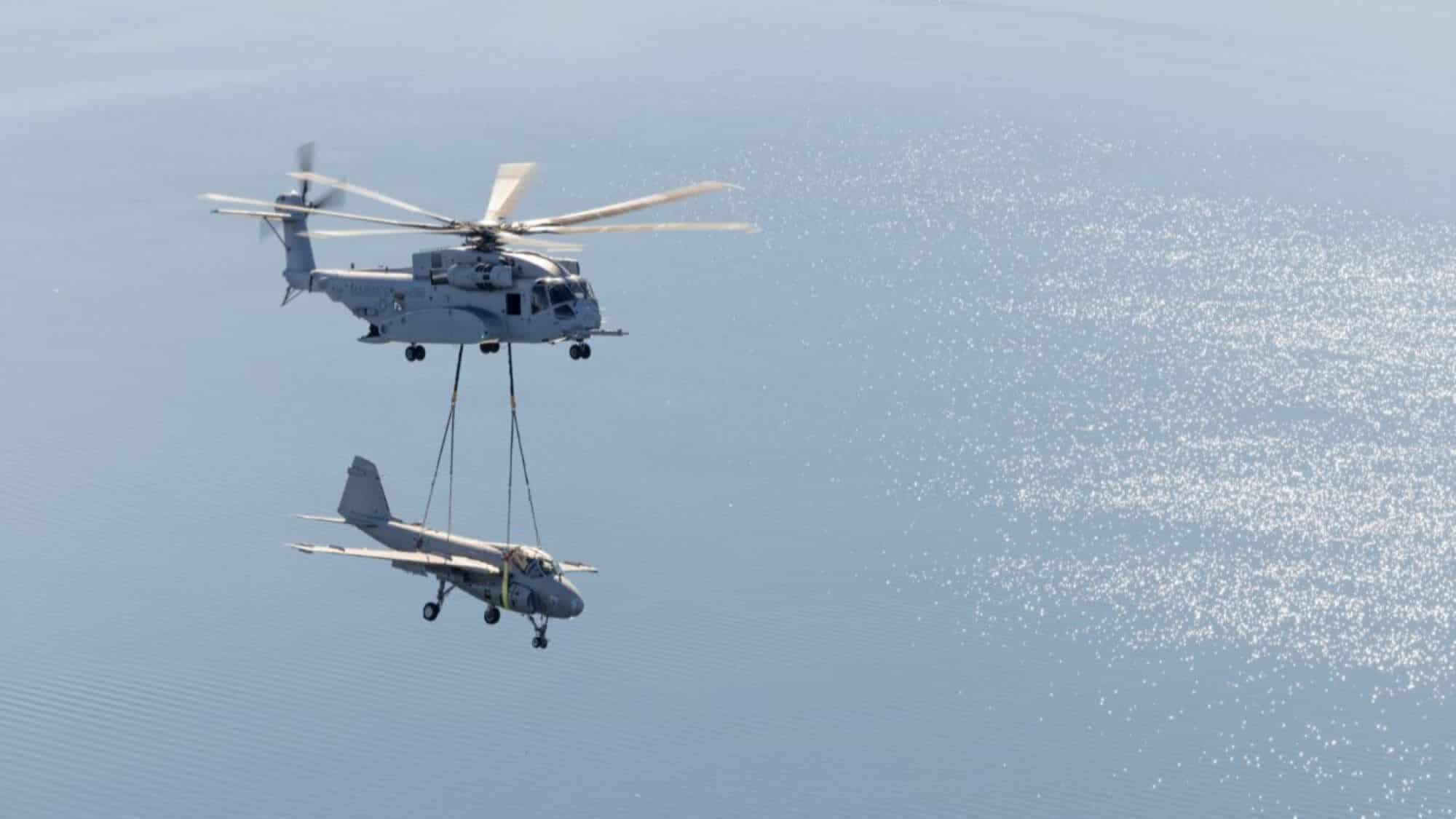
All the Marines are in full tactical gear, including ballistic vests and helmets. In-flight images of the CH-53K carrying the A-6 suggests another helicopter might have accompanied the journey.
CH-53K also lifted another CH-53K
The CH-53K King Stallion is the Corps’ primary heavy lift helicopter, and the latest exercise is another addition to its repertoire of sling-load operations. The previous such drill was reported by Naval Air Systems Command (NAVAIR) on Apr. 20, 2026, when a King Stallion from Air Test and Evaluation Squadron 21 (HX-21) lifted another CH-53K as a part of a “recovery rigging evaluation.”
The H-53 Heavy Lift Helicopters Program Office (PMA-261) said that a CH-53K Engineering Development Model without engines, most gearboxes and tail pylon, was used as the load. The primary purpose was to “validate the specialized rigging and procedures required to safely recover a downed or disabled CH-53K aircraft.”
The Engineering Development Model (EDM), used in the early years of the King Stallion program as a test airframe, weighed 28,000 lbs without the engines, gearboxes and tail pylons, and was still well within the CH-53K’s current external lift envelope of 36,000 lbs. The EDM will continue to serve the program as it will be transferred to Marine Heavy Helicopter Training Squadron 302 (HMHT-302), New River, North Carolina, where it will be used as a Ground Operations Aircrew Trainer, helping to educate and train the next generation of King Stallion aircrew and maintainers.
Heavy Lift, Meet a Heavy Lift — CH-53K lifts a CH-53K!
The CH-53K King Stallion achieved a new milestone by lifting itself. The ~28,000lb load was an Engineering Development Model from the program’s early developmental testing years.
📰: https://t.co/o5HuyP7hRb https://t.co/BgkPWPm2e1
— NAVAIR (@NAVAIRNews) April 21, 2026
#IKYMI the CH-53K achieved a major milestone by successfully lifting another King Stallion. The test was part of the 53K aircraft recovery rigging evaluation and a critical step toward developing new operational capabilities for the fleet. #OnlyTheKCan https://t.co/IYD0UJWl31
— Sikorsky (@Sikorsky) August 17, 2026
Other sling load operations
The CH-53K King Stallion had conducted its first “external load certification testing lift” on Dec. 13, 2022 at NAS Pax River. On that occasion, it carried a non-flyable F-35C, CF-1, “to evaluate the load and inform future lift capabilities,” and generate data from the “sling configuration analysis and cargo characteristics.”
Two years later, on Apr. 24, 2024, CF-1 was again lifted by a CH-53K King Stallion from VMX-1 and transported from Pax River ITF to NAWCAD’s Prototype, Manufacturing and Test facility at Joint Base McGuire-Dix-Lakehurst, New Jersey. The CH-53K was also refueled mid-flight by a KC-130T while the F-35C suspended underneath the helicopter.
#Marines with Marine Aircraft Group 29, 2nd Marine Aircraft Wing, transport an F-35B Lightning II near Naval Air Station Patuxent River, Maryland.
The F-35, known as BF-1, was the first F-35 to perform a vertical landing and was transported to Marine Corps Air Station Beaufort, South Carolina, for use as a permanent static display.
#USMC #SemperFi #Aviation
— U.S. Marines (@USMC) August 28, 2025
This was followed by another exercise on Aug. 27, 2025, when a CH-53K, again from HMH-461, transported the first F-35B Lightning II STOVL (Short Take-Off Vertical Landing) jet to be built, BF-01. Airframe BF-01 had performed the type’s first vertical take off and landing.
The retired aircraft was carried as a sling-load from Naval Air Station Patuxent River to Marine Corps Air Station Beaufort, South Carolina, in a 552 mile (888 km) journey.