New images of the Chinese ekranoplan show the presence of underwing weapons pylons, suggesting a strike role in addition to rapid support and resupply for amphibious operations in the South China Sea.
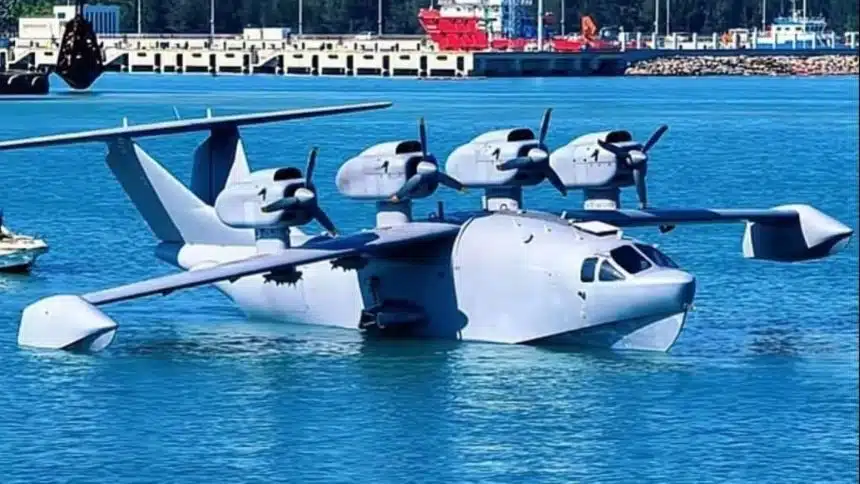
China’s Ekranoplan, the ground effect vehicle that first broke cover in July 2025, has come into full view in new clearer images on Chinese social media, taken at an unspecified seaport. Shared on X by leading Chinese military aviation analyst Andreas Rupprecht, the images shows the aircraft, visibly smaller in size than previously observed, stationary in the water and later being lifted off the water by a crane.
The aircraft was also originally dubbed the “Bohai Sea Monster,” from the name of the location where the aircraft was first photographed in the northwestern part of the Yellow Sea. We can now clearly see the four top-mounted turboprop engines have three-blade propellers, while two hardpoints are visible under the starboard (right-side) wing.
There could also be two more on the port-side wing as well for symmetrical purposes. However these are not visible in the photograph, which captures the aircraft from its left.
Rupprecht said in his post: “New pictures of the new GEV, interestingly it has apparently 4 underwing hardpoints (of which two of them on the left side has been fitted with pylons) for presumably antiship munitions or torpedoes. Also, it appears to be much smaller in size than previously expected.”
It is only a technology demonstration prototype. The actual prototype will be scaled up to a size similar to the new Y-15 and will use the same four WJ-10/AEP500 turboprop engines, or possibly even larger.
— Fay (@FaySue6) May 24, 2026
What the new images show
At this stage it is far from being known whether the aircraft will be acquired by the PLA Navy, since its existing warship, aircraft carrier, land, ship, underwater, air-launched missilery, and fighter-bombers can comfortably sustain both a prolonged and short, sharp war in the western Pacific. It nevertheless joins a long line of new, possibly experimental, aircraft that Beijing has produced off late, in a growing display of its aerospace technological prowess.
In the July 2025 picture, the aircraft, whose designation remains unknown, appeared to be moving on the water. The port entry door behind the cockpit was visibly open, and we could also see a square-shaped dish above the cockpit and antenna blades on the horizontal stabilizer mounted on top of the V-tail.
The dish can now be clearly seen in the new images, surrounded by six slanted blades. These are usually related to High/Very/Ultra Frequency (HF, VHF and UHF) communications.
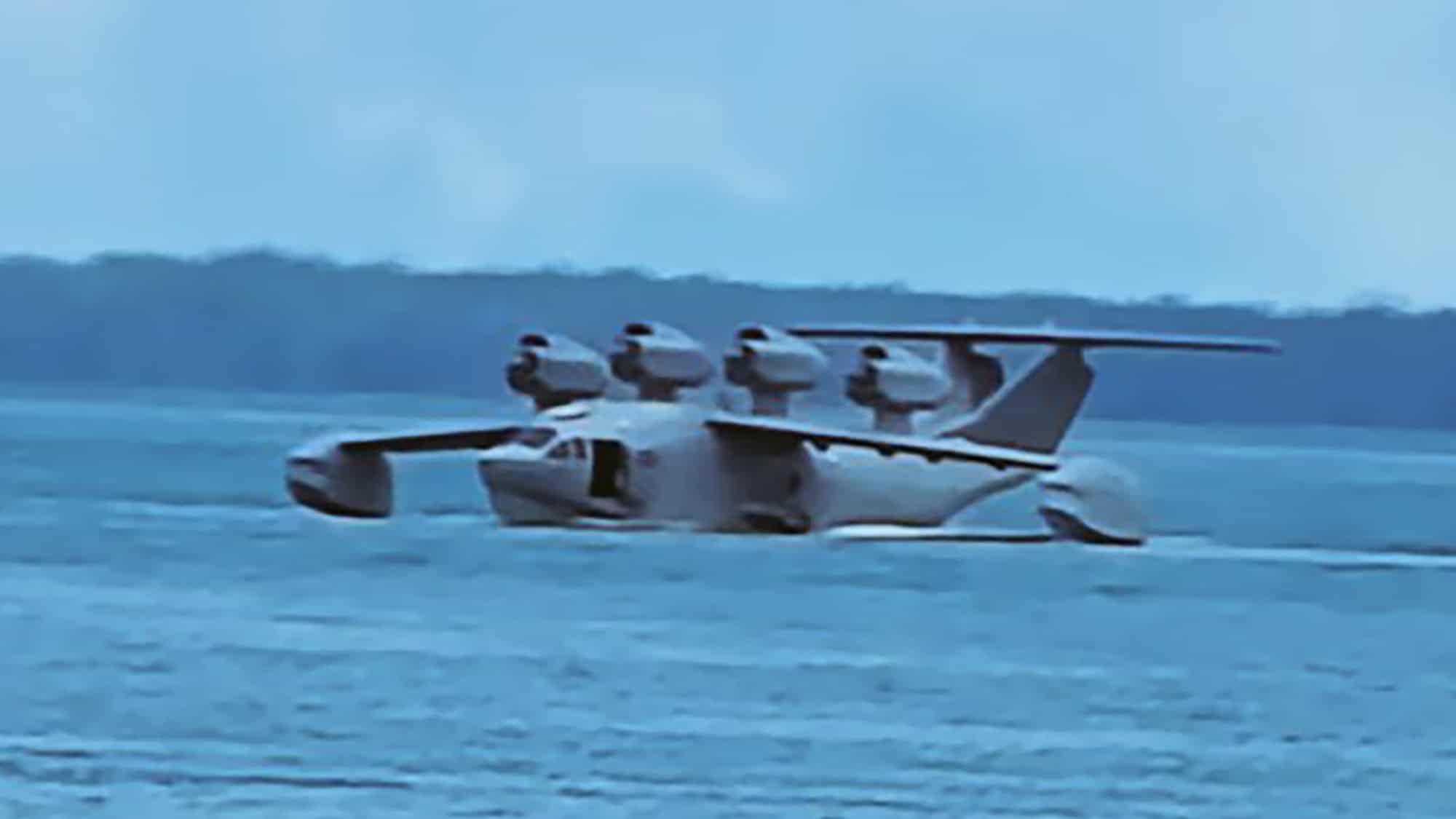
In the image showing the aircraft being picked up by crane, we can see the extended landing gear, suggesting the aircraft might also be amphibian and able to operate from land bases. More images and visuals of the aircraft, possibly in flight, can shed more light on this aspect.
A known Chinese flying boat is the civilian AG600, which has now been adopted in a firefighter role. The aircraft also has a massive market within China, where local governments along the coast can use it for search and rescue, passenger ferry, while also being commandeered by the PLA for resupply in the event of a war.
Coming back to the Bohai Sea Monster, one observer in the comment thread under Rupprecht’s post believes this is only a technology demonstrator aircraft. The actual aircraft could be as large as the new Y-15 turboprop medium tactical lift aircraft, and will be powered by the same four WJ-10/AEP500 turboprop engines.
The powerplants on the final aircraft could however be larger to support the new aircraft’s larger size. A larger number of engines also can’t be excluded.
The AG600 Kunlong…. China’s giant amphibious firefighter… doing a full ground water load without shutting down engines. Fire truck hose straight into the fuselage, 12 tonnes going in fast, then controlled overflow from the side vents the second it’s topped off. Every second… pic.twitter.com/NgcPhct4Yq
— Fahad Naim (@Fahadnaimb) March 28, 2026
Ekranoplans
Ekranoplans, or GEVs, are also called wing-in-ground effect (WIG) craft, which are a hybrid between airplanes and ships. They move over water without actually touching it. The International Maritime Organization classifies them as ships, but the principle behind their operation is entirely unlike one.
The unique high-speed craft attain their kinematics by skimming the water’s surface at a height of between one and five meters (three to 16 feet). It can, therefore, be said that they share some of their characteristics with seaplanes, hovercrafts, and hydrofoils.
They exploit an aerodynamic principle called the “ground effect.” This combination of speed and stealth – their proximity to the surface while flying makes them difficult to detect by radar – got the attention of the Soviet military, which experimented with some variants of the concept during the Cold War.
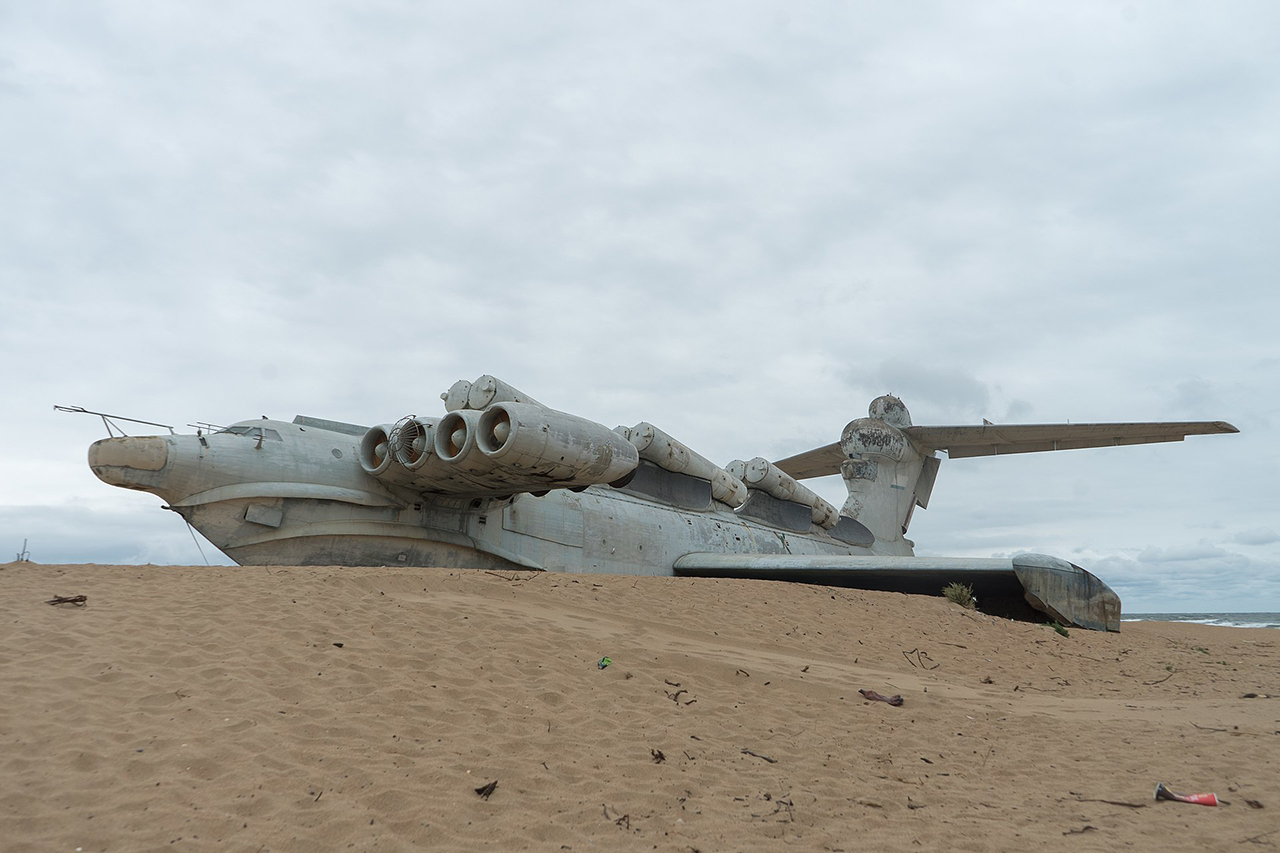
The most famous Soviet ekranoplan was indeed jet powered, and famously known as the ‘Caspian Sea Monster’. The first ‘Caspian Sea Monster’ was an experimental design that first took flight in 1966, but was later destroyed in a crash in 1980.
The Soviets then built a smaller Lun class ekranoplan, which became the only such vehicle to enter operational service. Carrying six missile tubes on the top fuselage in rows of two, the aircraft had a top speed of 300 knots and could ‘fly’ just three to five meters above the water’s surface.
A similar effort by the U.S. Defense Advanced Research Projects Agency (DARPA) as part of the Liberty Lifter program, was cancelled in July 2025 notably just a few weeks after the Chinese aircraft emerged.
China’s Type 728 Zubr class air-cushioned landing craft (LCAC) is the world’s largest military hovercraft, displacing 555 tons at full load. Derived from the Soviet Project 1232.2 Pomornik (better known as Zubr, Russian for European bison), it is designed to move small amphibious… pic.twitter.com/RT3W0ry2GL
— Eurasia Naval Insight (@EurasiaNaval) February 5, 2026
Use in war
The Chinese aircraft could very well have a role in smaller, low intensity operations in the shallow littoral waters of the South China Sea, transporting materials and weapons to PLA Navy marines on its massive artificial island bases, or even in a Taiwan invasion scenario.
China’s new amphibious “jack-up” barges have received a lot of attention. The PLA Navy’s Type 726-class air-cushioned landing craft (hovercraft), in contrast, have receded into the background over the past ~15 years. A newly released picture from Weibo shows 4x Type 726 inside… pic.twitter.com/Lp1fM92NuB
— Shahryar Pasandideh (@shahpas) April 4, 2025
This would be consistent with the amphibious capabilities China is building with the Type 075 and Type 076 Landing Helicopter Dock (LHD) amphibious assault ships, as well as the Type 728 and Type 726 hovercrafts. The weapons pylons can offer a secondary strike role, releasing either sea-skimming anti-ship missiles or torpedoes, on targets of opportunity based on information received by other platforms.