RQ-4 Global Hawk in shock cancellation news: old planes better than new? January 27, 2012
Posted by Richard Clements in Drones, Military Aviation.Tags: Airbus, Airbus 380, Aviation, Dragon Lady, drone, Global Hawk, Military Aviation, Northrop Grumman, Northrop Grumman RQ-4 Global Hawk, Pentagon, U-2, United States Air Force, US Air Force
1 comment so far
Is new better than old?
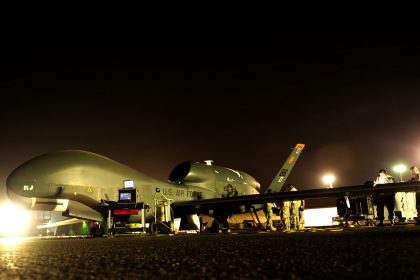
It would seem not. Industry insiders have leaked that the Pentagon is to cancel the RQ-4 Global Hawk program not just stopping buying new aircraft but to retire the Air Force active fleet, in favor of keeping the U-2 flying into 2020.
Air force times writer Dave Majumdar wrote: “The Air Force had been planning to buy 42 Block 30 aircraft. According to 2011 budget documents, the cost of each aircraft was around $215 million. It was not immediately clear how many Global Hawks the Air Force has.”
The aircraft is being killed off due to its high cost to buy and to maintain; also the program hasn’t lived up to its early promise. A knowledgeable industry insider confirmed the project cancellation and said “Yes, this is accurate — been a lot of discussion on the possibility of this a long while,” said the source, who was not authorized to speak to the media. “There is a high probability it will come to pass now unless Congress takes a major exception.”
The industry source also said “I don’t think that’s likely in the economic environment of this year’s DoD budget, and there are no real ‘hawks’ in Congress from California,” he said. The aircraft is both built and based in the Golden State.
Majumdar said that Northrop Grumman declined to comment whilst Air Force officials would neither deny nor confirm the reports.
Oddly the US Navy is going to keep its version of the aircraft therefore keeping the option open that it could, if needed, be used by the air force.
Surely, Global Hawk has not enjoyed the best of safety records with three prototypes lost and a failure rate much higher than many manned planes facing lethal threats in combat.
However, the U.S. RQ-4Bs belonging to the 9th Operations Group/Detachment 4th of the U.S. Air Force, based at NAS Sigonella, in Sicily, the base of the NATO AGS (Air Ground Surveillance) Global Hawk program were the first drones to operate in the Libyan airspace where they performed high altitude Battle Damage Assessment sorties.
Anyway, all of this is good news for the U-2, a 50 year old program that has ironed out all its techncal issues many years ago.
Affectionately known as “Dragon Lady”, the U-2 entered service in 1957. Since then, it has undergone many upgrades and has become a relatively cheap viable platform during these harsh economic times. In what would normally be the types twilight years, a breath of fresh air has been breathed over the majestic old ‘Lady’ which will see the type in service for more years to come.
Actually, it has been a bad week for other new or recent aircraft types too.
Another rather embarrasing news (this time for Airbus) is that further cracks have been found in the wings of its much lauded A380 “Superjumbo”, after the famous uncontained engine failure of Nov. 4, 2010. Airbus did tweet “For those following reports on A380 wing rib findings we confirm inspection & repair process underway and aircraft are safe to fly”: a damage limitation message by the company’s PR rather than a reassuring statement.
The apparent win of obsolete technology on newer, supposed to replace it, does pose the usual question: are modern aircraft too complex?
One thing is sure: you can’t compare new planes with older types. Even if there can be programs free from major problems during their whole lifetime and much troubled ones, facing myriad issues since their birth, generally speaking, those that have survived for 3, 4 or 5 decades and are still flying today, were probably properly designed, maintained, fixed and upgraded during their career. So they are today much more reliable than those integrating cutting edge experimental technologies.
Written with The Aviationist’s Editor David Cenciotti
Above image: U.S. Air Force
First Airbus A380 lands at Rome Fiumicino airport June 6, 2011
Posted by David Cenciotti in Aviation, non-military aviation.Tags: A380, A388, A6-EDJ, ADR, Airbus, Airbus 380, commercial aviation, EK97, EK98, Emirates, non-military aviation, Rome Fiumicino
add a comment
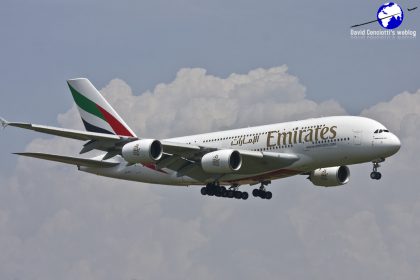
On Jun. 6, 2011, the first (long awaited) Emirates Airbus 380 landed at Rome Fiumicino. It was a one-off trip to celebrate Fiumicino airport’s 50th anniversary, along with 150th anniversary of Italian unification. The Super Jumbo (A6-EDJ) replaced the usual B777 scheduled service on the Dubai-Rome route: EK 97 departing Dubai at 08.55 LT and arriving in Rome at 13.15LT (the A380 actually landed at 13.30LT). The flight left Fiumicino at 17.03 (scheduled time 16.45LT) with an expected arrival time in Dubai at 00.40LT on Jun. 7.
Emirates had initially planned the upgrade of the EK097/098 DBX-FCO-DBX daily flights from the Boeing B777-300 (B773) to the Airbus A380-800 (A388) in Dec. 2009.
Looks like the EK98 had to perform some orbits before landing at Dubai:
Another Qantas engine failure?! The wrong week to fly from Singapore to Sydney? November 6, 2010
Posted by David Cenciotti in Aviation.Tags: A380, Airbus, Airbus 380, Aviation Safety, B747-400, emergency, emergency landing, Engine Alliance, engine failure, GP7200, Qantas, QF32, QF6, Rolls Royce, RR Trent, Trent 900, Uncontained engine failure, VH-OJD, VH-OQA
add a comment
The Qantas Airbus A380 uncontained engine failure experienced by QF32 on departure from Singapore on Nov. 4, 2010, has already made the news. The following day, Nov. 5, a B747-400ER “VH-OJD” flying from Singapore to Sydney as QF6 was compelled to return to Changi for a failure on engine #1. When I first heard of this new emergency I thought to joke but the mishap has been confirmed by Qantas spokeman.
Pure coincidence? Maybe. However, please notice that: both flights departed Singapore for Sydney, both Qantas flights, both 4 engines aircraft, both Rolls Royce powered, both experiencing engine #1 failures.
Qantas Airbus 380 uncontained engine failure November 4, 2010
Posted by David Cenciotti in Aviation Safety, non-military aviation.Tags: A380, Airbus, Airbus 380, Aviation Safety, emergency, emergency landing, Engine Alliance, engine failure, GP7200, Qantas, QF32, Rolls Royce, RR Trent, Trent 900, Uncontained engine failure, VH-OQA
1 comment so far
Two months ago, commenting about the uncontained engine failure involving the Qantas B747-400 just departed from San Francisco (for details read here) I wrote: “Unlike other minor failures occuring almost daily everywhere, an uncontained failure (that is quite different from an engine explosion….), is somehow rare, but not a big deal (if there’s no damage to the wing or fuselage caused by a separated engine part), especially if happening in the vicinity of the departure airport”. What happened to QF32, an Airbus A380 from Singapore to Sydney somehow prov
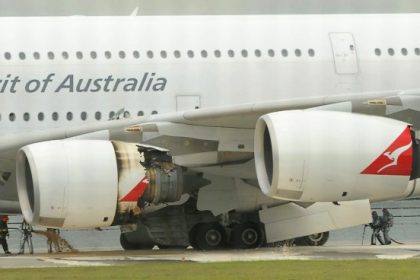
e that such kind of emergency is not as rare at least for Qantas aircraft…. On Nov. 4, 2010, Airbus 380 “VH-OQA”, the first A380-800 flying with Qantas, with 433 passengers and 26 crew members on board, experienced an uncontained engine failure 30 minutes after departure from Singapore and was compelled to return to Changi airport where it performed a successful emergency landing after circling above the sea for fuel dumping. Parts from the #2 engine punctured the left wing while debris fell on the ground (fortunately, nobody was hurt). Even if the cause of the failure is obviously still unknown, as a consequence of the engine problem Qantas grounded its seven Airbus 380s, to be followed, according to rumors, by the Singapore and Lufthansa ones in the next few h
ours (Qantas, Singarpore and Lufthansa A380s are equipped with the Rolls Royce Trent 900 variant power plant – while Air France and Emirates are powered by Engine Alliance GP7200 engines). Since I’ve not heard latelyabout similar events involving aircraft of other airlines, what happened to QF32 raises a question: what’s wrong in the Rolls Royce – Qantas duo? Perhaps nothing. Perhaps Qantas planes with Rolls Royce engines had just bad luck but investigation will have to analyse also airline’s maintenance procedures as well as engine design and type of material used to build engine components at RR.
So, what have we learnt so far from this event?
1) engine failures happens (on 4 engine aircraft but also on 2 or 3 engine planes – the number of engines is statistically irrelevant)
2) uncontained engine failures are not so dangerous, provided they don’t cause damages to the wing or fuselage
3) in the last two occurrences, the “uncontainment” happened few minutes after departure (hence, in such a phase of flight in which stress on engine is at the highest level)
4) aircraft experiencing this type of emergency can return to the departure aerodrome safely
5) this was the most serious incident worldwide involving an A380 since it entered service three years ago
6) aircraft parts sometimes fall from the sky (as in Donnie Darko movie….) so be careful :)

Anyone see something strange in this picture? October 6, 2010
Posted by David Cenciotti in Aviation, non-military aviation.Tags: A380, Airbus 380, Charles De Gaulle airport, Emirates, Roissy
3 comments
I took the following picture on Sept. 30, 2010, in Paris, France, at 16.47LT. Can you see something strange?
If you open it you will notice what seems to be a small aircraft above the Paris Opéra: that is actually an Emirates A380 just departed from Charles De Gaulle-Roissy airport. Below you will find one of the pictures I took a few seconds earlier, as soon as I spotted the plane and identified it as a “380″ and a close-up of the wide body.
Emirates A380 lands in Malpensa August 2, 2010
Posted by David Cenciotti in Aviation, non-military aviation.Tags: A380-800, Airbus, Airbus 380, civil aviation, Emirates, Lufthansa, Milan Malpensa
1 comment so far
On Jul. 29, 2010, the Emirates A.380-800 “A6-EDG” flying as EK93 made its maiden Dubai-Milan Malpensa flight for the official presentation of the Milan Football Club shirt, sporting the Fly Emirates sponsor, made by Adidas, whose image appeared magnified on the left hand side of the fuselage, aft of the front door on the main deck. For the moment, the aircraft will not be used on a daily scheduled service between Dubai and Milan even if it be used on routes to Milan and Rome Fiumicino in the future. Actually, the Emirates one, was not the first A380 to land in Italy (it was the first revenue flight with the Super Jumbo): on Jul. 14, 2010, a Lufthansa’s one had already made a stop in Malpensa during a test flight from Germany.
Simone Bovi, took the following picture of the Emirates A380 departing as EK94 from Malpensa airport.
ECOLUX Airlines: my virtual airline in Airline Manager game November 18, 2009
Posted by David Cenciotti in Aviation, non-military aviation.Tags: A-380, Airbus 380, Airline Manager, ECOLUX, Facebook
3 comments
Airline Manager is an addicting Facebook game (http://apps.facebook.com/airline_manager/index.php) developed outside the Social Network, that let you create and manage your own airline; buy aircraft; choose routes according to the aircraft type and endurance, and to the demand for a particular destination; pay for catering and maintenance; purchase fuel (whose prices depend on the global market and change); invest in advertising and buy and sell other companies stocks. The go
al of the game is to increase the value of the company by expanding your fleet and routes. Interestingly, the game is in real time, meaning that you can follow in “live mode” a flight in progress and if a flight lasts 14 hours (as my Rome – San Diego does), you have to wait all that time before the return flight can depart. Incidents, failures and personnel strike can occur, so you have to spend your money carefully because you could need some hundred thousands US Dollars to fix an aircraft or to give you pilots a pay raise.
But, first of all, you have to think to a name for your airline. The one I chose is EcoLux, from Ecological and Luxurious: Ecological because, today, both airlines and aircraft manufacturer are compelled to address environmental issues with a “green vision”; Luxurious because a modern airline with the ambition of growing fast has to provide first class services to its passengers to cope with important challengers like the rich Middle East airlines (Emirates, Ethiad, etc.). I created a logo (that you can see on the right image) for ECOLUX and a colour scheme according to it.
My virtual airline is expanding very fast so, if you have your own company on Airline Manager, I suggest you to invest on ECOLUX soon!
How to go Down Under with an Airbus 380 (saving some money) January 27, 2009
Posted by David Cenciotti in Aviation, non-military aviation.Tags: A380, air travel, Airbus, Airbus 380, B747, B777, Boeing 777, civil aviation, commercial aviation, DXB, Emirates, Milan Malpensa, mxp, Rome Fiumicino, Terminal 3
add a comment
The title of this post could be deceiving. I’m not suggesting how to get an Airbus 380 inverted for aerobatic purposes. I was just providing an advice for those who want to visit Australia possibly reaching the Red Continent on board the largest plane on commercial routes (like myself). Emirates has launched some promotional fares to fly towards 4 destinations in Australia: Brisbane, Sydney, Melbourne and Perth. With 950 Euro, it is now possible to fly from Italy to Brisbane, Sydney and Melbourne in Economy Class with the possibility to perform a stopover in Dubai to visit the town. Starting from next Feb 2, 2009 each Wednesday, Friday and Sunday, all passengers to Sydney will have the oppportunity to travel on board the A380.
Flights to Perth are offered by Emirates at 850 Euro with a stopover in Dubai. Tickets should be purchased within Mar 31, 2009, from one of the tre Emirates airports in Italy: Rome, Milan and Venice. Dealing with Milan Malpensa airport, a second daily flight was added (departure at 21.15LT) to Dubai where connections are managed at the brand new Terminal 3 of Dubai International Airport, that is completely dedicated to the handling of Emirates flights.
Emirates to introduce the A380 in the Dubay-Rome-Dubay on Dec 1st 2009 January 8, 2009
Posted by David Cenciotti in Aviation, non-military aviation.Tags: A380, air travel, Airbus, Airbus 380, B747, B747-400, B777, Boeing 777, civil aviation, commercial aviation, DXB, Emirates, FCO, Fiumicino, Rome Fiumicino
3 comments
One of the highlights of the 2009 for Rome Fiumicino airport is the expected upgrade of the Emirates EK097/098 DBX-FCO-DBX daily routes from the Boeing B777-300 (B773) to the Airbus A380-800 (A388) effective from Dec 1, 2009. With this upgrade, Rome is going to be the second destination in Europe to receive the “giant” aircraft. So far London Heathrow, with Emirates and Qantas A380s was the only airport in Europe to receive the biggest aircraft in Airbus family.
According to the Emirates.com website, the schedule is the following:
EK97 DXB FCO 09.25 12.45 daily – A380-800
EK98 FCO DXB 14.30 23.00 daily – A380-800
In other words: 5h 30m flight time with 1h 45m turn round.
The flights can be already reserved. I made a test, here’s the screeshot:
The configuration of the aircraft is unknown at present. Emirates has ordered 58 aircraft in three configurations:
489 seats / 3 classes
517 seats / 3 classes
625* seats / 2 classes (some sources reported 644, others 604).
So far, the EK201/202 on the very long range flight DXB-JFK-DXB is in the 489 seats configuration. Same for the EK001/002 of the DXB-LHR-DXB route. Since flight to Rome is shorter it is possible that aircraft in the 517 seats configuration (a long range one) will be used. The two class high-density layout should be used in short range flights.
The arrival of the Emirates A380 in Rome Fiumicino has various meanings: first of all, it reaffirms the interest of Emirates for the Italian market, especially now that Alitalia is so weak and with an uncertain future. Emirates can surely gain an important share of market, especially if Rome will be used as a sort of European hub for other intercontinental destinations that are not currently directly served from Italy. Emirates strategy could be to get passengers from Asia and the Gulf area to Dubai and to fly them to Rome. Same could be for passengers coming from NYC: with a single aircraft, Emirates could perform the JFK-DBX-FCO route with an efficient utilizitation of its A380 fleet.
Someone speculated that an increased capacity to Rome could be achieved with a second daily B777 flight to FCO, however there’s a bilateral issue and the maximum number of weekly flights (7) has been already reached. Furthermore, the A380 has a strong image impact and must be considered as a part of a marketing strategy that focuses on Italy. In these days, an interesting ads has been broadcasted by all the Italian TV channels.
Second is that Rome-Fiumicino is ready (well, it will be ready by Dec 1 2009) to handle the A380. Actually, an A380 has not so many “needs” one might think: it is able to operate on a typical 45 mt wide runway and doesn’t require an extended runway that does a 747-400. It is heavier than a Jumbo but its landing gear has 4 extra wheels that absorbe the weight reducing the stress on the underlying runway and taxiways. Fiumicino hasn’t any taxiway passing above a bridge that would need to be strengthened. However, taxiways must be large enough to ensure that the outboard engines run above an asphalted surface in order to prevent injestion of foreign objects and consequent engine damage (FOD, Foreign Object Damage). At the gate, provided that the distance from the other stands is sufficient (the A380 has a wingspan of 79.8 mt/261 ft), in order to speed boarding and unboarding of passengers, double fingers would be ideal, even if I think that also the “normal” jetways can be used (with longer loading/unloading time). The aircraft is pretty tall, thus servicing vehicles able to reach the aircraft’s top deck must be available. However, despite its colossal shape, the Emirates A380 makes less than half the noise of a 747 and uses 20% less fuel. Its environmental impact is low. Just have a look at the specification page on the Emirates page (http://www.emirates.com/nz/English/flying/our_fleet/emirates_a380/emirates_a380_specifications.aspx):
Most probably, a series of compatibility flights using an Airbus company A380 will be performed in the months preceeding Dec 1, has happened for the other airports expected to receive the aircraft.
Emirates A380 Environmental Facts
* The Emirates A380 burns up to 20% less fuel per seat than today’s largest aircraft
* This is the most significant advancement in reducing fuel burn and emissions in four decades
* Low fuel burn means lower C02 emissions. The Emirates A380 produces less than 75g of C02 per passenger kilometre, almost half of the European target for cars manufactured in 2008
* Emirates A380s will progressively feature digital inflight magazines, entertainment guides and shopping catalogues, saving 2kg per seat or almost one tonne per aircraft
* Emirates A380s, which offers more space per passenger in all classes, will also meet ICAO’s gaseous emissions standards by a substantial margin
* We will comfortably meet current Stage Three and proposed Stage Four noise level standards
* Our new Emirates A380 maintenance facilities in Dubai are state of the art, efficient buildings
* A380s feature lightweight materials that account for 25% of its structure
* Our emissions components – such as NOx – will be well under the regulated ‘cap four’ rule
* Emirates is working with Airbus to further reduce weight of our future A380s
* Larger aircraft mean less takeoff and landings (in passenger terms, some Emirates A380 versions would be the equivalent of flying up to seven smaller aircraft types)
* Emirates average fleet age is less than half that of many European airlines, meaning newer technology and efficiency breakthroughs characterise our aircraft.
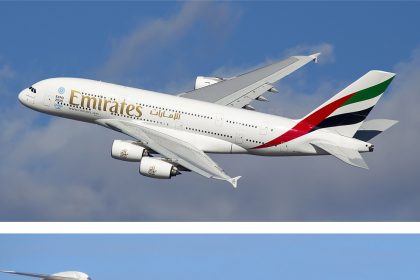
Above, Emirates 777 taking off from Rome Fiumicino. Below, EK A380 pictures from Emirates Media website.