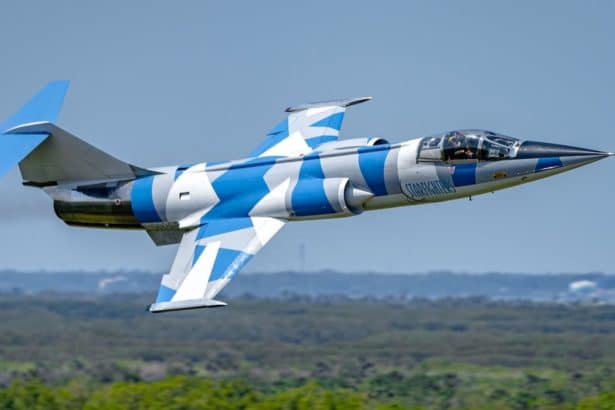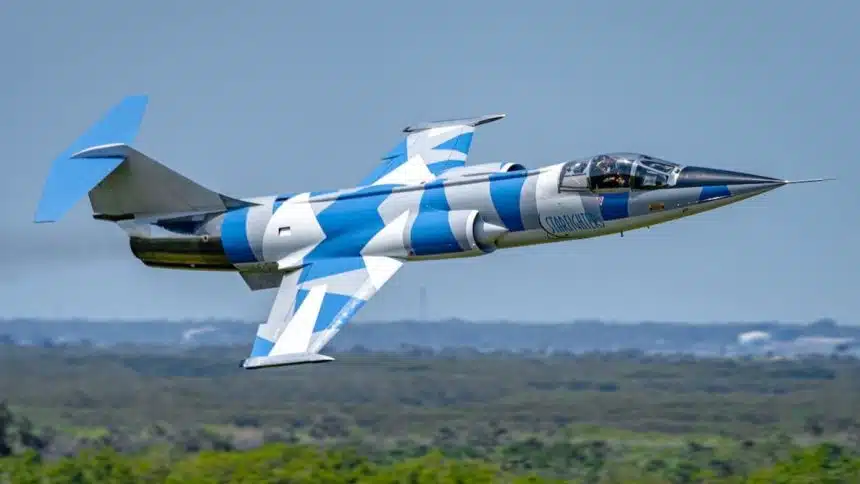
Starfighters Space is preparing to conduct in December a captive-carry test flight of its new Starlaunch 1 suborbital development vehicle on one of the company’s F-104 Starfighter aircraft.
Starfighters Space is preparing to take the next step in the development of its Starlaunch suborbital vehicle, with an F-104 Starfighter expected to carry Starlaunch 1 airframe on a captive-carry flight in December 2026. The mission will mark the transition from ground-based development to flight testing, after the completion of wind tunnel testing of the vehicle earlier this year.
The company announced on Oct. 13, 2026, that it has finalized the airframe design for Starlaunch 1 and ordered flight hardware from Italian company Robby Moto Engineering. The hardware, which the company says will be inert, is expected to arrive at Starfighters Space’s hangar at NASA’s Kennedy Space Center in November, where the team will assemble the vehicle and test its interface with the carrier aircraft ahead of the planned flight.
“The planned captive-carry flight would move STARLAUNCH™ 1 from design and ground-based development into flight testing,” said Tim Franta, CEO of Starfighters Space. “Our approach is deliberately incremental: build the hardware, integrate it with the aircraft, fly it, collect data, and use those results to advance toward separation and powered flight. This work on STARLAUNCH™ 1 is also expected to generate engineering and operational experience to inform the future development of STARLAUNCH™ 2.”
The mission is expected to take place between Kennedy Space Center in Florida and the Federal Aviation Administration (FAA)-licensed Cecil Spaceport in Jacksonville. During the captive-carry flight, STARLAUNCH 1 will remain attached beneath the wing of the F-104 throughout the mission, without attempting an actual release.
In fact, the test is intended to demonstrate the vehicle’s behavior in flight, verify its integration with the aircraft and generate experience for future developments. The company says the data will also support work by its propulsion partner, Vaya Defense & Space, which could develop a hybrid rocket motor for Starlaunch.
“December’s captive-carry mission would essentially be step one of a multi-flight campaign, building processes for our launch team while capturing data for the FAA and the Space Force as we move toward propulsive air launch,” said Piercarlo Ciacchi, Director of Flight Operations and Chief Pilot of Starfighters Space. “Our plan is to follow the December mission with a drop test over the Atlantic Ocean followed by a demonstration of the integrated propulsion system. Development of STARLAUNCH™ 2 would be informed by these missions, concurrent with the STARLAUNCH™ 1 development.”
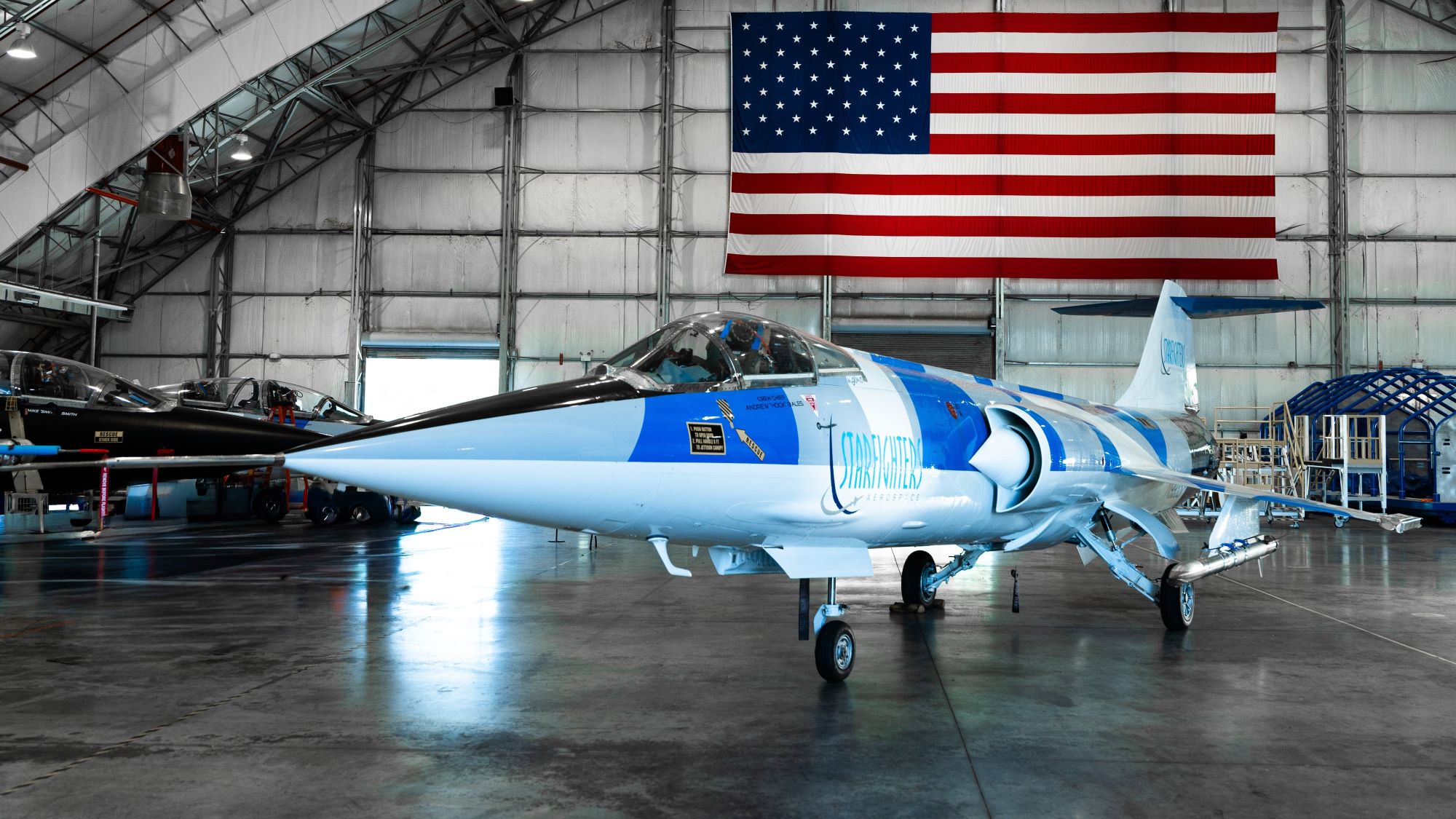
Additionally, the F-104 might also carry Starfighter’s recently-completed Wind Tunnel in the Sky hardware under the other wing on a customer-funded rideshare mission. This payload will also serve as a counterweight to balance the aircraft and improve its aerodynamic stability, which would be affected by a single, asymmetric payload.
The press release mentions that the two systems share some components and interchangeable hardware, allowing the company to apply common integration procedures. The components, again produced by Robby Moto Engineering, are enroute to the company’s hangar at KSC, and will be assembled into two modular underwing flight articles.
Starlaunch
The company previously said that Starlaunch 1 is being developed as a sub-orbital vehicle designed to support short-duration microgravity missions and serves as a pathfinder for future air-launched concepts. The vehicle is based on the proven envelope of the AIM120 AMRAAM, says the company on its website.
The company describes Starlaunch 1 as its “first proprietary design air-launch satellite delivery rocket.” The listed performance mention a total thrust of 41,000 lbf, an orbital inclination between 0° and 120° and a payload which can include multiple small satellites.
The flight profile sees the F-104 climbing at 45,000 ft at Mach 2, launching the rocket. Starlaunch 1 will be able to reach sub-orbital altitude, just above the Kármán line at 100 km, while the larget Starlaunch 2 will be able to reach low Earth orbit.
In September 2026, Starfighters signed a Memorandum of Understanding with Vaya Defense & Space, a privately held developer of the patented Vortex-Hybrid rocket engine. The MoU covers two collaboration tracks.
The first one covers the flight testing of Vaya hypersonic test articles and other payloads on Starfighters’ Wind Tunnel in the Sky. The second will assess whether Vaya’s hybrid propulsion is suitable for Starlaunch.
“Vaya has spent years maturing a propulsion technology that is throttleable, restartable, and non-explosive — which is close to an ideal profile for a vehicle carried under the wing of an aircraft,” said Franta. “Their shop is also a short drive from our hangar at Kennedy Space Center. That combination of technical fit and proximity allows us to develop and test hardware faster than either of us could alone.”
Wind Tunnel in the Sky
Starfighters Space announced the development of its Wind Tunnel in the Sky platform in July 2026. The company described it as “a reusable airborne platform designed to help commercial, government, defense, and research customers evaluate advanced technologies during sustained Mach 2+ flight in real-world atmospheric conditions.”
The system is being developed as a modular and reusable underwing platform able to host a variety of sensors, test articles, and other payloads for long-duration exposure to both high-speed and low-gravity conditions. The company expects to use it for aerodynamic test articles, avionics, sensors, communications systems, electronic equipment, advanced materials, and other technologies for hypersonic programs and microgravity research.
The flight hardware will support an initial planned customer deployment while establishing capabilities that can be adapted for future missions, said the company. A statement also provided the dimensions of the system, which measures 3.65 meters in length and 178 millimeters in diameter with a form factor “based on a proven military air-launch vehicle.” The dimensions match the publicly released ones of the AIM-120 AMRAAM.
“Using a proven aerodynamic configuration allows us to focus on payload integration, flight testing and mission execution rather than developing an entirely new external flight body,” said Ciacchi. “The modular design gives us the flexibility to support a wide range of customer requirements while maintaining predictable flight characteristics throughout our development program.”
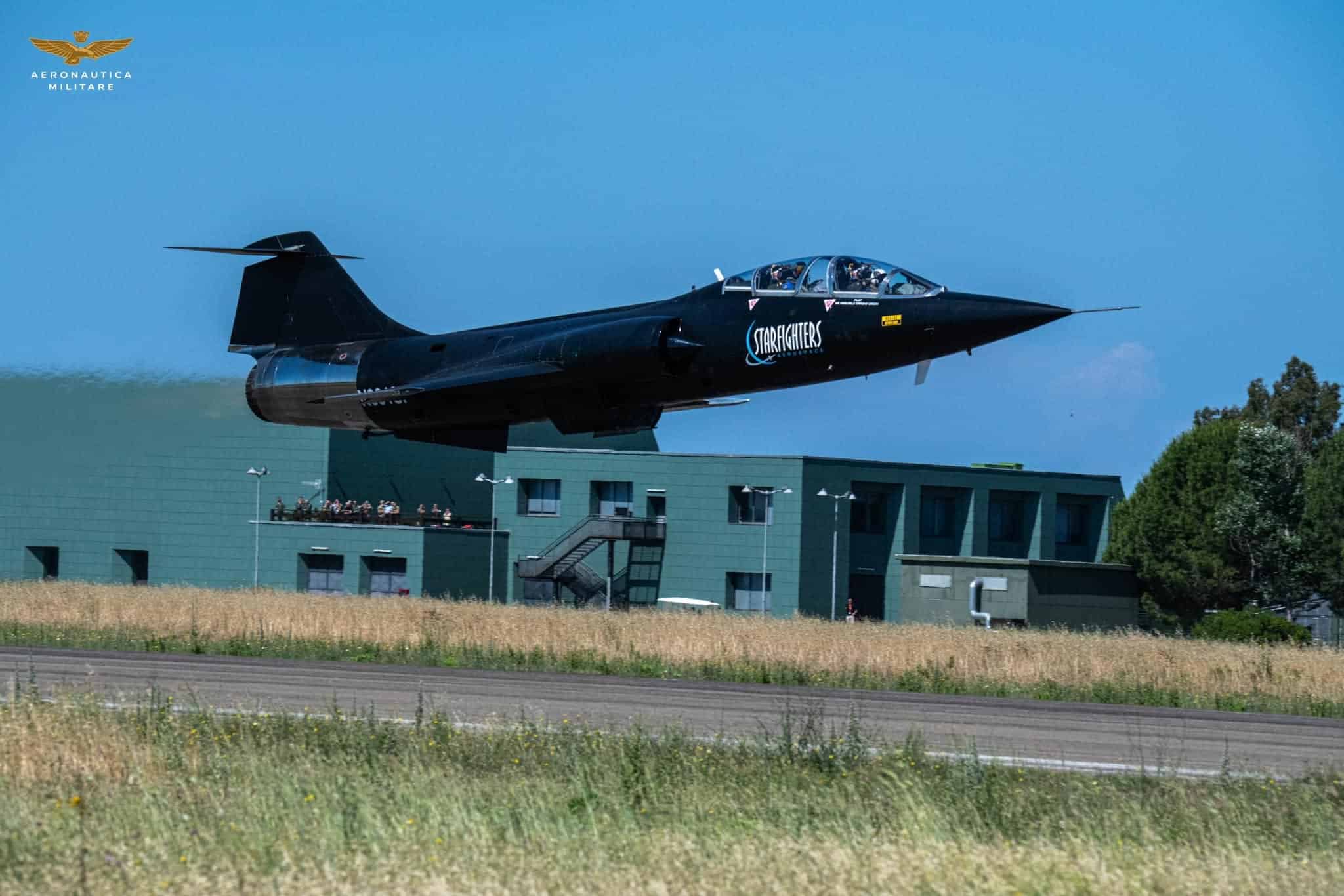
Rather than relying exclusively on ground-based wind tunnels, this system will exploit the F-104 Starfighter’s flight characteristics to subject the payload to real atmospheric conditions. The company says this also allows longer tests, as “a typical 45-minute mission can include up to a 10-minute Mach 2+ test window, providing significantly longer exposure than traditional wind tunnel test runs – which typically can last only seconds at a time.”
“As demand for hypersonic and advanced aerospace systems continues to grow, access to specialized test infrastructure remains limited, increasing demand for complementary commercial flight-test capabilities,” said Tim Franta, CEO of Starfighters Space. “While ground wind tunnels remain essential for aerospace research and development, airborne testing can expose hardware to combinations of weather variation, vibration, acceleration, dynamic pressure, temperature and operational conditions that cannot always be fully reproduced in a fixed facility.”
The F-104 as an airborne research platform
Starfighters Space operates a fleet of F-104 Starfighters from Kennedy Space Center and Midland International Air & Space Port in Texas. Originally developed by Lockheed as a high-performance supersonic interceptor, the F-104 is now being used by the company for commercial flight testing, aerospace research and the development of its air-launch capabilities.
The company plans to have a fleet of seven airworthy F-104s. In the past, Starfighters has purchased five F-104s from the Italian Air Force after the service retired the type from operational service in 2004, including three TF-104G-M two-seat trainers, as well additional aircraft from the Royal Canadian Air Force.
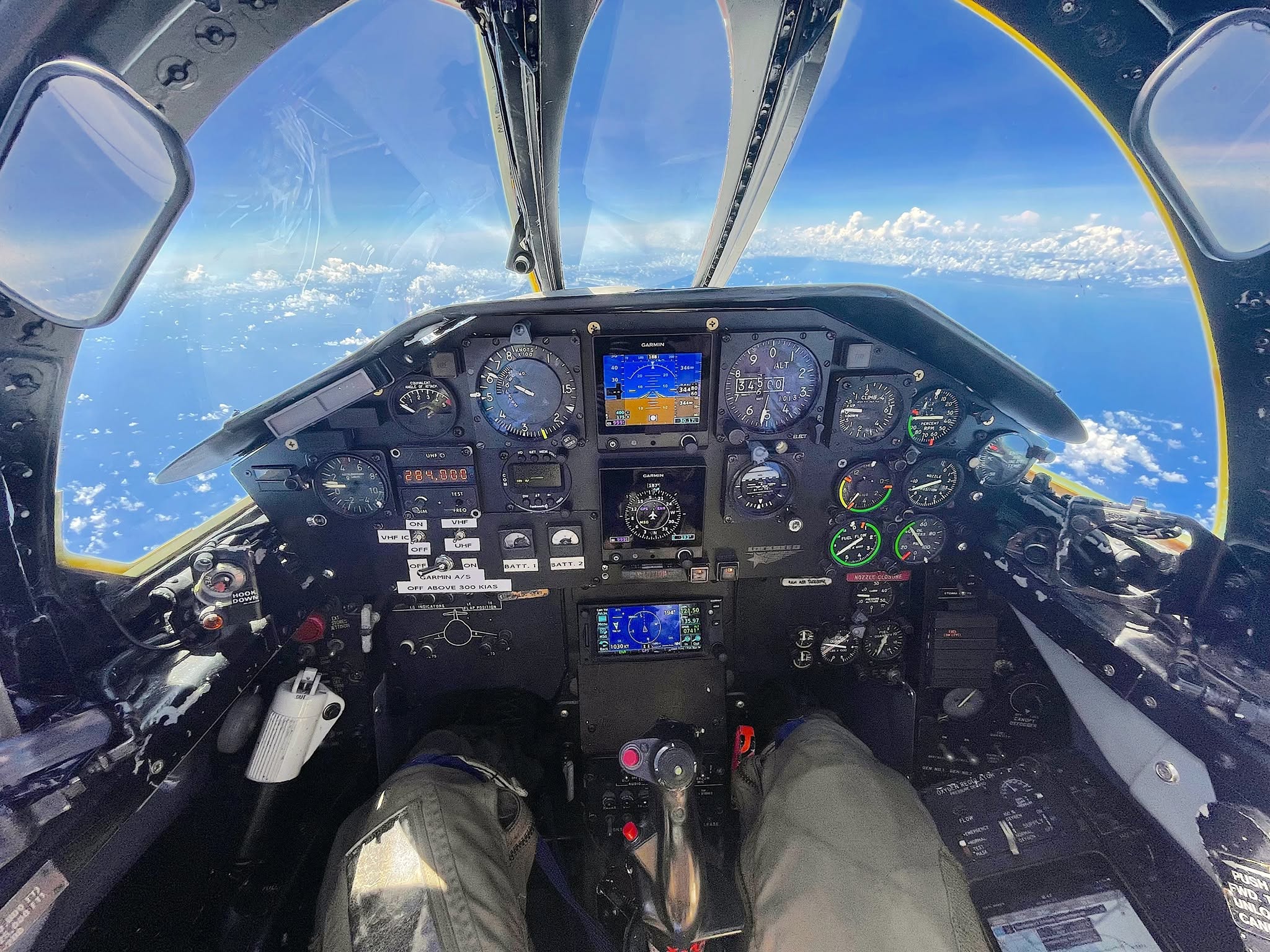
“The F-104 is a remarkable aerial platform, capable of putting research projects into microgravity, high altitude, high speed, and high G environments. The jets can mimic the ascent, descent and flight profiles of spaceflight vehicles and high performance military aircraft, and — according to NASA estimates — can provide between 60-90 seconds of microgravity during parabolic maneuvers,” Starfighters website explains.