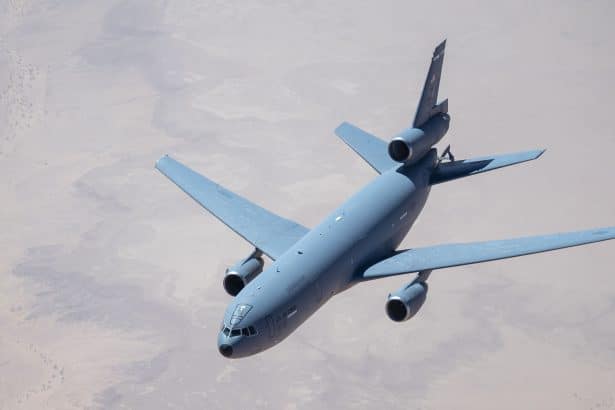
A contract notice, first reported on by Aviation Week, was released seeking industry interest for the reactivation and in-service support of up to four KC-10 Extender aircraft for a foreign military sales (FMS) transfer to a nation in North Africa, most likely Morocco or Egypt.
The KC-10s, which have been designated as Excess Defense Articles (EDAs), were retired from the U.S. Air Force inventory in 2024 and most of the fleet was subsequently placed into storage with the 309th Aerospace Maintenance and Regeneration Group (AMARG) boneyard at Davis-Monthan AFB, Arizona.
Private sector aerial refueling contractor Omega has already seemingly snatched up as many as ten of these surplus tanker aircraft, which notably offer a greater fuel offload than both the KC-135 Stratotanker and the KC-46 Pegasus, to support their contracted services. Now, the remaining operational life of some more of these aircraft looks to be destined for African skies.
Specific nation isn’t disclosed. But the big news is that Big Sexy is returning—first for contract refueling and now this.
— Brian Everstine (@beverstine) October 8, 2026
The request for information (RFI), as written in the official notice, seeks to “identify potential industry sources that possess the capability, expertise, and facilities to execute the regeneration, one-time flight clearance, depot-level return to service, worldwide ferry delivery, in-country Contractor Logistics Support (CLS), and operational/maintenance training for up to four (4) KC-10 Extender aircraft”.
A request for proposals (RFP) would then, in due course, follow on and allow interested bidders to compete for the final contract.
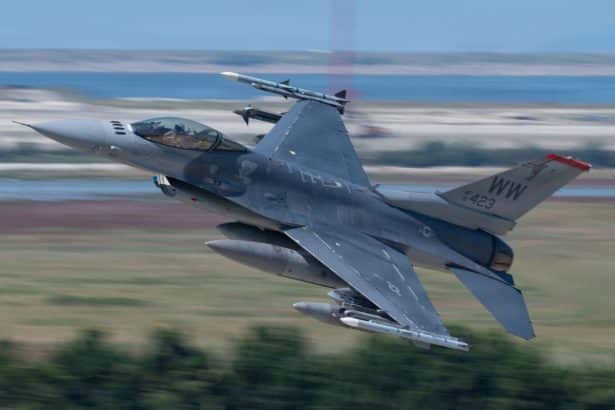
Though the “partner nation in North Africa” is not disclosed, the most likely candidates are undoubtedly Egypt and Morocco. These are the only two nations in North Africa to not only maintain good relations with the U.S. and operate U.S.-sourced military equipment but also fly aircraft – the F-16 Fighting Falcon, or ‘Viper’ – which would require the flying boom refueling system fitted to these KC-10 Extenders.
Morocco’s F-16 Block 72 has successfully completed its first flight. 🇲🇦
A key milestone toward delivering the most advanced F-16 to the Royal Moroccan Air Force, strengthening the Kingdom’s defense capabilities and contributing to regional security and stability. https://t.co/oPFdy5SOff
— Lockheed Martin ME & Africa (@LMMiddleEast) October 6, 2026
Morocco is in fact the launch customer for new-build Block 72 F-16s, which includes the various avionics, electronics, and mission system upgrades of the Block 70 but switches out General Electric’s F110 engine for Pratt & Whitney’s F100-PW-229. The Royal Moroccan Air Force’s existing fleet of 23 Block 52+ standard F-16s are due for upgrade to match the Block 72 specification.
Egypt, meanwhile, operates the F-16 in far greater numbers, spread across F-16A/B and F-16C/D variants. Alongside these American supplied jets, the Egyptian Air Force flies French-built Dassault Mirage and Rafale fighters. These aircraft rely on hose and drogue refueling, but this is notably where the KC-10’s ability to refuel both probe and receptacle equipped aircraft during the same sortie would prove exceptionally useful.
Milestone in the skies:🇨🇳Chinese PLA Air Force YY-20 tanker refuels🇪🇬#Egyptian Air Force’s French-built Rafale in mid-air.
Following last year’s refueling to #Egypt’s MiG-29s, this signals tighter integration between the two air forces.
🇨🇳Chinese and🇪🇬Egyptian air forces joint exercise ‘Eagles of Civilization 2026’ is now underway in Egypt.
— Shen Shiwei 沈诗伟 (@shen_shiwei) September 1, 2026
After Egyptian refueling exercises with the Chinese People’s Liberation Army Air Force this year, the U.S. might also seek to use such an offer as a way to persuade Egypt away from China’s influence.
There has been no official comment suggesting one of these nations over the other, though there is a growing amount of unconfirmed rumor on social media that Israel understands Egypt is the planned recipient of the KC-10s.
For either nation, a deal of this level with the U.S. – especially one providing ongoing support – could also rest on behind-doors deals over the use of forward bases by U.S. tanker aircraft. Bases in Egypt would provide additional capacity in the Middle East for these strategic enablers, which have been proven to face a significant threat while stationed at typical forward bases around the Persian Gulf.
Bases in Morocco, on the other hand, could be used as a staging point during oceanic transits, and additionally offer support to U.S. operations further into Africa.
8x KC-135R/T LEMO to ETAR:
#AE059D – 60-0362 – RCH295
#AE066C – 62-3562 – RCH263
#AE0243 – 58-0047 – RCH203
#AE07AB – 60-0331 – RCH213
#AE049B – 61-0313 – RCH???
#AE068F – 62-3534 – RCH429
#AE04C0 – 58-0124 – RCH275
#AE013D – 64-14839 – RCH??? https://t.co/WugFCey7Wr
— Aux OSINT (@AUX_OSINT) March 1, 2026
Spain would historically be one of the key partners here, but during the U.S.-Iran War the Spanish government’s refusal to allow related operations from its territory threw a spanner into the U.S. Air Force’s plans.
Both Morocco and Egypt, if the transfer occurs, would become the first African operators of a dedicated jet powered U.S.-built aerial refueling aircraft.