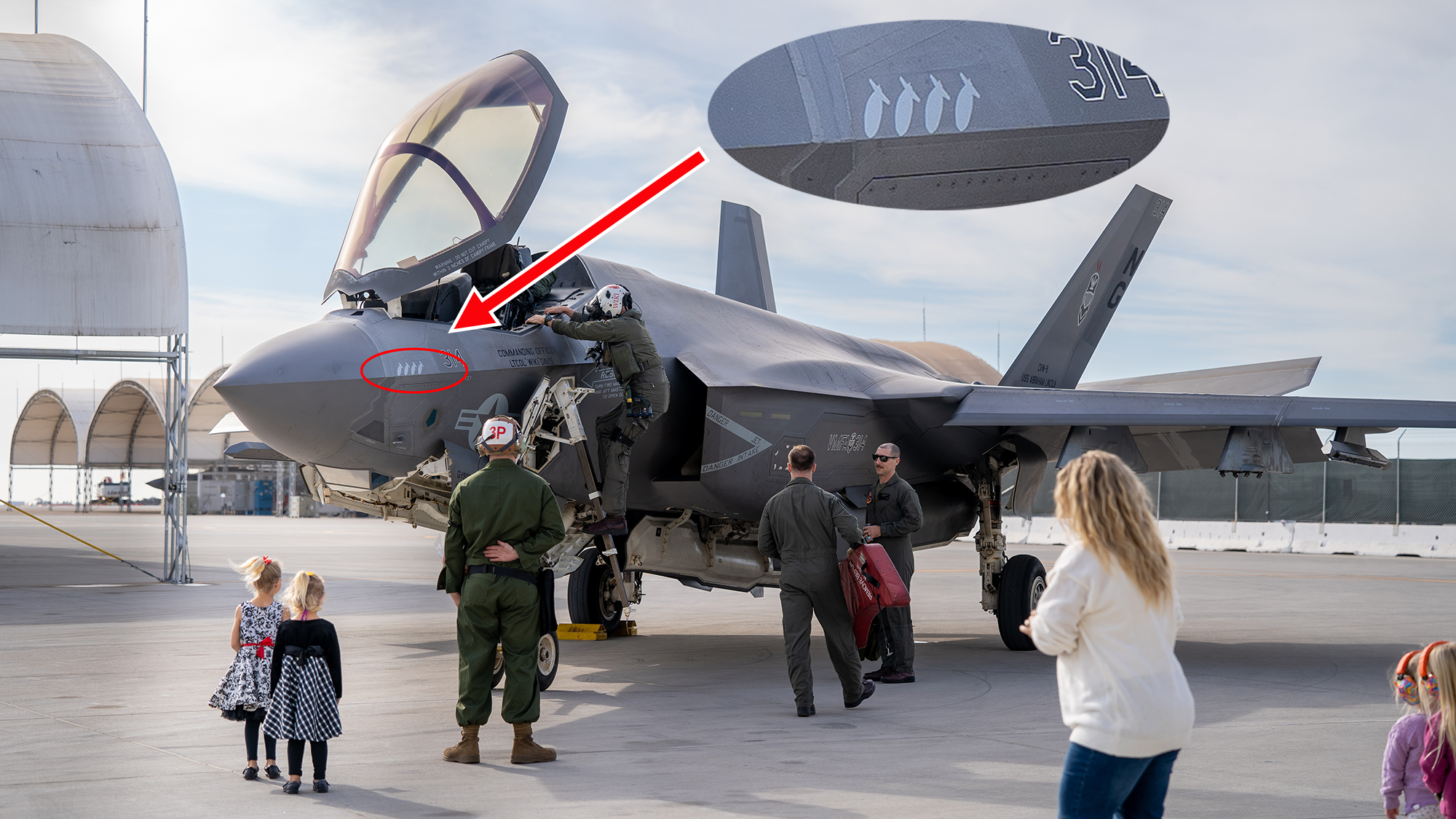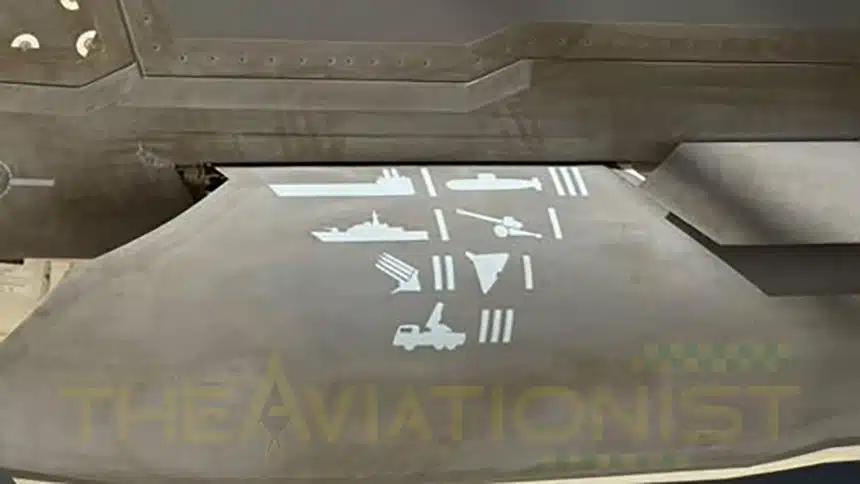
An exclusive image obtained by The Aviationist reveals an extraordinary array of target markings on a VMFA-314 F-35C, apparently representing an oil tanker, three submarines, a surface combatant, a Shahed-type drone, an artillery piece, and several ground-based launchers.
The return of U.S. combat squadrons from Operation Epic Fury is providing some interesting insights into the number and variety of weapons expended by the various aircraft, as well as the ground, air and naval targets struck during the operation against Iran.
A few days ago, we reported on the unusual submarine silhouette, filled in with the moniker “Sub Buster,” sported alongside numerous bomb markings by an F/A-18F Super Hornet of the U.S. Navy’s Strike Fighter Squadron 41 (VFA-41), the “Black Aces,” as it returned to NAS Lemoore on Oct. 1, 2026.
As explained, with the destruction of submarines operated by relatively few nations worldwide being rare even during open warfare, the marking adorning the nose of BuNo 168491 marked the first known instance of a Super Hornet carrying such a decoration.
However, the Navy’s Super Hornet was apparently not the only aircraft to score against an Iranian submarine. One of our readers sent us an interesting close up image showing an F-35C of the “Black Knights” of Marine Fighter Attack Squadron (VMFA) 314 with some pretty gnarly battle markings.
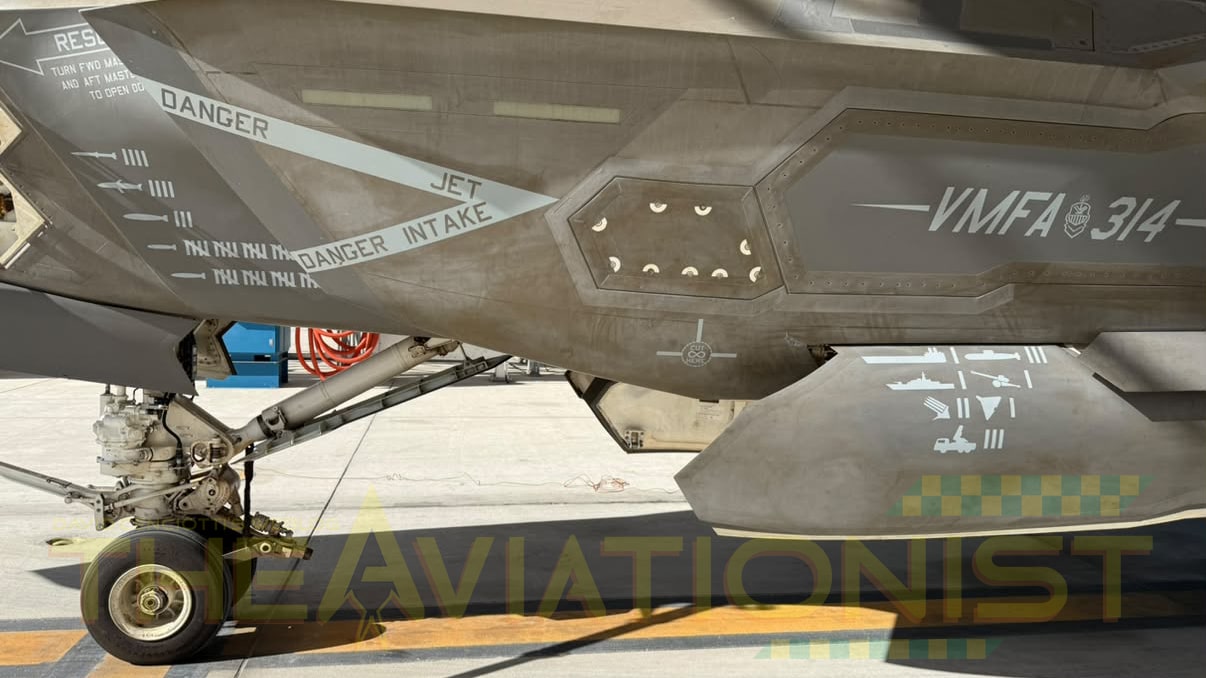
The close-up image shows an unusually detailed set of mission markings on the VMFA-314 F-35C. Along the left side of the forward fuselage, below the cockpit, just ahead of the air intake, a series of weapon silhouettes appears to represent, from top to bottom, the AIM-120 AMRAAM, AGM-154 JSOW, GBU-31 JDAM, GBU-54 Laser JDAM and GBU-32 JDAM, each accompanied by tally marks indicating multiple weapons expended.
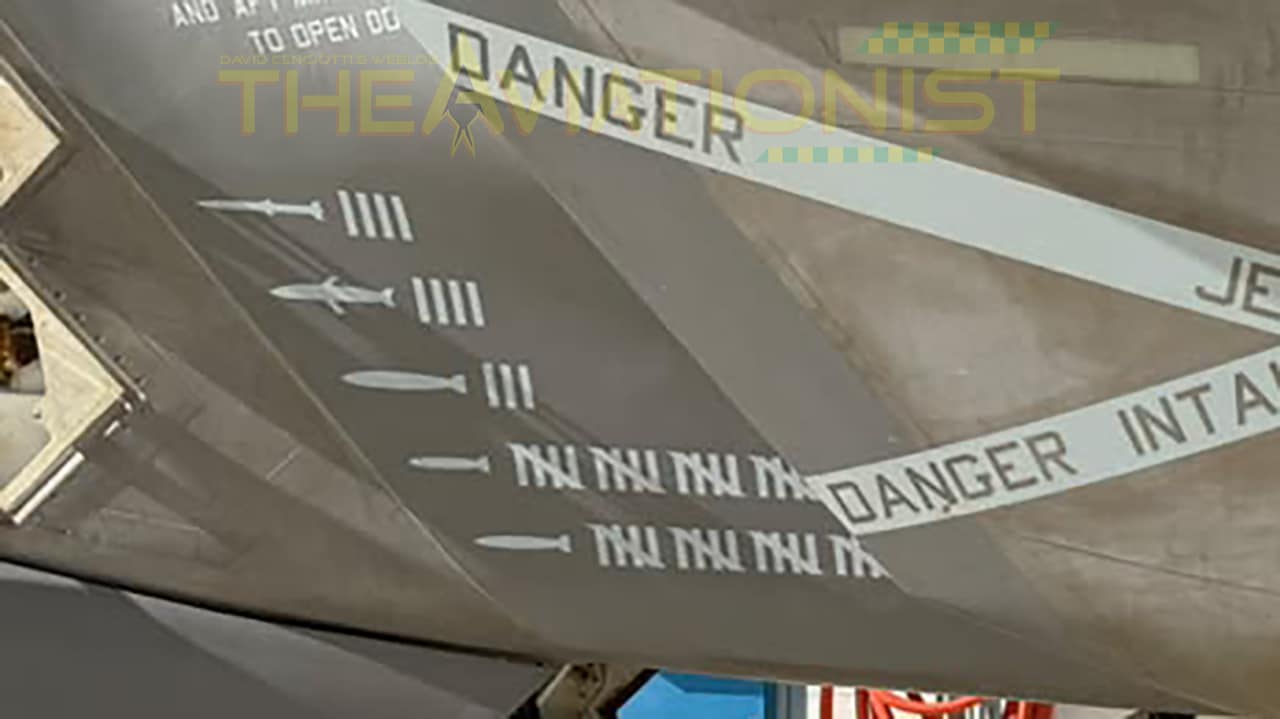
Even more interesting are the target markings applied to the weapon bay door. These appear to depict a remarkably diverse set of targets: an oil tanker, three submarines, a surface combatant resembling a corvette or frigate, a delta-wing one-way attack drone resembling the Shahed-136, and what appears to be a howitzer or other artillery piece. Two additional symbols are more difficult to identify with certainty, but may represent a truck-mounted air-defense system and a static missile launcher or similar ground-based target.
Noteworthy, the VMFA-314 shot down a Shahed-139 drone flying towards the USS Abraham Lincoln as it was sailing in the Arabian Sea on Feb. 3, 2026: therefore, the kill marking may represent that unmanned aircraft, although the shape of the drone does not match the type involved in the engagement.
Anyway, taken together, the markings suggest that the aircraft was involved in strikes as well as engagements against a broad mix of naval, air and ground targets during Operation Epic Fury.
1/ Some of the air-to-surface weapons employed by Carrier Air Wing (CVW) 9 multirole fighters during Operation Epic Fury:
GBU-38(V)2/B series JDAM (top left)
GBU-54(V)2/B series LJDAM (top right)
GBU-32(V)2/B series JDAM (top right)
GBU-31(V)4/B series JDAM (bottom left)
AGM-84K-1 SLAM-ER ATA (top right)
AGM-154C JSOW (bottom right)
AGM-154C-1 JSOW (see 2/)
— Guy Plopsky (@GuyPlopsky) March 8, 2026
The three submarine silhouettes are particularly noteworthy. Iran lost a significant portion of its submarine force during Operation Epic Fury, making it impossible to determine with certainty which boats the markings refer to. The symbols themselves are highly stylized and may simply be generic representations rather than accurate depictions of a specific class. If they are intended to reflect the actual targets, however, at least one could represent one of Iran’s Russian-built Kilo class submarines. Of the three Kilos in Iranian service, the Taregh was specifically confirmed by the U.S. as destroyed while in port. The other two were believed to have been inoperable for some time, although destroying them on the ground, or in this case alongside, would still count as a strike on a submarine.
The U.S. also confirmed the destruction of the Fateh, the lead vessel of Iran’s indigenous class of small coastal submarines, while multiple Ghadir class boats were also destroyed during the operation. At least one Ghadir was reportedly struck with an AGM-114 Hellfire, which would appear to rule out the F-35C in that particular engagement (just like it ruled out the Super Hornet). With three submarine markings displayed on the VMFA-314 jet, however, there are clearly several possible candidates, and there is currently no way to associate the individual silhouettes with specific boats.
It is also unclear which weapon, or weapons, the F-35C may have employed against the submarines. As commented reporting the Super Hornet’s marking, submarines are particularly vulnerable when surfaced or in port, as even relatively limited damage to the pressure hull, propulsion system or other critical components can render a boat unusable for an extended period, if not permanently. This is especially relevant in a campaign such as Epic Fury, where repair facilities and supporting infrastructure could themselves be subjected to follow-on strikes.
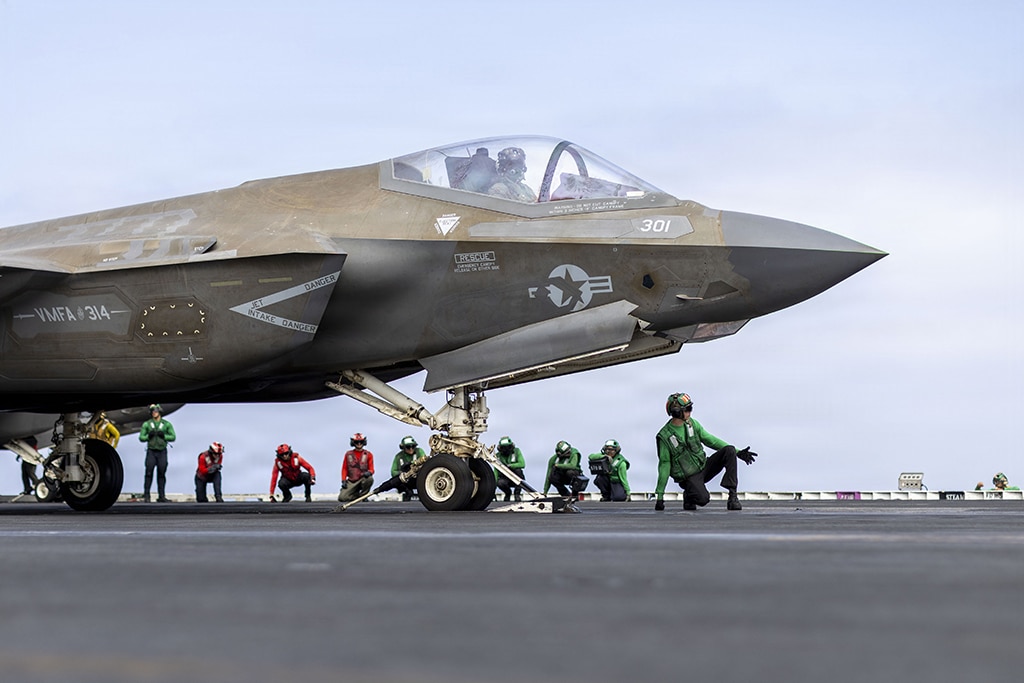
The fact that a Marine F-35C carries no fewer than three submarine markings is arguably even more remarkable than the single “Sub Buster” marking recently seen on VFA-41’s F/A-18F. Engaging submarines is an extremely unusual achievement for a tactical fighter, and, if the symbols indeed represent confirmed kills, they would document a particularly unusual chapter in the combat history of both VMFA-314 and the F-35C.
Notably, when the “Black Knights” of VMFA-314 returned to Marine Corps Air Station Miramar on Dec. 14, 2024, following their deployment aboard the Nimitz-class aircraft carrier USS Abraham Lincoln (CVN 72) with Carrier Strike Group (CSG) 3, the squadron’s F-35Cs sported bomb markings that appeared to indicate the first combat use of AGM-154 JSOWs against Houthi targets in Yemen. The silhouettes were applied in a different location, however: on the nose section, ahead of the aircraft’s MODEX (the short tactical identification number painted on a U.S. Navy or Marine Corps carrier aircraft).