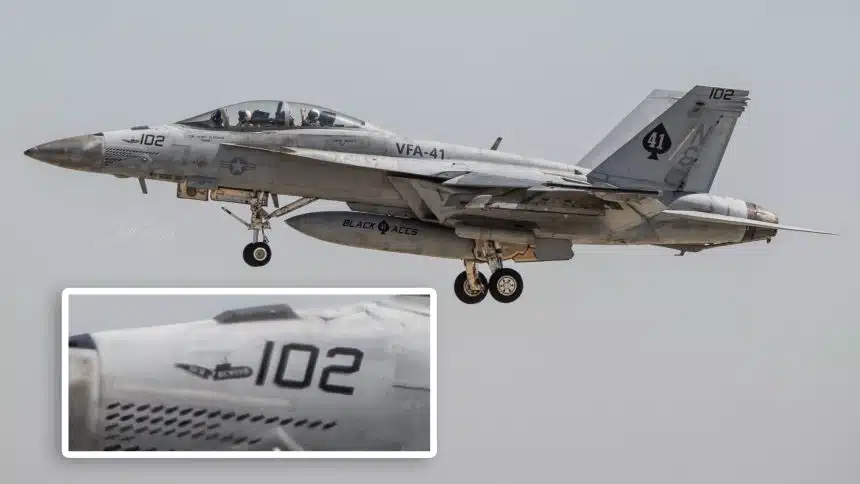
As VFA-41 returned to NAS Lemoore on Oct. 1, one of their jets carried a unique decoration indicating its involvement in the destruction of an unidentified Iranian submarine during the squadron’s tour on USS Abraham Lincoln (CVN 72).
A silhouette of a submarine, filled in with the moniker ‘Sub Buster’, adorned the nose of F/A-18F Super Hornet 168491 as it was photographed landing at Naval Air Station Lemoore, California. With the destruction of submarines, operated by relatively few nations globally, being rare even during open warfare, this is undoubtedly the first time a Super Hornet has carried such a decoration.
View this post on Instagram
Iran lost a large number of its submarine force during Operation Epic Fury, so it is not possible to definitively confirm which vessel the Super Hornet was involved in destroying. However, if the marking is designed to be representative, it most resembles a Kilo class submarine. Of Iran’s three Russian-built Kilo class submarines, one, the Taregh, was specifically confirmed by the U.S. as destroyed while in port. The remaining two are thought to have long been inoperable though, if also targeted, would count as a kill all the same.
Kilo class submarine “IRIS Taregh” launching the new Homa class recon UAV. Hopefully we see a UAV able to fit in the torpedo tubes pic.twitter.com/yPLVH1Z3EH
— Iran Defense commentary (unofficial) (@IranDefense) July 15, 2022
The U.S. also confirmed the sinking of the Fateh, the lead vessel of an indigenous class of small, coastal submarines, though – again, if the marking is representative – this submarine type does not resemble the one depicted. Multiple Ghadir class submarines, even smaller than the Fateh, are known to have been destroyed, with at least one targeted using a AGM-114 Hellfire missile (ruling out a Super Hornet).
🇺🇸 MQ-9 strike on an Iranian submarine with Hellfire. https://t.co/TSlXzzN0Ua pic.twitter.com/5oyLcoMO2l
— Colby Badhwar (@ColbyBadhwar) March 10, 2026
ATACMS ballistic missiles and uncrewed surface vessels (USVs) are also known to have been employed to target submarines alongside in port.
WATCH: CENTCOM deployed uncrewed surface vessels to strike an Iranian submarine and naval maintenance facility. pic.twitter.com/eWFHLPvArX
— Open Source Intel (@Osint613) July 13, 2026
The Kilo class subs are, by a large margin, Iran’s most theoretically capable submarines. If operated to their fullest potential, the three submarines would have the potential to be among the deadliest military assets in the region, able to target surface vessels as well as lay mines, launch guided munitions and even drones with little warning before slipping away beneath the waves, hidden amongst the sounds of the busy shipping lanes. On the other hand, the Persian Gulf’s limited depth and high salinity make submarine operations – even for experienced crews – difficult, presenting a high risk of accidental grounding and difficulty maintaining sonar contacts. Nonetheless, two or three Kilo class submarines, employed well, could have presented a major hazard in and around the Strait of Hormuz running barrier patrols.
However, since delivery in the 1990s, Iran has consistently failed to maintain its Kilo submarine force to a standard where they present any form of sustained threat. Aims to keep at least two submarines in active service at one time were rarely achieved.
Video of Iranian Kilo class submarine Tareq launching Miaad torpedo, Fateh and Ghadir class submarine launching Valfajr-2 torpedo, and SH-3D helicopter launching Mk-46 torpedo during Iranian Army Zolfaghar-1401 exercise today. pic.twitter.com/zQvBr7AY2j
— Mehdi H. (@mhmiranusa) January 1, 2023
It is unknown what type of weapon was deployed by the jet to target the submarine. Submarines are extremely vulnerable when not underwater, and any breach of the pressure hull could render the boat unusable either permanently or for a significant period of time. The latter is of particular note here, since any effort to repair the submarine could be delayed by further strikes.
Given how unusual engaging a submarine is for a Super Hornet, the kill marking (or a version of it) is sure to live on the side of 168491 as a permanent feature in a similar fashion to F-15E Strike Eagle 89-0487’s green star commemorating the destruction of an Iraqi helicopter with a laser guided bomb.
Many thanks to Jeff Rojas for capturing this aircraft and sharing his images with us. You can find him on Instagram at @jro_photography.