The W93 warhead and Mk7 reentry body assembly are part of the Trident II D5 Life Extension (D5LE2) which will modernize the sea-based leg of the nuclear triad.
The U.S. Navy’s W93 warhead and Mk7 reentry body assembly, which will equip the Trident II Submarine Launched Ballistic Missile (SLBM) as part of the D5 Life Extension 2 (D5LE2) program, have entered the Engineering and Manufacturing Development (EMD) stage, the Portfolio Acquisition Executive (PAE) Strategic Systems Programs (SSP) announced on Sept. 24, 2026.
The program reached Milestone B earlier this year, and the EMD phase will now “focus on completing production design and proving that the design is producible to meet the needs of the Navy,” the PAE SSP said. The W93 warhead and the Mk7 reentry body assembly are the first U.S. nuclear warhead and reentry system in nearly four decades, says the service, providing a modern warhead to the Navy’s submarine-launched ballistic missiles and strengthening the sea-based leg of the nuclear triad.
The announcement also comes after Sandia National Laboratories (SNL) – the design agency for the W93’s nonnuclear components and the lead warhead systems integrator for nuclear weapons programs – announced on Aug. 31 the launch of the Atrax sounding rocket to collect critical physical performance data and match its simulated models for the W93’s development.
SNL subsequently revealed that the W93’s first flight test is scheduled approximately two years after the Atrax test. The W93/Mk7 program is an interagency Nuclear Weapons Life Cycle effort between the PAE SSP and the Department of Energy’s National Nuclear Security Administration (NNSA).
The US announce the progression of the new W93/Mk7 nuclear warhead for TRIDENT D5LE2 into its Engineering and Manufacturing Development (EMD) phase. This directly touches the UK as well: the W93 is effectively the US counterpart and “sister” to the UK’s ASTRAEA A21/MK7, with some… pic.twitter.com/EqbzfmpwOV
— Gabriele Molinelli (@Gabriel64869839) September 24, 2026
Trident D5 Life Extension 2
The D5LE2 is being developed for the U.S. Navy’s upcoming Columbia-class nuclear-powered ballistic missile submarines (SSBN), meant to replace the 14 older USS Ohio-class boats. The first eight Columbia-class SSBNs will enter service with the D5LE system, while D5LE2 will be introduced on the ninth SSBN and retrofitted to the earlier ones.
During its service aboard Ohio-class submarines, the Trident II D5 also underwent its first life extension program, the D5LE, that upgraded critical electronics and guidance components, which will allow it to remain operational through the 2040s.
Lockheed Martin Awarded $850 Million Contract for Trident II D5LE2 Program
Lockheed Martin has received an $850 million contract modification from the U.S. Navy to continue the design and development of the Trident II D5 Life Extension 2 (D5LE2) program, a key component of the… pic.twitter.com/cq3Dt6Wr25
— Global Defense Insight (@Defense_Talks) July 14, 2026
Navy officials later deemed additional upgrades would be insufficient for long-term aging of critical components and the modern demands of the Columbia fleet, prompting the D5LE2 effort. D5LE2 effort ensures the Trident remains credible through 2084.
The Trident II D5 also arms the four boats of the Royal Navy’s Vanguard-class ballistic missile nuclear submarines (SSBN). A January 2025 Lockheed Martin release about a $383 million contract modification for the D5LE2 confirmed that the UK will participate in the effort under the Polaris Sales Agreement.
Effective interagency coordination
PAE SSP director Vice Adm. Douglas Williams emphasized the “flexibility and adaptability” that the W93/Mk7 provides to “ensure an uninterrupted at sea deterrent for the sea-based leg of the nuclear triad.”
“We were able to accelerate our entry into this next phase because of the dedicated partnership between PAE SSP, National Nuclear Security Administration, and our industry base,” Williams said in the Navy release. “This is what working at hyper-speed looks like.”
The collaboration between PAE SSP, NNSA and SNL under the interagency Nuclear Weapons Life Cycle supported the design and development of the W93 warhead and Mk7 reentry system. NNSA administrator Brandon Williams said in the release: “Credible deterrence demands that we move with urgency, and the progress we’re making on W93/Mk7 demonstrates exactly that.”
Happy 8-26‼️
The largest submarine ever built by the US, Columbia-class ballistic missile submarine USS District of Columbia (SSBN 826), will be launched next year. pic.twitter.com/b3FnamR0jy
— 🇺🇸𝗢𝗹𝗱 𝗦𝘂𝗯𝗺𝗮𝗿𝗶𝗻𝗲𝗿⚓️ (@USN_Submariner) August 26, 2026
“We are revitalizing and modernizing the Nuclear Security Enterprise to design, develop, and produce this critical new weapon with the precision our Warfighters demand,” added Williams. “We will continue working together to deliver this capability to the fleet and ensure our sea-based strategic deterrent remains ready for the future.”
As mentioned earlier, while the PAE SSP will sustain the existing Trident II D5 on the Ohio-class boats, and integrate the Trident II D5 Life Extension 2 (D5LE2) on the new Columbia-class SSBNs, it is also “pioneering regional strike capabilities of the future.”
This includes the development of the Nuclear-Armed Sea-Launched Cruise Missile (SLCM-N) and the non-nuclear hypersonic Conventional Prompt Strike (CPS) system. The CPS shares the same Common-Hypersonic Glide Body (C-HGB) with the U.S. Army’s Long-Range Hypersonic Weapon (LRHW) “Dark Eagle.”
Sounding rocket tests provide W93 development data
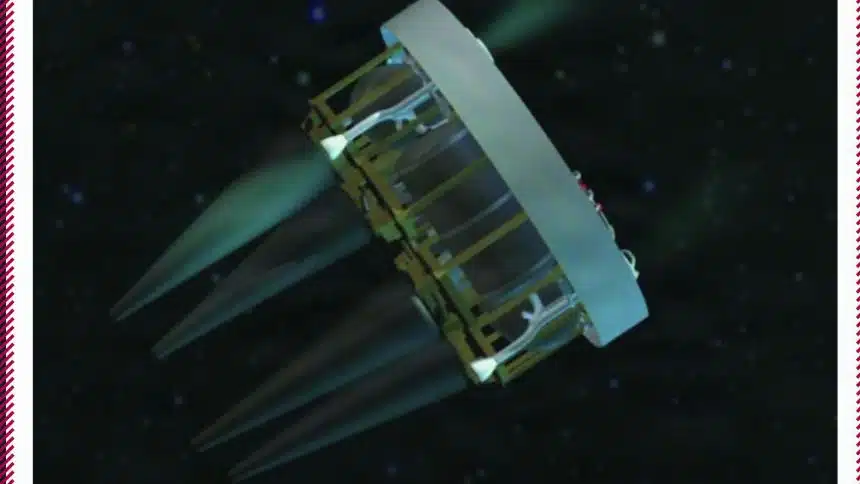
Ross Wagnild, an aerospace engineer at Sandia National Laboratories (SNL), said the Atrax sounding rocket test helped them improve the credibility of their modeling and simulation tools in preparation for the W93 warhead’s development. SNL is also developing the Mk7 reentry vehicle, meant to “safeguard and carry” the W93 warhead and the Multiple Independent Reentry Vehicles (MIRV) – as shown in the official concept illustration by PAE SSP – to the target.
Sounding rockets are suborbital experimental vehicles carrying instruments “to collect [general] environmental data in flight without the scope of a full program test,” otherwise difficult to be replicated on the ground.
The Atrax test is not intended to assess “the precision or accuracy of the reentry vehicle.” The Atrax specifically measured the interplay of “aerodynamic forces and structural response” during reentry conditions.
A sounding rocket flight test is giving Sandia engineers real-world reentry vibration data to improve modeling and inform nonnuclear component designs for nuclear weapons.
🚀 https://t.co/ib5WqE7R6x pic.twitter.com/dBj06oLkhg
— Sandia National Labs (@SandiaLabs) September 21, 2026
The trial provided data that can be compared with the models developed through NNSA’s Advanced Simulation and Computing program and make them more accurate. The measurements of the actual vibration, aerodynamic load and impact on internal physical components helped “better evaluate the survivability of nonnuclear components of our weapon systems,” Wagnild added.
The data generated by the Atrax test also supports future weapons programs as it aids correct engineering and component design decisions, reducing costs and cutting development timelines, according to Kelsey Forsberg, who works in nuclear deterrence at Sandia. Forsberg said NNSA investments in programs like High Operational Tempo Shot and the Enzo demonstrator helped pave the way for the Atrax test and “reduced risk to the W93 program.”
The “cutting edge sensors” on the reentry vehicle collected data to test the accuracy of their simulation codes on “thermal, fluid and structural models to better understand where improvements might be needed.” The test vehicle itself had a new reentry vehicle, a three-stage sounding rocket and a new separation system.
In addition to the W93, Wagnild said the Atrax test will provide the broader hypersonic community with data that could improve hypersonics modeling and build confidence in modern sensor suites for other hypersonic vehicles.