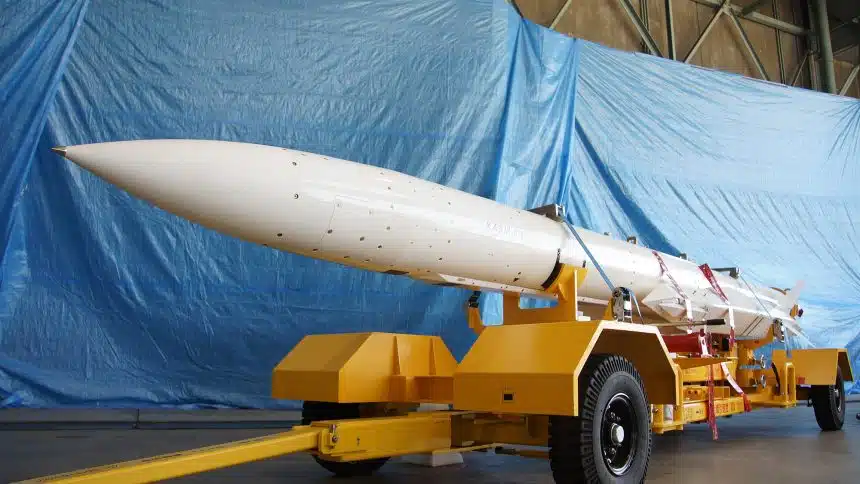
A new budget document released by the Japanese Ministry of Defense includes a reference to the ASM-3 as both an anti-ship and an anti-air missile, hinting at an additional role for the newly developed supersonic munition.
The ASM-3 is Japan’s latest indigenous anti-ship missile, designed to replace the ASM-1 and ASM-2 missiles carried most notably by the Mitsubishi F-2. Development took place during the 2010s, culminating in flight testing in 2017. At this stage, further testing was postponed in order to allow for an upgrade (ASM-3A) to increase the missile’s range to the 400 kilometre mark. ASM-3A officially began to be fielded in 2025, while a further upgrade pushing the range out to 600 kilometres is in development as the ASM-3 Kai (coming from 改, meaning ‘modified’ or ‘revised’).
An air to air variant has not previously been discussed before the release of this document, though it can be assumed to have now been on the cards for some time. Presumably, this missile would fulfil the long-range air to air missile role for the Japan Air Self-Defense Force (JASDF).
Japan has planned to develop a new air-to-air missile based on the ASM-3 supersonic anti-ship missile.
CC @CombatAir @Aviation_Intel @cencio4 @TheAviationist
— Ryan Chan 陳家翹 (@ryankakiuchan) August 31, 2026
Japan, at present, employs the AIM-120 AMRAAM and the home-grown AAM-4 as beyond visual range air to air munitions, but even the latest AMRAAM developments fail to break past the 200 kilometre mark that could be achieved by even the original ASM-3 design.
今日の岐阜基地は1stでF-15がAAM-4Bを4発搭載してミッションを実施。
2ndでは外されました…
2025.7.7 RJNG pic.twitter.com/YQgwFL6l3Y
— TAKA (@alice_herb) July 7, 2025
This development would echo the rapid push towards longer range air to air missile seen across the Pacific in the United States, where the AIM-174B has been created from the ship-launched SM-6 (which has a range in excess of 370 kilometres) while the AIM-260 Joint Advanced Tactical Missile (JATM) and the newly revealed AIM-424 Malice wait in the wings.
An AIM-424 Long Range Air-to-Air Missile (LRAAM) is mounted in the internal weapons bay of an F-35C with an AIM-120 Advanced Medium Range Air-to-Air Missile (AMRAAM) mounted on the weapon bay door. (via Dvids) pic.twitter.com/xJLA4IN5Bc
— Air-Power | NatSec Ledger (@NatSecLedger) August 23, 2026
These missiles are expected to have the biggest impact in the Pacific theatre, countering China’s growing arsenal of long range air to air weapons.
As noted in our article on the AIM-424:
Although the capabilities of the large missiles aren’t clear when it comes to engaging hostile fighters over long distances, they will certainly be effective in targeting high-value targets including the likes of AEW&C (Airborne Early Warning and Control), EW (Electronic Warfare), and ISR (Intelligence, Surveillance, and Reconnaissance) aircraft in the early phases of a potential conflict.
The ASM-3’s guidance module already features an Active Electronically Scanned Array (AESA) radar derived from the one used in the AAM-4B, so it is possible very little to no modification might be necessary to use the missile for airborne targets. However, it is likely that any missiles designated for anti-aircraft use would be fielded with an alternative warhead to the armor piercing tandem charge, perhaps instead incorporating a proximity-detonated fragmentation round which would allow the weapon to be effective even without directly hitting an aircraft.
Meteor
Integrating the AAM-4B’s AESA radar onto the European MBDA Meteor was previously investigated by a joint UK-Japan program known as Joint New Air to Air Missile (JNAAM). Work on this soon went quiet, and it is unclear how far down the road the project got or whether it is still possibly held on the back burner.
Like the ASM-3, Meteor attains its extended range by using a highly efficient ramjet engine. Meteor’s current (publicly known) upper limit for range is around 200 kilometres, and a previously planned mid-life upgrade for the missile has been scrapped in favor of newer designs. If an AESA equipped Meteor did ever come to fruition, which seems increasingly unlikely as time marches on, it would more likely take the place of Japan’s AIM-120s rather than this new ASM-3 based design.
AARGM-ER
The Japanese budget documents also refer to the U.S.-made AGM-88 AARGM-ER (Advanced Antiradiation Guided Missile – Extended Range), the first time a possible procurement of this weapon has been disclosed for Japan.
Japan does not currently field a dedicated suppression of enemy air defences (SEAD) missile, so the introduction of AARGM-ER would also be an introduction of an entirely new category of weapon for the JASDF. Crucially, unlike earlier variants of the AGM-88, the AARGM-ER can be carried in the internal weapon bays of Japan’s fleet of F-35A Lightning IIs.
Except for F35B users, the rest of the #F35 community would have access to the AARGM-ER, and the USAF’s Stand In Attack Weapon. Initially, #SiAW will operationalize a modified #AARGMER on F-35A but may eventually produce a significantly different, or a completely new weapon. https://t.co/l04wVzeoZm pic.twitter.com/rGCQPSiLK4
— Air-Power | NatSec Ledger (@NatSecLedger) July 2, 2023
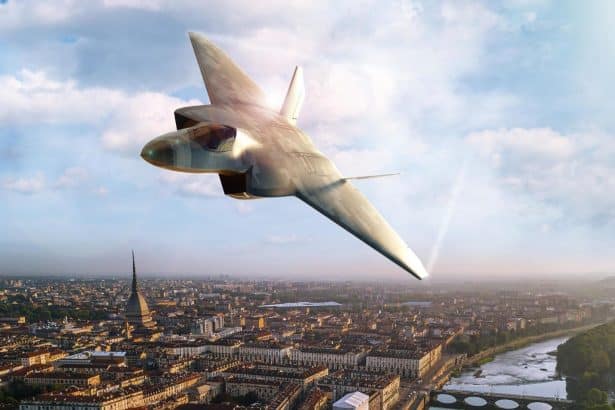
There is also the theoretical possibility that it would, in the future, be able to be integrated in the sixth generation fighter that is due to sprout from the Global Combat Air Programme (GCAP) joint venture with the UK and Italy.
As with the ASM-3 air to air variant, we await further comment and additional detail on this.
Many thanks to our friend Ryan Chan (@ryankakiuchan) for pointing us towards this story and many others. You can find his work on X/Twitter here.