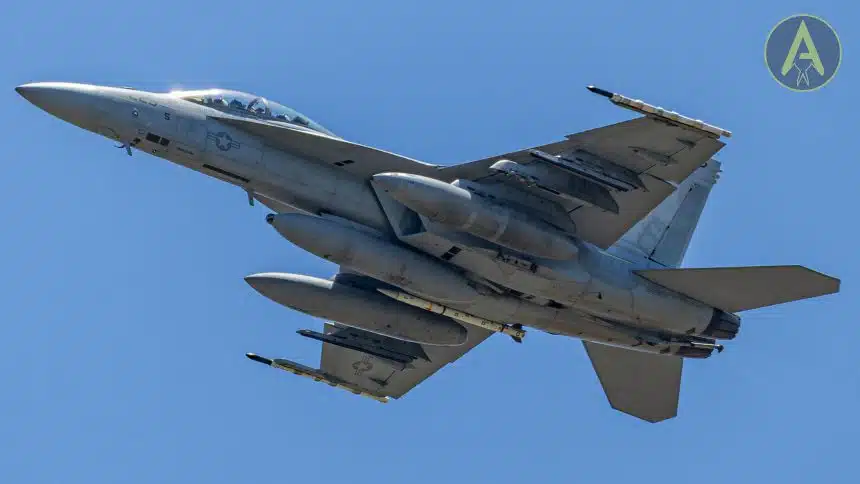
The new AIM-260 JATM was photographed during a test flight out of Eglin Air Force Base, offering the first public look at the highly secretive air-to-air missile.
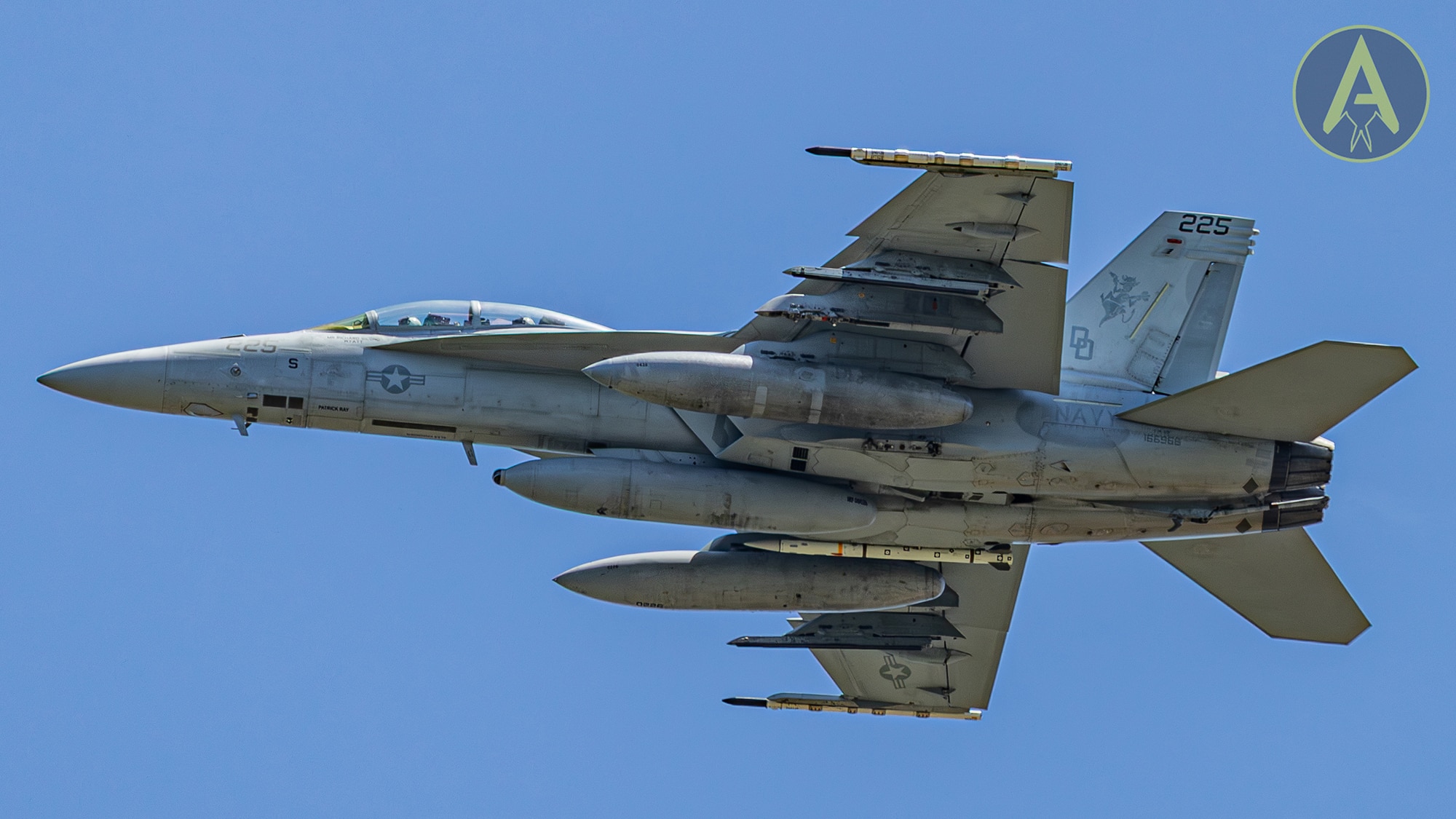
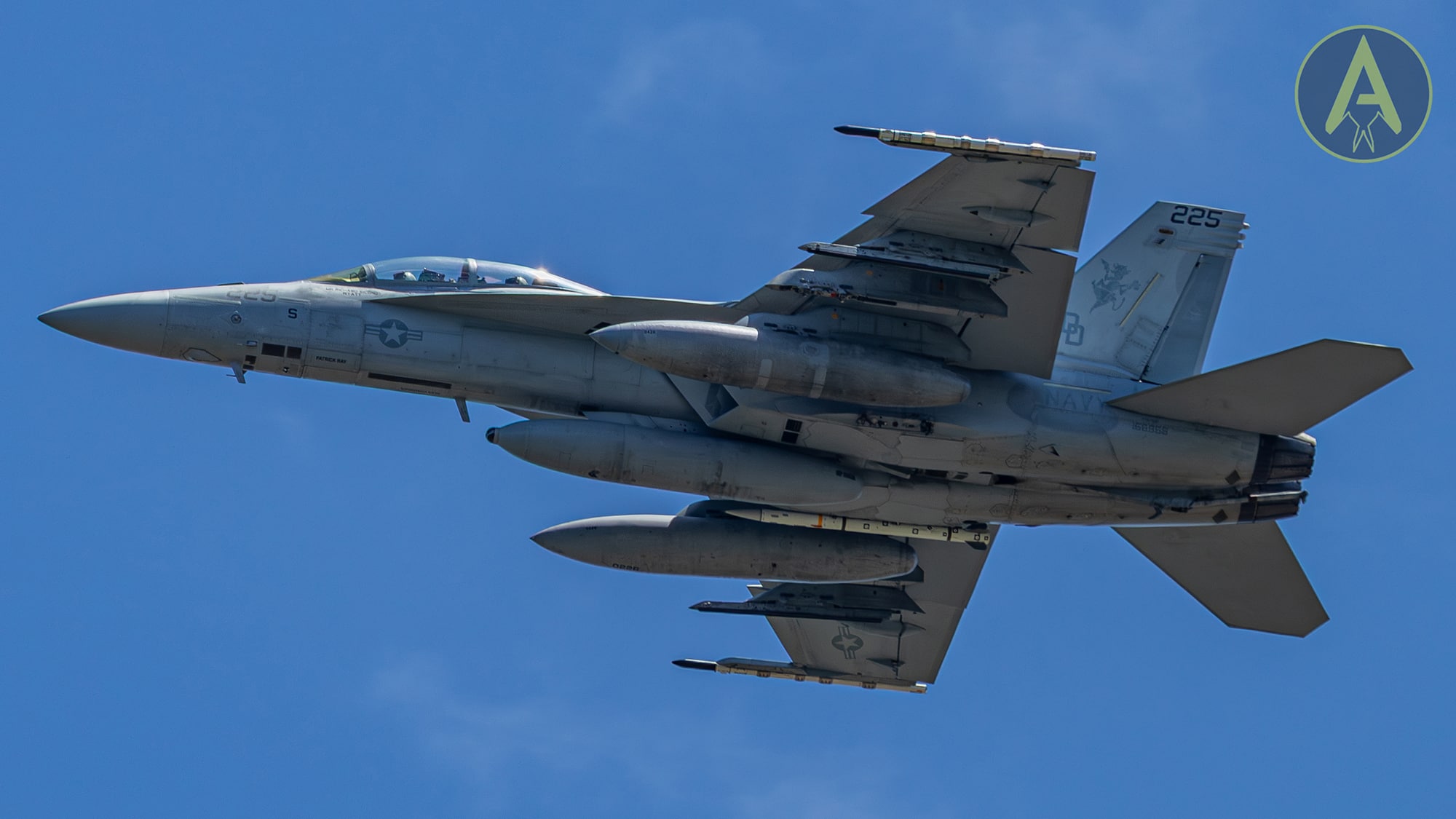
After years of waiting, it appears we have a first look at the secretive AIM-260A Joint Advanced Tactical Missile (JATM) which is being developed as a successor to the AIM-120 Advanced Medium-Range Air-to-Air Missile (AMRAAM). The weapon, notably a live example as denoted by the red and yellow bands, was loaded on one of the two fuselage hardpoints usually reserved to the AIM-120 or targeting pods, as photos taken by Jonathan Tweedy at Eglin Air Force Base on May 13, 2026 show.
The aircraft departed as part of a flight involving four other Navy test aircraft: one VX-9 E/A-18G Growler, one additional VX-31 F/A-18F, and a VX-9 F/A-18F. Their departure was at approximately 11:13 AM CST, and they returned to Eglin roughly an hour later after operating in the Gulf test airspace.
“I obviously cannot confirm the exact nature of the mission or whether the missile was fired, but based on the configuration, markings, and the live round indicators, I believe they may have at minimum been conducting separation-related testing,” Tweedy told us in an email. “Upon their return and based off of what was heard on their arrival communications the aircraft had offloaded the missile during the flight!”
Interestingly, the Tyndall based E-9A Widget (a surveillance platform whose role is to ensure the Gulf of Mexico waters are clear of civilian boaters and aircraft during live missile launches and other hazardous military activities) was also airborne over the Gulf at the time of their mission.
As we reported some weeks ago, the Northrop Grumman’s CRJ-700 test bed modified with a peculiar “pointy” nose bearing a striking resemblance to the AIM-260 had been spotted during testing at Eglin Air Force Base, Florida. For three consecutive days, on Mar. 24, 25 and 26, this aircraft, carrying the U.S. registration code N806X and typically operating using the radio callsign “SCAN 06”, and the Raytheon’s Boeing 727, with registration N289MT and radio callsign “VOODOO 1,” carried out concurrent missions over the Gulf of Mexico (Gulf of America).
SCAN 06 is one of the three heavily modified CRJ700s owned by Northrop Grumman, used to test sensors and communication systems before they are integrated into frontline combat aircraft, and was modified last year with the new missile nose. Because of this, the aircraft is believed to be involved in the development of the AIM-260.
The latest photos of the AIM-260 carried by the Super Hornet show the weapon as being very similar to the rendering released last year by the U.S. Navy. The U.S. Air Force later confirmed that the rendering reflected the weapon’s actual design and was not a placeholder.
The render was also almost identical in shape to an unknown missile depicted in a render from 2022 which showed three F-22A Raptors with new pods and fuel tanks, with one jet firing a new missile. According to the few known details, the AIM-260 should have a size and form factor comparable with the AIM-120, with the new photo apparently providing a confirmation of this aspect.
An aspect that immediately catches the eye is the lack of the mid-body control surfaces which are present on the AIM-120, which are typically used for enhanced aerodynamic stability and maneuverability. Four trapezoidal control surfaces can also be seen at the rear of the missile, which are quite similar to those of the AIM-120.
The markings appear to show a much larger rocket motor section compared to the AIM-120. That would be consistent with the much longer range expected from the AIM-260, with a minimum threshold range reportedly set at 100 miles (190 km), and a rumored new solid rocket motor to obtain the longer range.
Last month, the U.S. Air Force and Navy revealed plans to spend approximately $15.6 billion on development and production of the AIM-260 in the next few years. Last year, the two services publicly requested funding for the first time, and now are rising from the $894 million requested for 2026 to $2.9 billion for 2027.
AIM-260 JATM
The existence of the AIM-260 Joint Advanced Tactical Missile was first revealed in 2019 by the Air Force, who is jointly developing the missile with the Navy. However, it was also revealed that the program had been ongoing for more than two years in 2019, meaning the program might have started in 2017 or earlier.
The AIM-260 is intended to serve as the primary long-range air-to-air weapon of both the U.S. Air Force and U.S. Navy in the coming years, becoming the successor to the AIM-120 Advanced Medium-Range Air-to-Air Missile (AMRAAM). The latter will continue to be developed, complementing the AIM-260.
The new missile will be compatible with the AMRAAM (Advanced Medium Range Air-to-Air Missile) dimensions, but with greater range, and is planned to be carried in the F-22 weapons bay and on the F/A-18 at first, with the F-35 to follow. The AIM-260 is also expected to be integrated on the U.S. Air Force’s upcoming unmanned Collaborative Combat Aircraft (CCA).
The missile is being developed and produced by Lockheed Martin. When the weapon was first unveiled, reports mentioned that AIM-260 production would overtake AIM-120 production by 2026, however, with the program’s details being highly classified and the recent boosts in the AMRAAM’s production, it is unclear if this goal still stands.
Initially, it was said the AIM-260 was also meant to counter the threat posed by the Chinese PL-15 and PL-17 missiles. The military in fact said the goal was to avoid foreign threats being able to outrange the AIM-120.
The project is an advanced state, with official saying in 2019 that flight tests would start in 2021 and Initial Operational Capability was expected in 2022, although the current timeline is unknown. Documents later showed that flight testing of the AIM-260 began as early as 2020.
Special thanks to Jonathan Tweedy for sending us his shots and allowing us to share them with our readers. Make sure you follow him on Instagram here for more of his aviation photography.