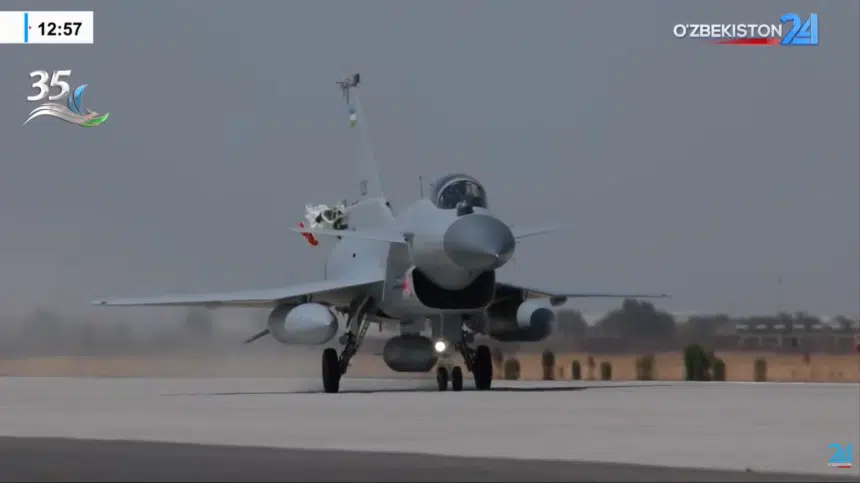
Weeks after the first photographs emerged, Uzbek J-10CE fighters have now been officially shown on national television.
Uzbekistan’s acquisition of the Chinese J-10CE fighter jets was finally confirmed on Aug. 28, 2026, when the aircraft appeared in a two-hour feature broadcast by state television channel O’zbekiston 24 Telekanali on the occasion of the 35th Independence Day celebrations. The appearance of the jets on TV comes days after unconfirmed photos showed the jets with faint tail flashes resembling the Central Asian country’s flag.
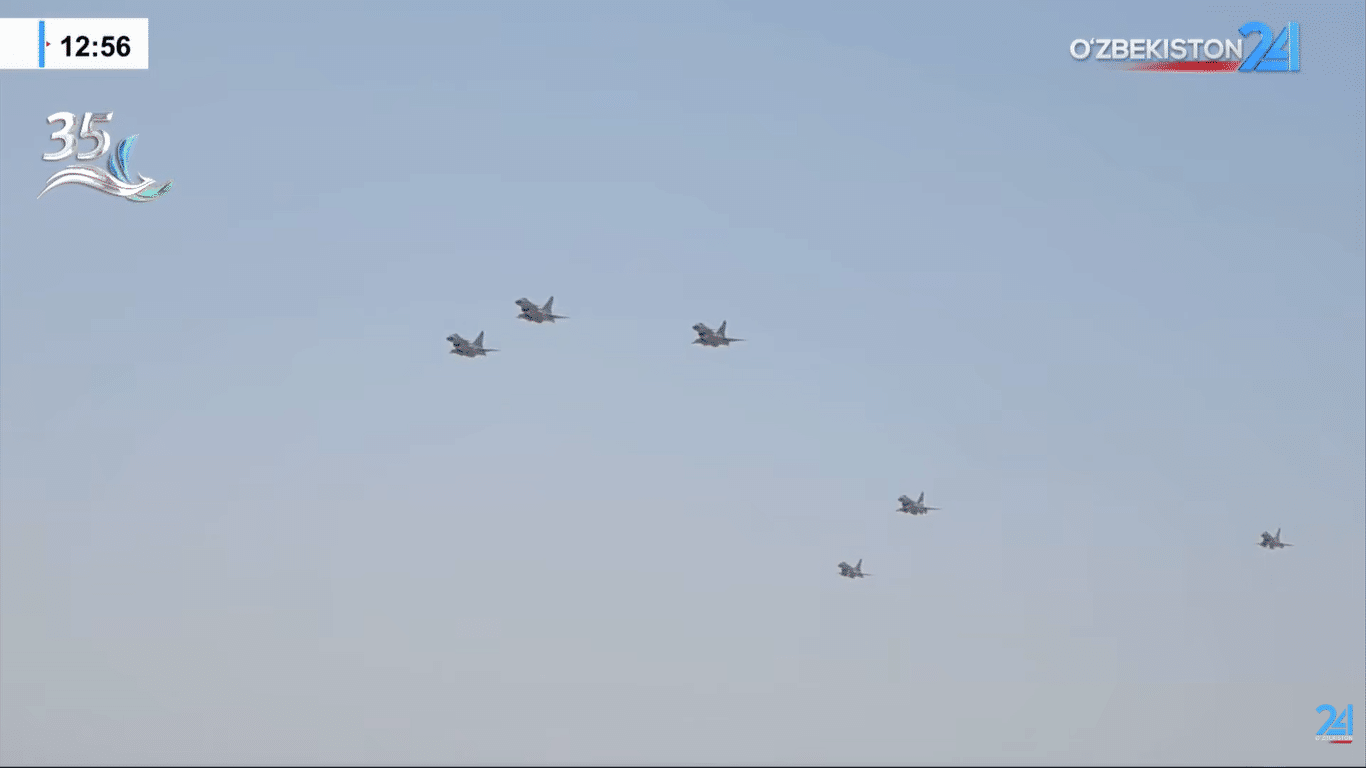
In the video, at least six fighters were shown landing at an air base in the country, greeted by a water cannon salute. One of the jets is seen landing with a brake chute, and with the national flag clearly visible on the tail.
An immediate feature that stands out is the absence of the J-10’s fixed In-Flight Refueling (IFR) probe, normally installed on the starboard (right-side) of the front fuselage, behind the nose.
The reason for the absence of the probe is not confirmed, however it must be noted that Uzbekistan doesn’t operate aerial refueling aircraft, nor has long-distance expeditionary military orientation. All the jets are also carrying three external fuel tanks – two underwing and one centerline – used for extended range operations.
The aircraft departed from Chengdu in central China for a 3,000 km journey to Uzbekistan, although it is unclear where the aircraft stopped for fuel. Chengdu is home to the Chengdu Aircraft Corporation (CAC), the J-10’s manufacturer.
🇺🇿J-10CE fighter jet of the Uzbekistan Air Force pic.twitter.com/9K2URDyWD1
— Uz_Air_Force (@Uz_Air_Force) August 29, 2026
Uzbek J-10CEs
The number of jets Tashkent has acquired and the finer diplomatic and military workings behind the deal remain unknown. It must be noted that photos of the jets with the tail flash hidden (either with low-visibility markings or reportedly masking tape) have been circulating since earlier this month.
In the intervening time, clearer photos emerged on Aug. 23 and 24, particularly showing tail number ‘1020’ meant for the UzAF but with the flag on the vertical stabilizer still masked. The images were reportedly captured at the Chengdu Aircraft Corporation (CAC) facilities.
The arrival of the J-10CEs in Uzbekistan thus could have been very recent, and just around the time they were featured on O’zbekiston 24. The water cannon salute suggests that the feature showed the landing at the end of the delivery flight.
Interesting claim; allegedly the original, clearer version of this picture was actually taken already last month.
I hope it is not again an AI modified version of it. https://t.co/2qxYnBJ5SU pic.twitter.com/qC3KasTWYH
— @Rupprecht_A (@RupprechtDeino) August 16, 2026
The J-10Cs join Uzbekistan’s fleet MiG-29s, Su-25 Frogfoots and Su-27s. This makes Uzbekistan the second international operator of the J-10CE after Pakistan, and its third overall user after the People’s Liberation Army Air Force (PLAAF).
The J-10C’s popularity grew following the May 2025 conflict between Pakistan and India. The Pakistani Air Force (PAF) has at least 20 J-10Cs in service with five more on order.
Another J-10CE with the serial 101x pic.twitter.com/jObQJ4xKty
— Dan The Man (@tong96083420) August 23, 2026
There is currently no information on the weapons package included in the deal between Uzbekistan and China. The deal is likely to include air-to-air missiles such as the PL-10 short-range air-to-air missile (AAM), the PL-12 medium-range AAM, and the PL-15 Beyond Visual-Range (BVR) AAM.
Other J-10C potential customers
Other Asian countries have already officially announced interest in the J-10C. Reuters quoted on Aug. 25 the Bangladesh Prime Minister’s Information and Broadcasting Adviser Zahed Ur Rahman saying his country was in the process of preparing a formal draft agreement for J-10CEs.
Bangladesh’s separate Letter of Intent (LoI) for Eurofighter Typhoons meanwhile has yet to be translated into a formal contract. The Bangladesh Air Force flies various variants of Chengdu F-7s (heavily upgraded Chinese derivative MiG-21 Fishbed) and MiG-29 Fulcrums.
Here in Uzbekistan, a video was shown on television about the arrival of the J-10. pic.twitter.com/Kq9vrPobNC
— Akela Freedom (@AkelaFreedom) August 28, 2026
The Indonesian Air Force (TNI Angkatan Udara – TNI AU), a Rafale, F-16, Su-27 and Su-30 operator, has budgeted $9 billion for the J-10C, but has not yet followed that up with a deal. The country previously denied claims that a contract was finalized.