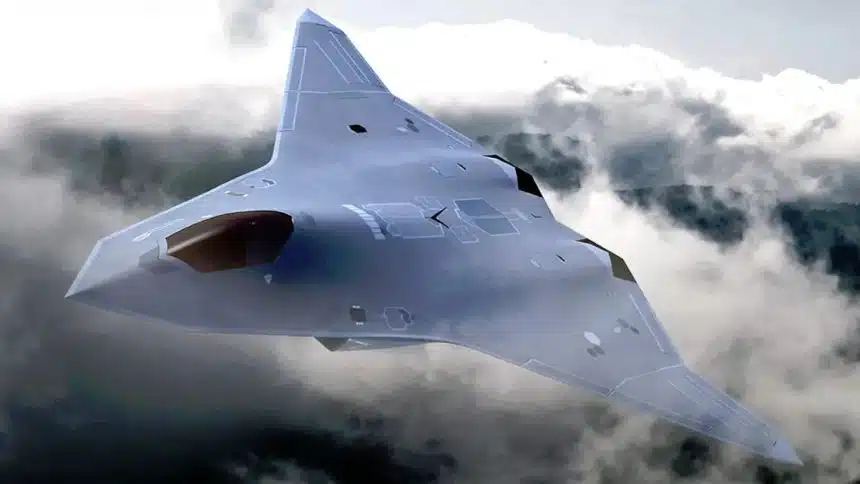
The South Korean Defense Acquisition Program Administration (DAPA) has sought detailed industry proposals for a sixth generation jet.
South Korea set the ball rolling for its future next-generation jet, with the Defense Acquisition Program Administration (DAPA) issuing a Request for Proposal (RFP) inviting companies to submit their conceptual designs, industrial and technological roadmaps. The RFP was issued on Aug. 21, 2026.
According to South Korean publication BizHancook, the Conceptual Study of the Korean Next-Generation Fighter seeks submissions in the next 14 months with a budget of 900 million Won ($650,000). It envisages both tailless and conventional designs for a single-seat fighter with Radar Absorbent Material (RAM) and low-observability in the L, S, and X bands, two adaptive cycle engines capable of supersonic cruising, and an internal weapons bay.
Interestingly, the Agency for Defense Development (ADD) also unveiled on Jul. 7, 2026 at the Aerospace Conference 2026 a conceptual design currently being researched. BizHancook however added that this design is currently a separate effort running in parallel.
[6th Generation Korean Fighter Jet] https://t.co/3tBSx2kfi9 pic.twitter.com/sIX5DfaXRm
— Forrestal’s 3D / Commission Always Ok (@3DCG_mylife) August 27, 2026
The ADD’s design was developed “during the research process on design methodologies aimed at rapidly realizing aircraft shapes and quickly analyzing flight performance and radar cross-section (RCS) compared to the past,” BizHancook added. It is possible elements of the study might still influence the features in the proposals the agency has sought, for which Korea Aerospace Industries (KAI) and Korean Air are likely to participate.
Concept
The concept rendition reported by the press is a creation by independent 3D artist Choi Dong-hyun. Choi also shared the rendition on his X profile ‘@3DCG_mylife/Forrestal’s 3D’ on Aug. 27 and, in a previous post, said the design was influenced by the references from the ADD.
It is thus important to note that this is not an official rendering.
The concept shows a single-seat, twin engine tailless fighter. The aircraft features a cranked delta wing with canard foreplanes which appears to be canted outwards.
The engines feature flat exhaust nozzles, although it is unclear if they feature thrust-vectoring.
FA-50, KF-21 and now this… South Korea’s defence ecosystem is clearly heading in the right direction. We’ve already seen two iterations of their 6th gen models, and they’re moving fast. #6thGen https://t.co/IiUNH7bUOd pic.twitter.com/xrd8ApfjPW
— Tatya Vinchu (@officialTatya_1) August 28, 2026
Future
The program is still in a very nascent stage, and a lot of questions remain regarding its place in South Korea’s other defense projects. South Korea is also developing advanced versions of the KF-21 Boramae, referred to as the KF-21 Block 3 or the KF-21EX.
It is unclear whether the future sixth generation fighter would affect the Boramae’s development and procurement. The KF-21 Block 3 is planned to have an internal weapons bay, low observability, ability to control Collaborative Combat Aircraft (CCA), advanced computing and sensor fusion technologies to bring it closer to a fifth generation classification.
https://t.co/64y23ni91G DAPA and ROKAF issued a tender on August 21 for a conceptual study on Korean Next-Generation Fighter. The study will proceed in parallel with Agency for Defense Development (ADD)’s Stealth Bridge Program, with a budget of KRW 900 million over a 14-month… pic.twitter.com/sE1Li0wo3y
— Sheldon (@sheldon3103) August 24, 2026
This new KF-21 version would also introduce an indigenous engine being developed under DAPA’s Advanced Aviation Engine Development Project. The KF-21 Block I currently flies with the General Electric F414, which Hanwha Aerospace manufactures locally under license.
The ongoing effort aims to develop a new engine, called the KTF16000, that produces 16,000 pounds of dry thrust and 24,000 pounds of thrust with afterburners. Following manufacturing, ground testing and certification, flight tests with the KF-21 Block III are planned to commence by 2040.
The RFP for the new fighter also includes adaptive cycle engines – powerplants that are able to adjust their air intake and bypass ratios mid-flight to switch between fuel efficiency and high-performance modes. It is not known at this stage whether the future sixth generation fighter will use KTF16000 engines or an adaptive cycle engine that South Korea would develop domestically.