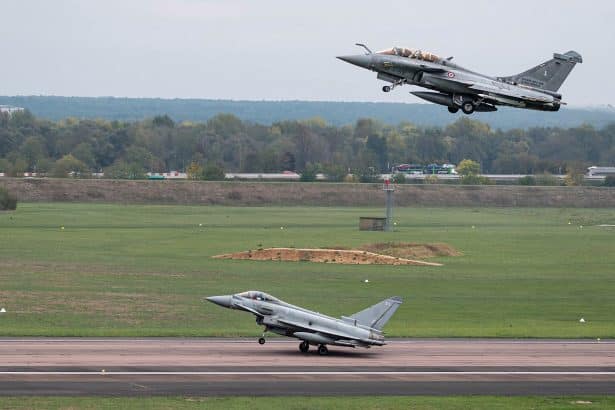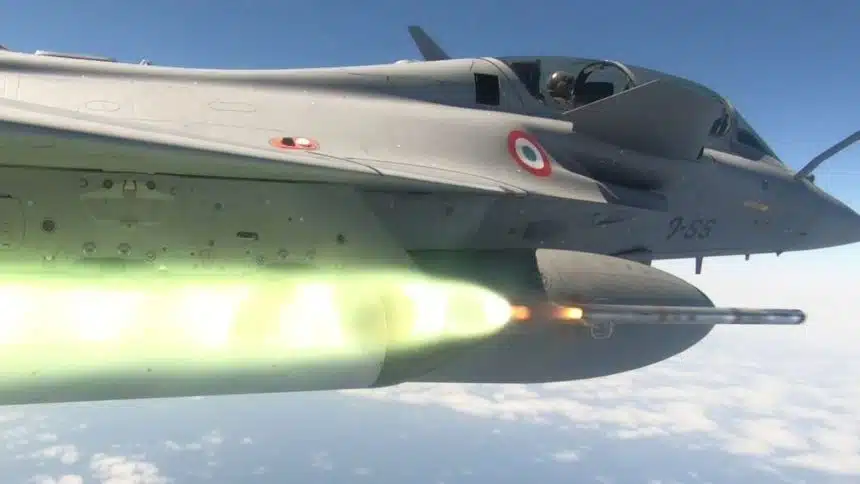
France has cleared the Rafale for the use of 68 mm laser guided rockets in the Counter-UAS role, following trials launched in February 2026.
France has approved the use of 68 mm laser-guided rockets and the TALIOS targeting pod on the Rafale against low-cost One-Way Attack (OWA) drones, following the conclusion of a lengthy testing campaign on Jul. 7, 2026. The milestone was mentioned in reports on Jul. 13 quoting the Directorate General of Armaments (Direction Générale de l’Armement – DGA).
The trials underway since February 2026 involved the DGA’s Flight Test Center in Cazaux, the French Air and Space Force’s (FASF) Military Air Expertise Center (CEAM), Dassault and Thales – the maker of the 12-round JF12 pod that fires the Aculeus LG laser-guided rocket. In April 2026, a French Navy (Marine Nationale) Rafale M was photographed with at least one JF12/TELSON 12 rocket pod, possibly at Istres-Le Tubé Air Base (Base Aérienne 125).
The testing followed reports from June 2025 quoting DGA officials, who stressed the need to start using rockets for the counter-UAS role to avoid “using their high-value assets.” DGA chief Patrick Pailloux, a year later, told the National Assembly about the ongoing tests of C-UAS rockets on the Rafales, aiming to field them operationally by this summer.
🚀 La roquette guidée laser sur #Rafale, c’est validé !
La DICOD confirme l’arrivée de la capacité LADAC (Lutte Anti-Drone sur Avion de Combat). En quelques mois, la DGA et le CEAM ont intégré la roquette de 68mm via la nacelle TALIOS.
🎯 La chasse aux drones Shahed est ouverte pic.twitter.com/oheVbHkVpb
— bruno aviation (@Bruno_Aviation) July 13, 2026
According to Mer et Marine, the system, called the Anti-Drone Warfare on Combat Aircraft (Lutte anti-drone sur avion de combat – LADAC) and developed for the Rafale, has reached an Initial Operational Capability (IOC). A larger order to Thales would follow soon, with deliveries beginning in July 2026 but details like the cost are not yet known.
Urgent requirement, rapid testing and fielding
To meet an urgent “operational emergency” and field an “effective and cost-effective anti-drone weapon as quickly as possible,” the DGA narrowed down its choice on Thales and the 68mm LGR in late 2025, since it was an available weapon that had already been integrated onto France’s Tiger attack helicopters. This was after the U.S. and Israeli experience fighting Iran, the Houthis, where the Americans had also quickly adopted APKWS II-armed F-15Es, F-16s and A-10s.
A few days before the Rafale M was spotted at Istres with the rocket pod, official videos showed FASF Rafales engaging OWA drones over Iraq with the MICA IR short-range air-to-air missile. The cost of the missile is in the $1-2 million range, while the Iranian drones are under $50,000.
Each Aculeus LG rocket costs between $25,000 and $40,000, roughly in the same range of Iranian Shahed-type OWAs. This would make the economics of the C-UAS mission more balanced.
FINALLY !
A French Rafale seen taking off from Istres air base with a rocket pod under its wing, most probably in order to test a low cost solution for drone hunting mission.
📸 via @Bruno_Aviation https://t.co/uYvZRFwwuS pic.twitter.com/U61V9d4gCD
— Etienne Marcuz (@Etienne_Marcuz) April 16, 2026
The tests of the DGA and FASF demonstrated the entire chain of engaging loitering munitions with larger fighters. The tests included drone detection by the radar Rafale’s RBE2 AESA radar, tracking and laser designation, the evaluation of the impact of the rocket pods on the airframe and flight characteristics, and finally firing the rockets in air-to-air mode. The report did not say how many flights and target drone engagements took place.
The trials took place at the DGA Missile Test site at Bicarosse and the DGA Aerospace Techniques in Balma, with EOS Technologies providing many of the target drones. At Balma, personnel assessed whether the pods function in an electromagnetic jamming heavy environment. DGA Land Techniques in Bourges and DGA Engineering and Projects in Paris validated the overall performance of the LADAC system.
Head of the DGA, Patrick Pailloux, told the National Assembly yesterday that integrating rockets onto the Rafale for the C-UAS role is now ongoing and will be ready for operational fielding “this summer”. @JanesINTEL story from myself and @JakOSpades to come… https://t.co/V4DTHM2jkd
— Gareth Jennings (@GarethJennings3) April 16, 2026
In October 2025, the FASF’s chief Gen. Jérôme Bellanger spoke in a parliamentary hearing about the need to approve either the Mirage 2000D RMV or the Rafale with rockets for the C-UAS role, Opex360 reported. “Regarding airborne anti-drone operations, it is not sustainable to use MICA air-to-air missiles costing over a million euros to shoot down a drone worth a few thousand dollars. […] There are off-the-shelf solutions, laser rockets that could very well be installed under Mirage 2000s or Rafales,” Bellanger said.
This was because, at the height of Operation Epic Fury against Iran, French Rafales operating from UAE’s Al Dhafra air base “dwindled” their stockpile of MICA missiles “too quickly,” La Tribune reported on Mar. 15, 2026, quoting unidentified French military and diplomatic officials.
French Dassault Rafale fighter jet intercepting an Iranian Shahed/Geran-type long-range strike drone with an air-to-air missile (presumably MICA-EM/IR) over Erbil Governorate in northern Iraq this afternoon. pic.twitter.com/lbM2xJ2TBb
— Status-6 (War & Military News) (@Archer83Able) April 14, 2026
Rafale coordinates with EW drone
Dassault Aviation also announced on Jul. 13, 2026 “the completion in flight of a simulated collaborative engagement between a Rafale F4 and a drone carrying a NAMIB payload.” NAMIB is a new electronic warfare product jointly developed by Dassault and Harmattan AI.
Leveraging the F4’s organic networking, data linking and sensor fusion capabilities “with a wide variety of actors, including ground forces,” the trial flight demonstrated NAMIB discreetly and accurately locating a radar tens of kilometers away. “This location was transmitted to the Rafale fighter jet, which then simulated a firing pass on the target,” the release said.
NAMIB, le nouveau produit de guerre électronique embarqué développé par Harmattan AI et Dassault Aviation, réalise un vol collaboratif avec un Rafalehttps://t.co/uDl4BRkmKR pic.twitter.com/YT6Q78A0Sr
— Dassault Aviation (@Dassault_OnAir) July 13, 2026
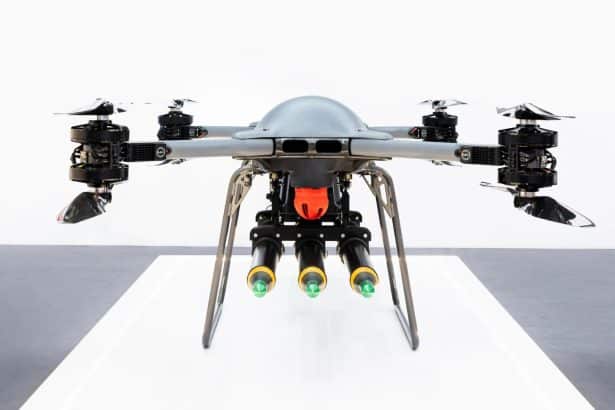
NAMIB is an electronic warfare payload capable of detecting, identifying, and locating electromagnetic emissions, particularly those from air defense systems. It can be deployed on tactical drones, such as quadcopters, or fixed-wing drones with longer endurance.