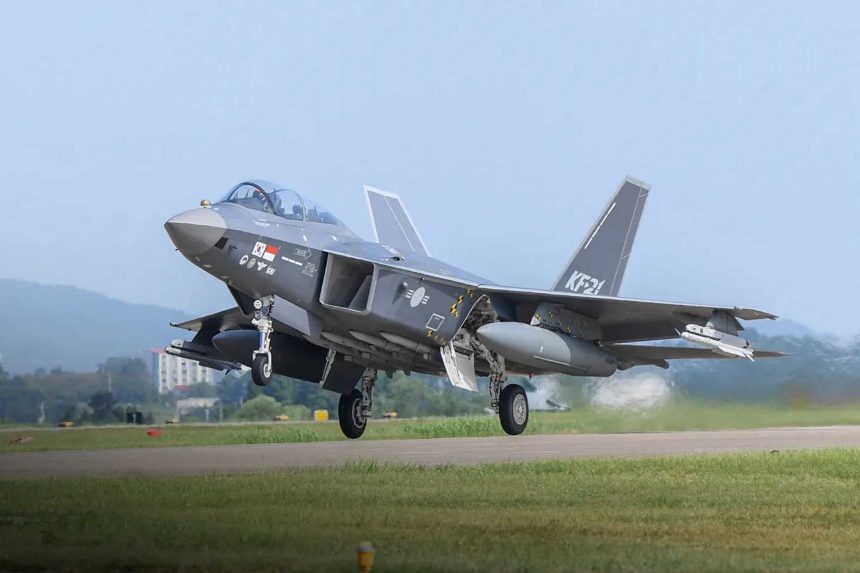
Contrary to the original plans, Indonesia will not co-produce the KF-21 Boramae locally, opting for a direct procurement from South Korea.
The old differences between South Korea and Indonesia over the KF-21 Boramae fighter program appear to have reached some resolution, as Jakarta confirmed on Jun. 29, 2026 that it would not co-produce the jet locally. Initially, the KF-21 was planned to be manufactured by Dirgantara Indonesia as a junior partner to Korea Aerospace Industries (KAI), before disagreements over the monetary contribution, technology sharing, workshare and an alleged case of intellectual property theft created friction between the two countries.
There were signs of this eventuality in 2025 when, following the series of disputes, South Korea announced it would reduce Indonesia’s contribution to 600 billion won (approximately $389 million). This was a major drop from the 1.6 trillion won (around $1 billion) Indonesia had initially agreed on for the project that is now reportedly worth 8.1 trillion won (nearly $5.3 billion).
However, Seoul is nevertheless likely to approve the transfer of one of the six KF-21 prototypes to Jakarta. This follows a February plan for a “value transfer” agreed with Indonesia, the Defense Acquisition Program Administration (DAPA) revealed to the National Assembly’s National Defense Committee in April.
According to the Korea JoongAng Daily, the total value of the transfer of the fifth prototype is commensurate with the 600 billion won ($389 million) final Indonesian contribution.The fifth prototype of the KF-21 conducted its first flight in May 2023, and has subsequently participated in the trials of the AESA radar and aerial refuelling tests.
Indonesia abandons KF-21 co-production in strategic shockwave as Jakarta turns to direct fighter purchase from South Korea.
Can anyone give me a context to this? pic.twitter.com/oBsA9SKBna
— Harrier023 (@av8harrier023) June 28, 2026
The KF-21 has been progressing steadily over the last few years, conducting pit-drop trials of various air-to-surface weapons in December 2025 and concluding its flight test campaign by January 2026 ahead of schedule. KAI rolled out the first of 40 serial production aircraft in March 2026 and, two weeks ago, DAPA also granted the KF-21 and initial type certificate for operations after the aircraft met all 745 inspection requirements across 14 airworthiness categories. These included airframe structure, weapons integration and electronic systems.
No jets to be manufactured in Indonesia
Indonesia’s defense ministry spokesperson Rico Ricardo Sirait confirmed the development to Jakarta Globe, which first reported it. “The government is adjusting the scheme in the KF-21 Boramae program. We will no longer co-produce the jet, but we will adopt a direct procurement mechanism,” Sirait told the news outlet.
Turun Kelas Jadi Pembeli Reguler KF-21, Investasi Ratusan Juta Dolar AS Indonesia Jadi Sorotan https://t.co/y608K2izSf pic.twitter.com/vFWDX2U8i9
— Indomiliter.com (@indomiliter) June 28, 2026
The government, according to Sirait, has made a “comprehensive evaluation” of the KF-21 program, taking into account “the program’s effectiveness, technology transfer, economic value, and domestic defense needs.” He “also admitted that Indonesia had not decided on how many KF-21 jets it would buy under the new mechanism,” Jakarta Globe added.
Fifth prototype transfer to Indonesia
According to KJAD, the transfer of the single-seat fifth prototype is worth approximately 350 billion won, part of Indonesia’s final 600 billion won contribution. The total package includes the technology transfer worth 174.2 billion won and 75.8 billion won for the development and testing data.
Since achieving its maiden flight in May 2023, the fifth prototype has been used to verify key avionics performance, including an active electronically scanned array radar, and to conduct aerial refueling tests.
Some really nice KF-21 Twin Seater Prototype Air to Air photos pic.twitter.com/2P6IEkBOxZ
— Fighterman_FFRC (@Fighterman_FFRC) February 19, 2025
Indonesia originally joined the program on the condition to meet about 20% of the KF-21 development cost. That figure came to roughly 1.6 trillion won, but a series of budget constraints and domestic economic conditions caused it to delay payments, with reports of Jakarta seeking renegotiation of the terms.
The Korean government subsequently lowered Indonesia’s contribution to 600 billion won and, following the review, it was also considering “whether to transfer a prototype from scratch,” KJAD added. Eventually, out of the total 600 billion won, Indonesia transferred 536 billion won and, as per the report, planned to pay the remaining 64 billion won by June.
KJAD said at the time: “DAPA plans to finalize the timing of the transfer of the prototype and development data once full payment is confirmed. Separately from the value transfer process, Korea is continuing talks with Indonesia to export 16 KF-21 jets.” Indonesia has also now been subsequently reported to have paid the full cost of 600 billion won, transferring the remaining 64 billion won.
Ok, what’s next? Mau diapakan prototipe KF-21 yang diserahkan ke Indonesia ini, tanpa adanya production line lokal? Sejauh apa Indonesia bisa memanfaatkan prototipe ini?
Penyakitnya selalu sama, berganti kepemimpinan, berganti juga kebijakannya. Komitmen kayanya sulit banget… https://t.co/IPmzrAIHwY pic.twitter.com/LGoM2Ulhic
— Feiferiz (@MightyWar3) June 28, 2026
KF-21 and Indonesia
In June 2025, the Indonesian Air Force’s (TNI-AU) Col. Ferrel Rigonald and Polish Air Force chief Maj. Gen. Iereneusz Nowak piloted the KF-21 Boramae for the first time. The Gen. 4.5 jet is part of Seoul’s and Jakarta’s 7.5 trillion Won ($6.3 billion) 2014 collaboration, where the latter had committed 20% of the development cost.
However, the joint program has witnessed financial, industrial workshare and technological transfer differences between the two countries. In 2018 Indonesia sought to renegotiate its share of the cost, resuming the payment of its share in 2022.
Then, in 2024, two Indonesian engineers were accused of attempting to steal the aircraft’s technical data in flash drives. A subsequent investigation by South Korea’s DAPA, the National Intelligence Service and the Defense Counterintelligence Command ruled out any classified data theft, effectively giving the Indonesian engineers a clean chit, the Herald Corporation reported.
🛩️🇰🇷🇮🇩 Indonesian Air Force (TNI AU) test pilot, Colonel Ferrel Rigonald @FRigonald61799, conducted the maiden flight of the KF-21 prototype from the front cockpit, accompanied by KAI pilot Koh Hwi Seok in the rear cockpit. pic.twitter.com/t4Iia2cAJQ
— RANOSINT (@Ranosint) July 3, 2025
The publication added that Jakarta had reservations with the scope of technology transfer, technical ‘know-why’ and Intellectual Property (IP) rights. These issues reportedly have been taken up informally at the diplomatic level.
This is when KEDGlobal reported on Jun. 13, 2025, that DAPA agreed a “two-thirds” reduction for Indonesia’s contribution to 600 billion won. This reduction, KED Global said at the time quoting DAPA and Ministry of National Defense (MND) officials, was conditioned on “transferring less technology than earlier agreed” to Jakarta.
An agreement to that effect was signed during the Indo Defence Expo & Forum held in Jakarta. As it now turns out, the reduction in the contribution quota has eliminated the complete industrial scope.
KAI 🇰🇷 CEO Cha Jae-byung presented the vision “Global KAI Beyond Aerospace”, with an aim of securing new orders for 2026. KAI focuses on achieving first successful exports this year, to countries such as Philippines 🇵🇭 for the KF-21. The contract is expected before mid-year 2026. pic.twitter.com/61GK1lb1zB
— Para Bellum (@ReHorizon3) March 15, 2026
The TNI-AU however still would have an effective Gen. 4.5 and Gen. 5 fleet. It will soon operate a fleet of 42 Dassault Rafales, with the first aircraft recently delivered, and has signed a contract with Turkish Aerospace Industries (TAI) for 48 KAAN fighters.
The Turkish fighter is expected to see significant local assembly and manufacture rights. Indonesia has also abandoned its plans to purchase the F-15EX and has budgeted $9 billion for the Chinese J-10C – a procurement yet to materialize.