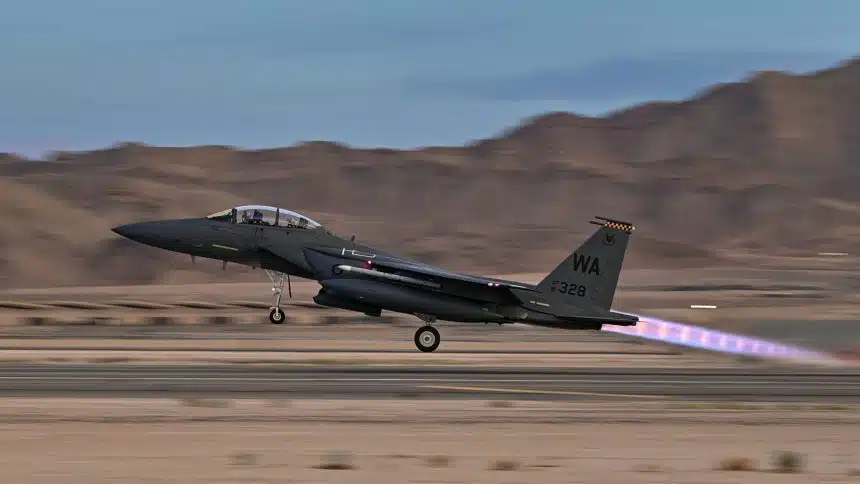
The Air Force Life Cycle Management Center has established a dedicated EPAWSS Speedline at the Warner Robins Air Logistics Complex to accelerate the fielding of the new defensive suite on the F-15E Strike Eagle.
The U.S. Air Force is taking steps to accelerate the fielding of the AN/ALQ-250 Eagle Passive Active Warning Survivability System (EPAWSS) on the F-15E Strike Eagle. In a press release on May 26, 2026, the service has announced that the Air Force Life Cycle Management Center has established a dedicated EPAWSS Speedline at the Warner Robins Air Logistics Complex, in Georgia.
The EPAWSS Speedline will receive the first F-15Es slated for modification in June 2026. The service says the line will be independent and significantly accelerate the installation and fielding of next-generation Electronic Warfare (EW) capabilities on F-15E Strike Eagle.
Before the establishment of the Speedline, the EPAWSS upgrade was included in the F-15E’s scheduled Programmed Depot Maintenance (PDM) cycles. The service noted that this was an efficient method for routine depot work, however it slowed down the fielding of the upgrade as it was restricted to the jet’s standard maintenance schedule.
The Speedline will remove the limitation by working independently from the standard F-15E PDM line. The service says this “provides the program with the necessary flexibility to complete installations of this critical defensive system on aircraft that may not be due for PDM for another five to seven years.”
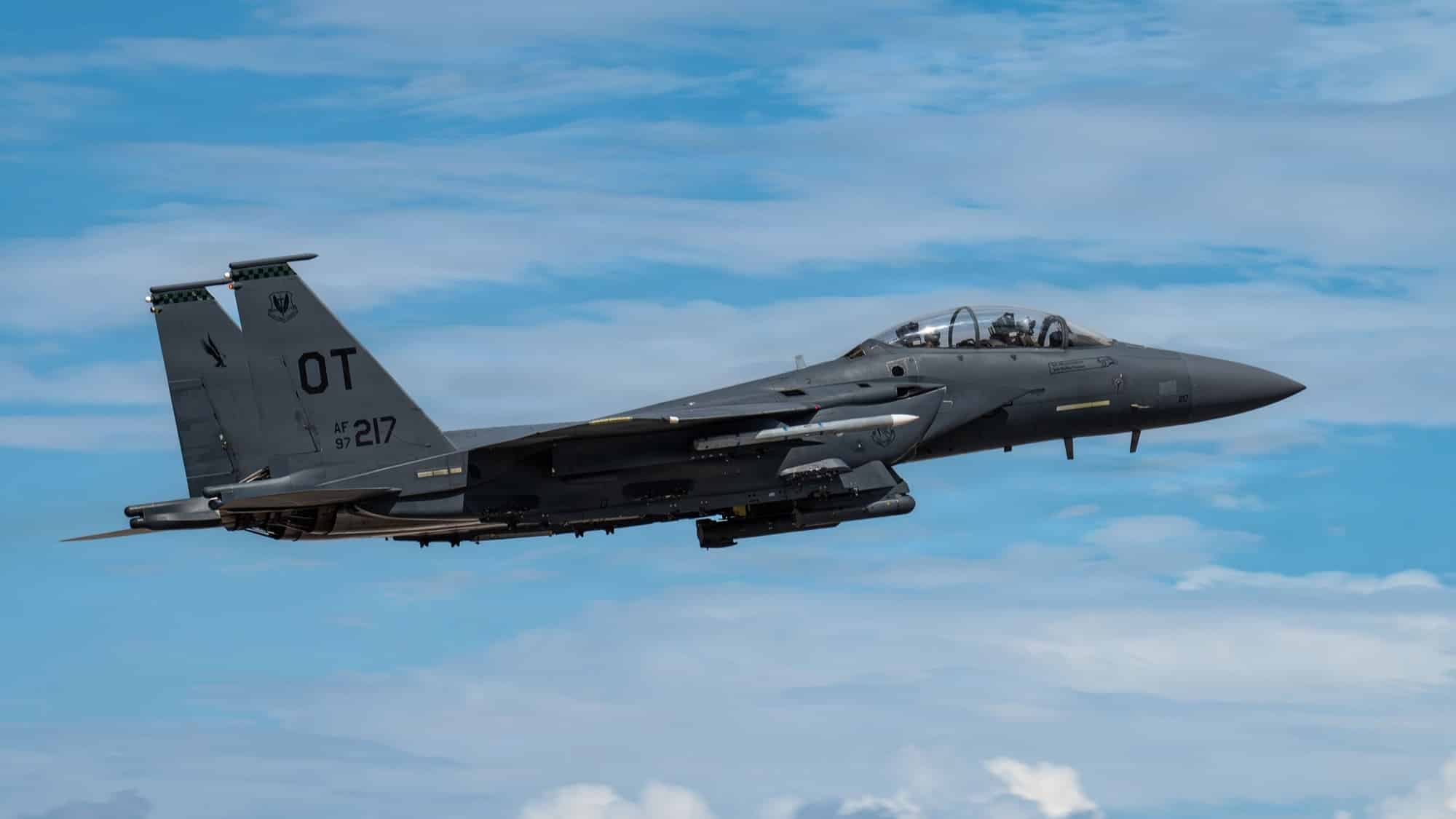
“The F-15E Strike Eagle remains a cornerstone of our tactical airpower and deep strike capabilities,” said Lt. Col. Matthew Heil, F-15 Program Office, EPAWSS Materiel Leader. “The integration of advanced electronic warfare suites, such as the Eagle Passive Active Warning Survivability System, ensures the F-15E will not just survive, but actively disrupt and dismantle adversary kill chains in the most highly contested, electromagnetically dense environments. We are not merely extending the life of this platform; we are aggressively expanding its lethality and survivability to ensure it dominates the modern battlespace.”
The upgrade
The first modifications for the F-15E Strike Eagle, specifically an aircraft from the 48th Fighter Wing based at RAF Lakenheath, UK, began in May 2023. The first two modified aircraft were then delivered to the British base in January 2025.
Earlier in the same month the EPAWSS also entered full rate production. The Air Force completed in early 2024 the Initial Operational Test & Evaluation (IOT&E) of the EPAWSS for the F-15E Strike Eagle and F-15EX Eagle II.
The system is installed from the factory as standard issue on the new F-15EX and is being retrofitted on F-15Es to replace obsolete components of the legacy Tactical Electronic Warfare System. In total, the Air Force plans to retrofit 99 F-15Es and equip all F-15EXs with EPAWSS.
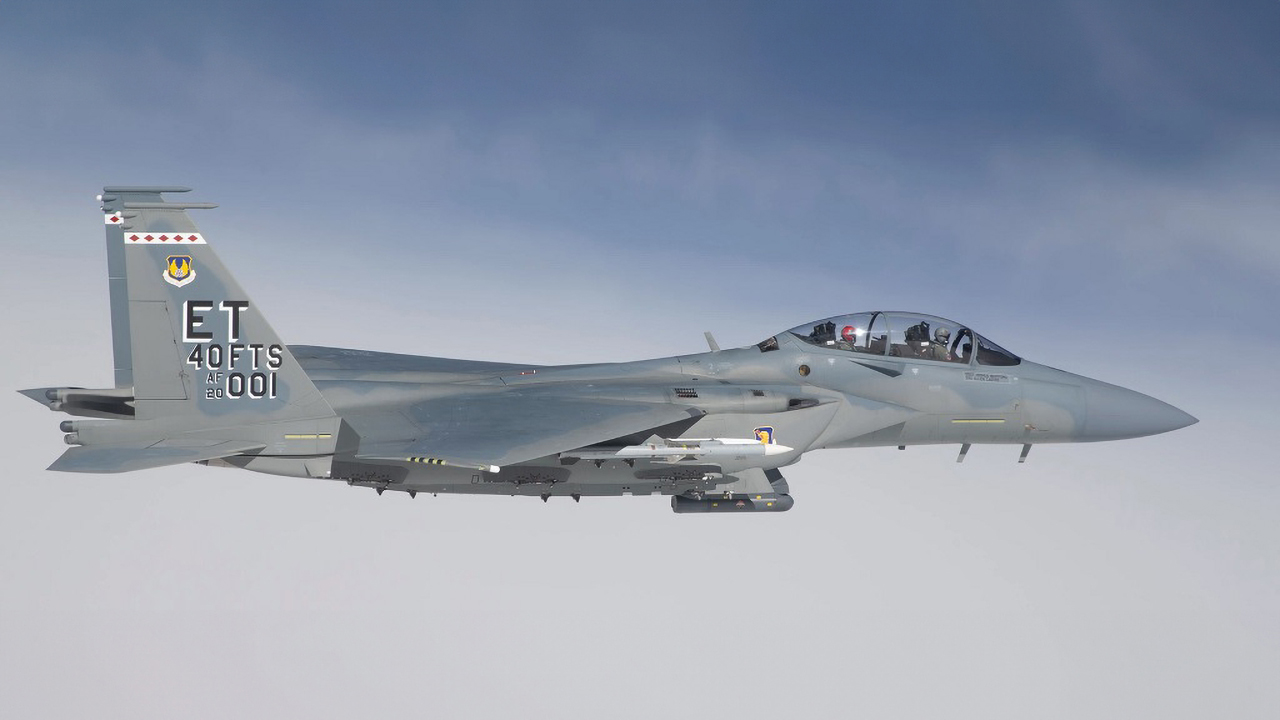
Previously, EPAWSS was installed only Strike Eagles assigned to Eglin AFB, Florida, and Nellis AFB, Nevada, in addition to the Eagle IIs. These F-15Es were dedicated to developmental and operational testing.
The AN/ALQ-250 EPAWSS
The Eagle Passive Active Warning Survivability System is a cutting-edge self-protection system intended to enable the F-15 to detect, identify, locate, deny, degrade, disrupt, and defeat air and surface-to-air threats during operations within highly contested environments. The system will replace the previous self-protection suite installed on the Strike Eagle.
EPAWSS is fully integrated with radar warning, geo-location and increased chaff and flare capability to detect and defeat surface and airborne threats in signal-dense and highly contested environments. Because of this, the system enables freedom of maneuver and deeper penetration into battlespaces protected by modern integrated air defense systems.
“EPAWSS is a leap in technology, improving the lethality and combat capabilities of the F-15E and F-15EX in contested, degraded environments against advanced threats,” said Maj Bryant “Jager” Baum, EPAWSS Test Director for the Air Force Operational Test & Evaluation Center (AFOTEC). “EPAWSS has set the baseline for EW within the fighter community.”
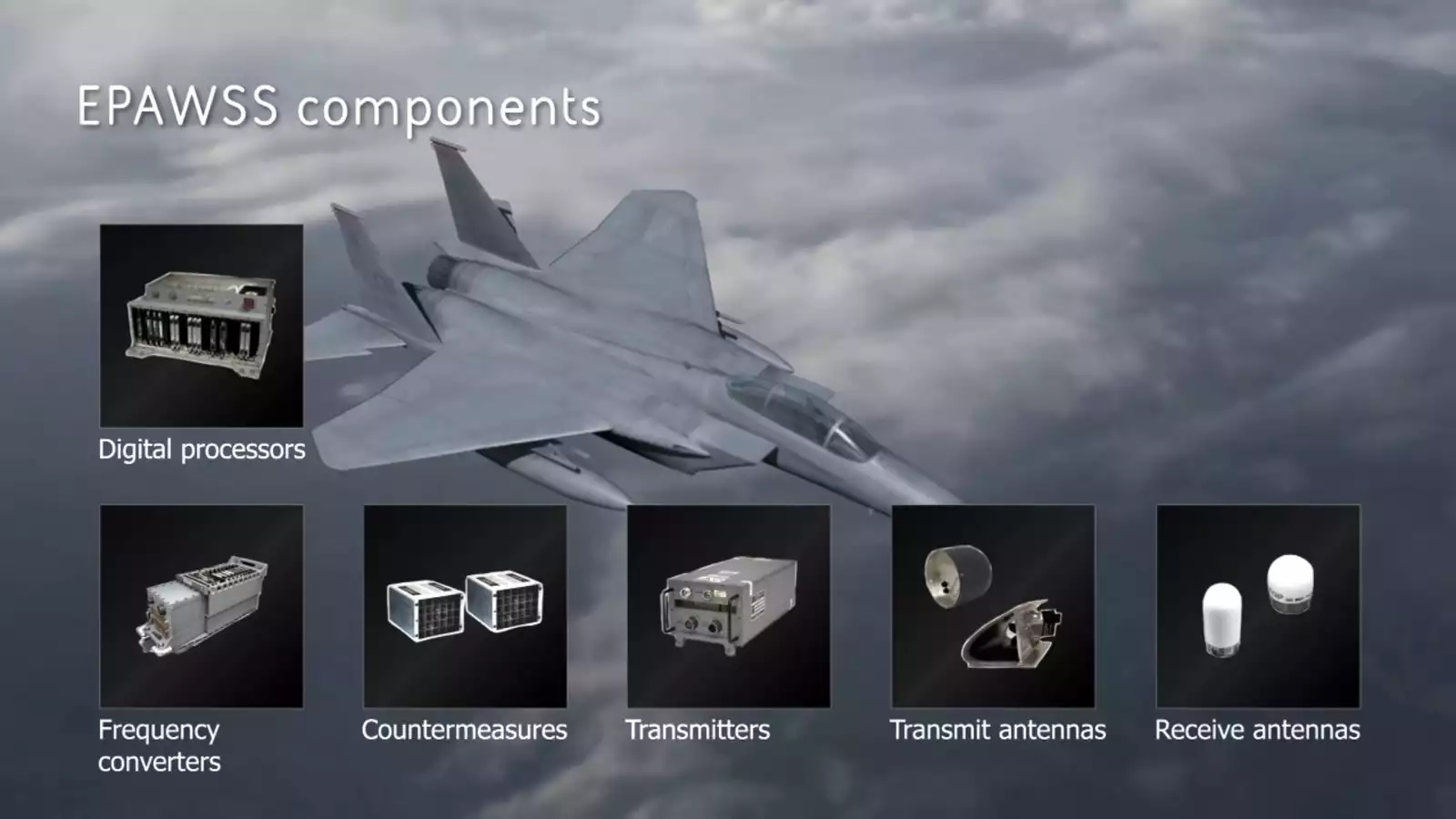
BAE Systems, the manufacturer of the system, notes EPAWSS is notably smaller and lighter than previous EW systems for the F-15, thanks to its fully digital technology. The company also says EPAWSS has broad instantaneous bandwidth and a high-speed scan capability to detect all RF threat classes, including low probability of intercept and modern agile threats.
“EPAWSS was designed for upgradeability and rapid capability insertion,” added Amy Nesbitt, EPAWSS program manager at BAE Systems. “We’re using agile software development to provide iterative upgrades to fielded EW systems—allowing our customers to defeat future electromagnetic threats.”
The system in U.S. service is currently not integrated with the AN/AAR-57A(V) Common Missile Warning System (CMWS) designed to detect infrared threats, even if the F-15EX features the same mounting points used for these sensors on the F-15QA and F-15SA. However, systems like CMWS can still be integrated later, as BAE officials told us in 2021 that “EPAWSS can integrate with multiple sensor sources to provide warfighters with enhanced survivability via a fully integrated countermeasure response.”
EPAWSS also allows to increase the F-15’s chaff and flares capacity by 50%, with four more dispensers added in the EPAWSS fairings behind the tail fins (two for each fairing), for a total of 12 dispenser housing 360 cartridges. This improvement is important as in modern scenarios chaff and flares are often released preemptively to counter MANPADS (Man Portable Air Defense System), meaning that now the Eagle will have more countermeasures available for a better protection.
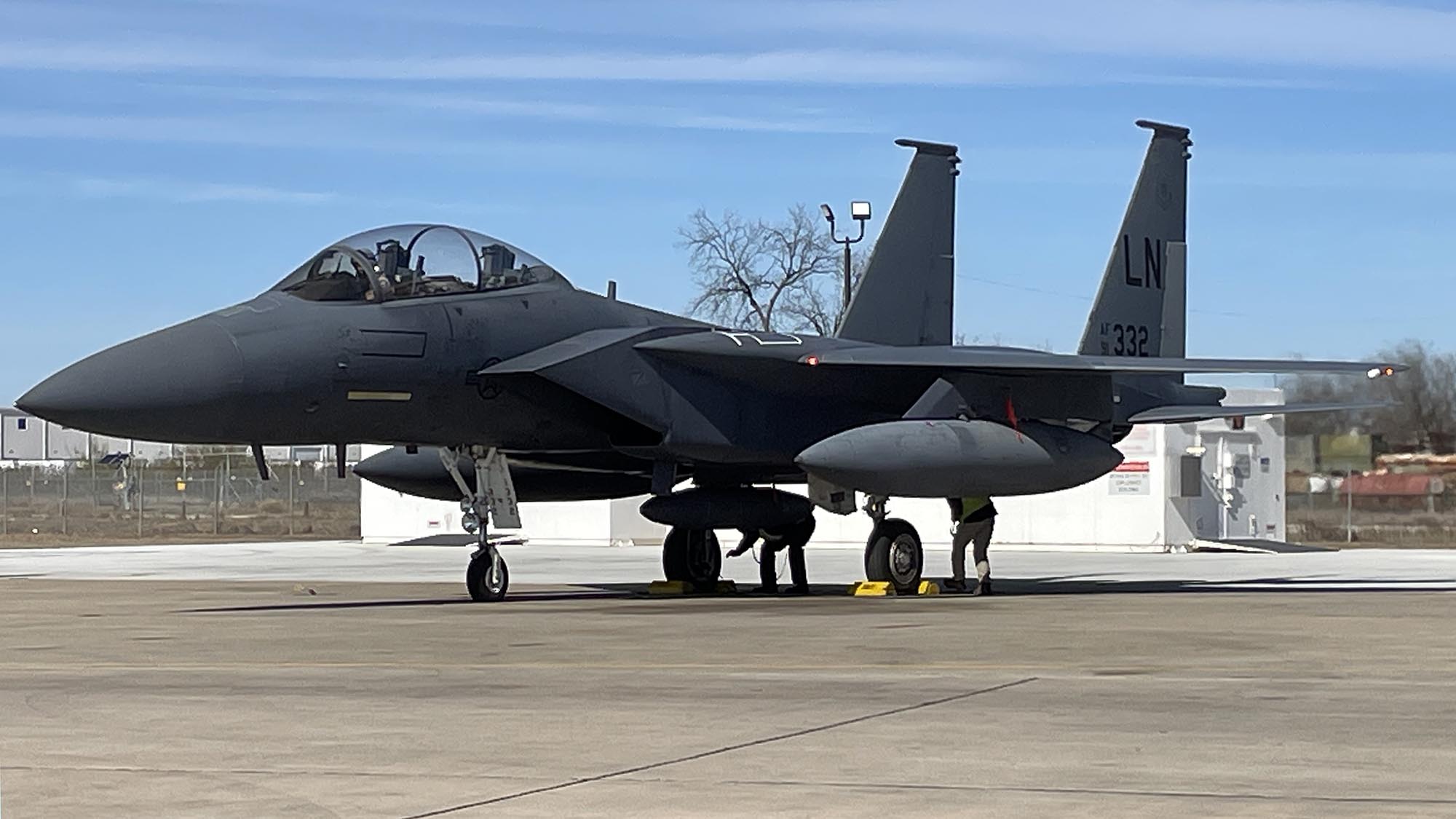
EPAWSS integrates cognitive electronic warfare to better discriminate the signals received by the system. This capability was demonstrated during the Northern Edge 2023 large force exercise test event, which tested EPAWSS’ ability to rapidly respond to previously unencountered electromagnetic threats. The tests challenged the system’s ability to process in-mission sensor data, create exquisite techniques, and optimize waveforms in real time.
“Our close collaboration with the U.S. Air Force allows us to mature EPAWSS cognitive processing capabilities,” said Chip Mosle, program director at BAE Systems. “By incrementally testing and fielding cognitive EW solutions to proven systems such as EPAWSS, we are enabling tactical spectrum overmatch against advanced threats that are unpredictable, evolving, and adaptable.”
In the Director, Operational Test & Evaluation report, it is mentioned that EPAWSS replaces three functionally obsolete F-15 legacy Tactical Electronic Warfare System components: the AN/ALR-56C Radar Warning Receiver, the AN/ALQ-135 Internal Countermeasures Set, and the AN/ALE-45 Countermeasures Dispenser Set. The system also integrates with the F-15 AN/APG-82(V)1 radar and Advanced Display Core Processor II mission computer.