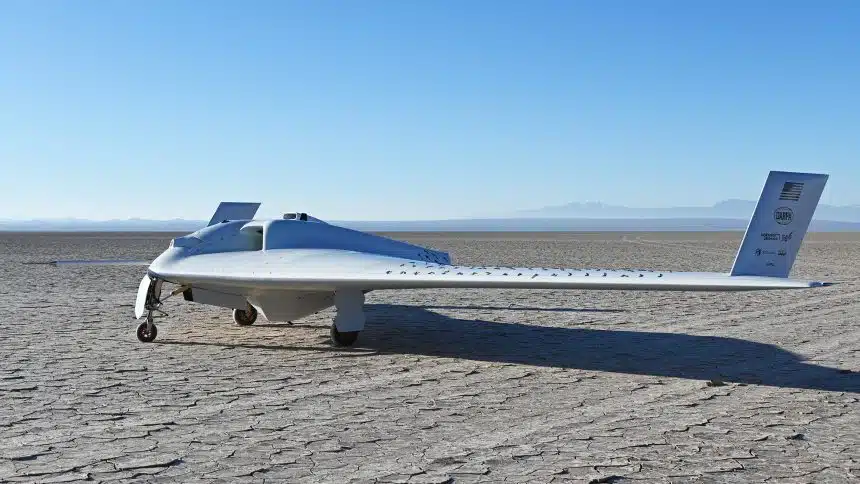
Designed by Northrop Grumman and subsidiary Scaled Composites, the unmanned XRQ-73 features an ultra-quiet propulsion system powered by electricity from a gas turbine.
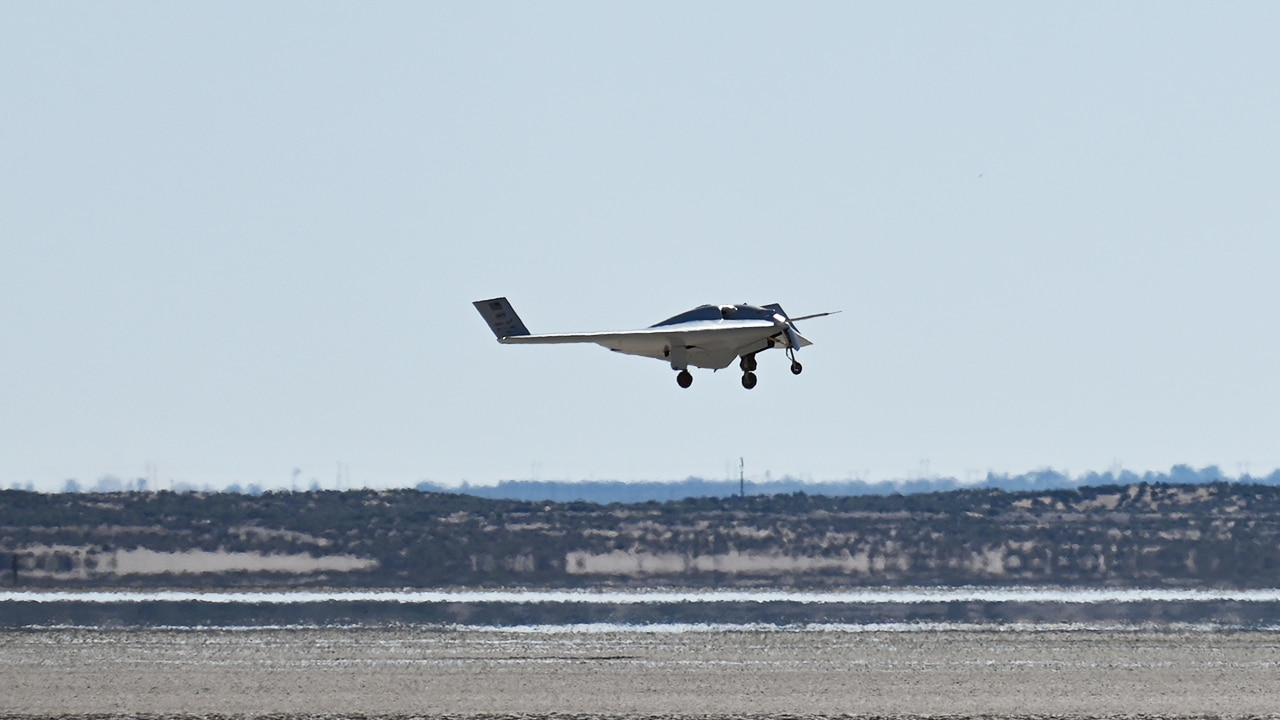
Taking off from Edwards Air Force Base in April 2026, the XRQ-73’s first flight was hailed by DARPA (Defense Advanced Research Projects Agency) as a “step forward in demonstrating the military utility of hybrid-electric propulsion”. The aircraft is the result of the agency’s Series Hybrid Electric Propulsion AiRcraft Demonstration (SHEPARD) program, building on the secretive XRQ-72 Great Horned Owl project.
Data embedded in the released images suggest the aircraft’s first flight took place on Apr. 14, 2026.
According to Northrop Grumman, the aircraft weighs in at around 1,250 lbs (555 kilograms), and is designated as a Group 3 Uncrewed Aircraft System (UAS) under the U.S. Department of Defense’s classification system. This puts it in the same category as the RQ-21 Blackjack and RQ-7B Shadow, indicating altitude performance up to around 18,000 feet and speeds up to 250 knots.
We recently flew the XRQ-73 hybrid-electric unmanned aircraft in collaboration with @AFResearchLab and @northropgrumman at Edwards Air Force Base, Calif.
Part of the SHEPARD program, the flight proves the military utility of hybrid-electric propulsion. ✈️⚡️ pic.twitter.com/CEO4GD7CqL
— DARPA (@DARPA) May 6, 2026
Initial planning would have seen the XRQ-73’s first flight take place in 2024. It clearly missed this milestone, although the exact nature of the delays are unclear. Much about the SHEPARD program remains behind closed doors, and this is perhaps evidenced in a way by the news of its first flight only being revealed weeks after it actually took place.
“This milestone is not just about a single flight,” said Lieutenant Colonel Clark McGehee, SHEPARD program manager. “The architecture proven by the XRQ-73 paves the way for new types of mission systems and delivered effects. We look forward to advancing this technology through the flight test program and delivering new capabilities for our warfighters.”
Our @DARPA SHEPARD demonstrator is officially an X-Plane! Meet the XRQ-73 Hybrid Electric Uncrewed Aircraft System. https://t.co/J5uDXKybwB pic.twitter.com/3GtBjnS3lL
— Northrop Grumman (@NGCNews) July 10, 2024
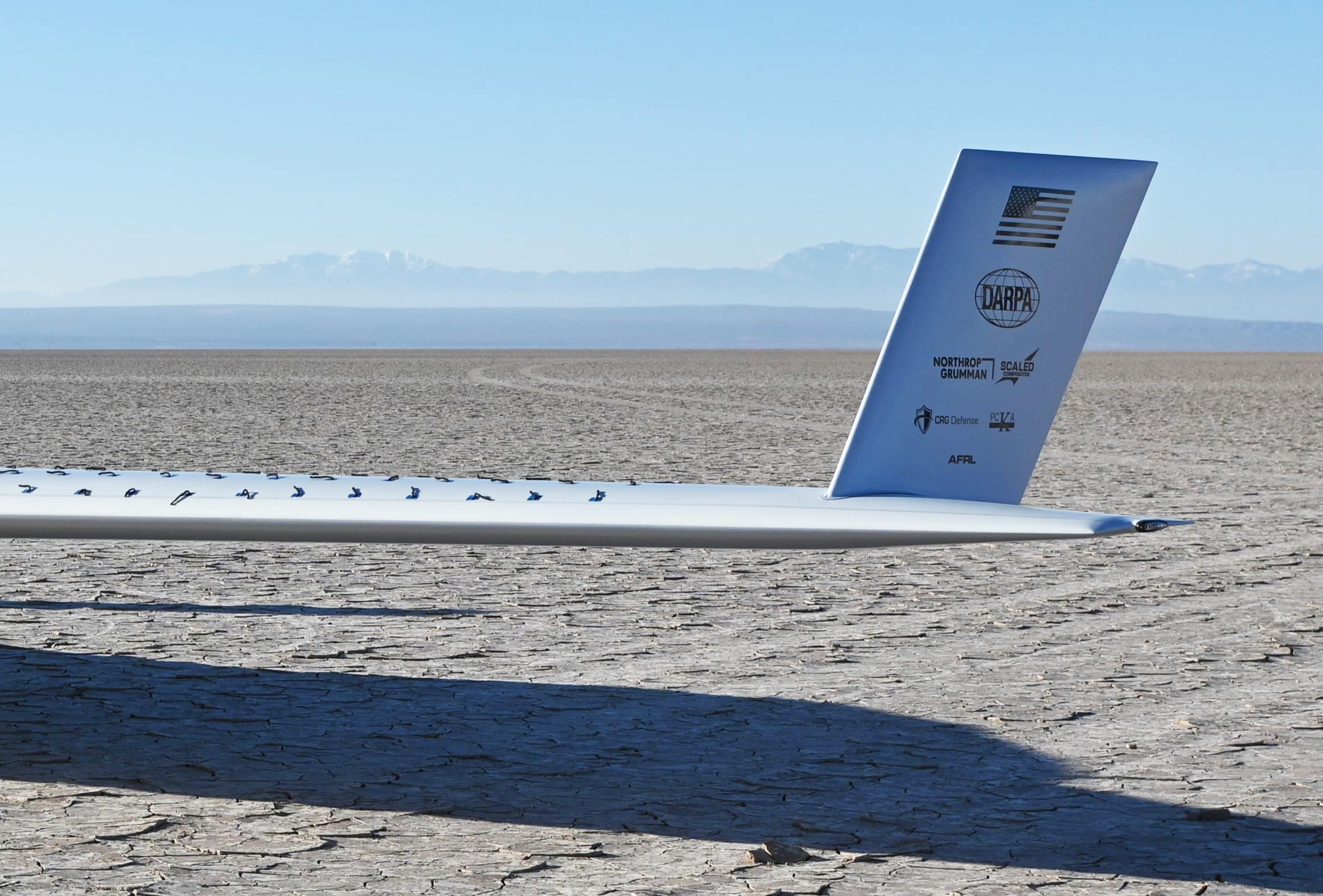
Since our first look at the XRQ-73 design in July 2024, the aircraft has apparently taken on a number of design changes. Most notably, vertical stabilizers are now featured towards the tip of each wing – it’s unknown whether these are permanent fixtures. A new air inlet has appeared on the topside of the aircraft, along with some blade antennas. In between the two main intakes, we can also see a new device fitted with what appears to be a forward-facing aperture – this could be for a camera or other visual system to aid aircraft control.
The large fairing on the belly of the aircraft remains, most likely intended for whatever payload the design is envisaged to carry. This has not yet been revealed, but is almost certainly due to be some form of intelligence, surveillance, and reconnaissance (ISR) equipment. The stealthy flying wing design in combination with the quiet and – likely – low thermal signature electric propulsion system would lend themselves well to clandestine ISR activities at lower altitudes than platforms like the ‘RQ-180’.
We can also see black devices covering the surfaces of the wings – these are simple airflow indicators, and will likely be removed at some point during the aircraft’s flight testing program once all relevant data is obtained.
Interestingly, the official pictures now released of the SHEPARD aircraft show it resting on Edwards AFB’s dry lake bed rather than on a runway, taxiway, or apron. The dry lake, officially Rogers Dry Lake, acts as a huge extension to Edwards AFB’s tradition runway surfaces and has been used by the Space Shuttle, the X-15, and a variety of other aircraft during testing or during emergencies.
Coolest guy on the lakebed 😎
A #throwbacktuesday to when a C-17 Globemaster III from the @911_AirliftWing out of Pittsburgh Air Reserve Station conducted proficiency landings at Rogers Dry Lake Bed here at @EdwardsAFB. @HQ_AFMC @usairforce @AirMobilityCmd #aviation pic.twitter.com/cgIMwJVhOH
— Edwards Air Force Base (@EdwardsAFB) March 8, 2023
As a relatively secretive program, it is likely that further flight testing of this latest ‘X-plane’ will be carried out without much public fanfare.