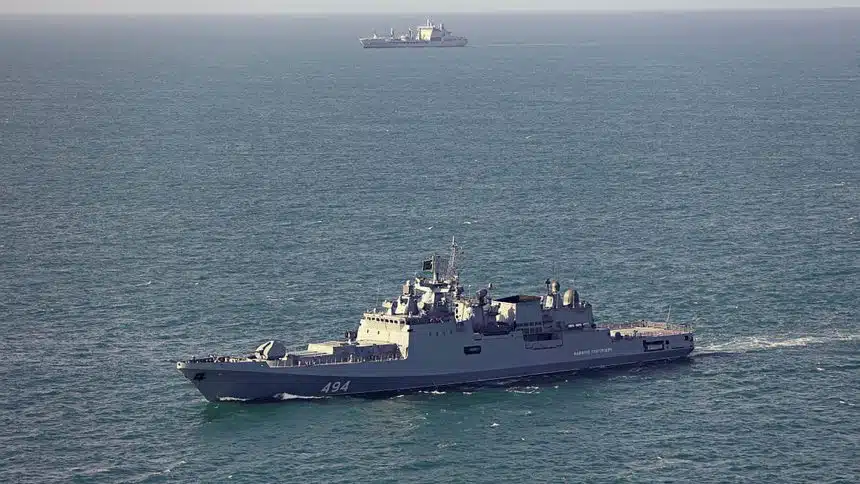
The incident, which reportedly occurred at around 11:40 BST, happened as a civilian yacht sailed near the warship Admiral Grigorovich, operating in international waters approximately 20 nautical miles south of the Isle of Wight.
Coming just days after the UK conducted its first boarding of a vessel alleged to belong to Russia’s ‘shadow fleet’, the Admiral Grigorovich is suspected to have been tasked by the Russian Navy to escort these ships as they pass close to NATO countries on their routes. Though yet to directly intervene in a boarding attempt, the frigate’s presence would undoubtedly provide a level of deterrence against plans to seize Russian-linked cargo ships.
BBC News understands that, although the two incident are close in timing, the UK Government at present does not view this new event as related to the boarding of the Smyrtos on Jun. 14, 2026.
BREAKING: A Russian warship has been accused of firing warning shots towards a UK-registered yacht that sailed nearby in the English Channel on Tuesday
The UK Ministry of Defence confirmed it was “investigating reports of an incident in the Channel”.
The yacht alleged that the…
— Lucy Fisher (@LOS_Fisher) June 16, 2026
The warning shot is said to have come following an ‘audible warning’ from the frigate to the civilian yacht, which Russia claims was the 40 foot sailing vessel Bright Future. An official statement says the warning shots, as well as flares and audio warnings, only came after the civilian vessel failed to change course in response to radio calls on internationally recognised VHF frequencies.
Russian Defense Ministry confirmed that the crew of the “Admiral Grigorovich” frigate fired warning shots at the UK-owned “Bright Future” yacht in the British Channel waters on Tuesday.
The Russians claimed that the frigate’s commander decided to open preemptive fire with small… https://t.co/0mggKOvjBT pic.twitter.com/mV8vra0hCN
— Status-6 (War & Military News) (@Archer83Able) June 16, 2026
Initial reports from the yacht’s occupants stated the incident took place around 500 yards from the Russian warship, although the official Russian statement gives a distance of 150 metres, or 164 yards. The statement also says that the yacht was using its engines at the time, rather than its sails, which – if accurate – means the crew would have greater control over the boat’s speed and course. There are unconfirmed reports, via Sky News, that the frigate itself was experiencing technical issues and had limited maneuverability.
Royal Navy patrol vessels HMS Mersey and HMS Tyne were already monitoring the Admiral Grigorovich as part of their routine operations around British waters. The patrol ships are said to have witnessed the incident, with Tyne subsequently dispatching a boat to the Bright Future to ensure the occupants were safe and likely to note down their interpretation of events. No injuries or damage aboard the yacht were reported, with the warning shots said to have been aimed – as is procedure in most armed forces – well clear of the vessel.
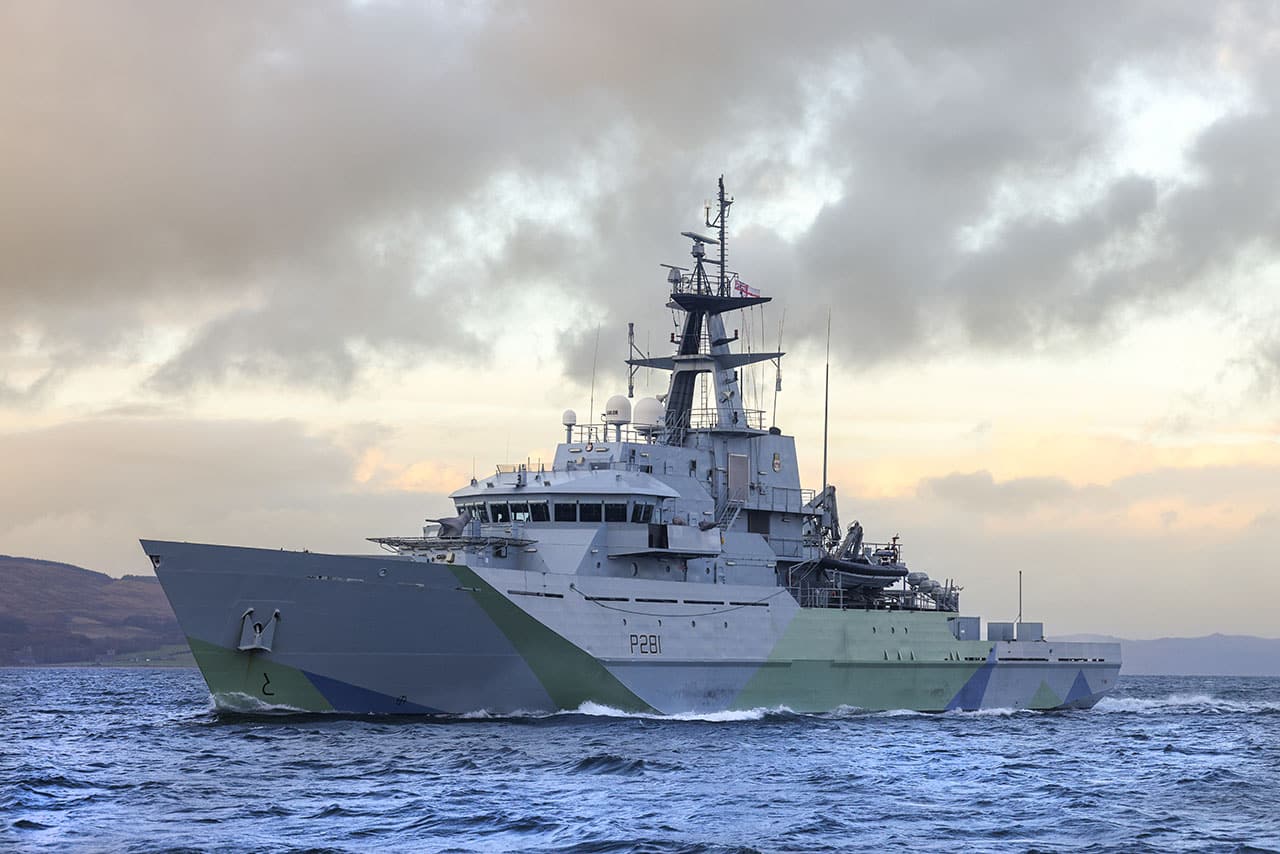
The UK Ministry of Defence has so far made only limited remarks as it continues to investigate the incident.
Update: June 18th, 2026
UK Prime Minister Sir Keir Starmer has labelled the Russian warship’s actions as “reckless” and “deeply concerning”. He is currently attending the G7 Summit in Evian, France, alongside other world leaders including President Donald Trump, President Emmanuel Macron, and Chancellor Friedrich Merz.
The British citizens on board the yacht have disputed Russia’s version of events, claiming that they were under sail and not using engine power at the time of the warning shots. Vessels under sail are accorded a level of priority over powered vessels owing to their more unpredictable maneuverability.
The AIS-track of BRIGHT FUTURE corroborates the crew claim that they were sailing.
As they had passed the Needles boat made a maneuver consistent with setting sail (going against wind) and the rest of the track also fits with a steady sail (angles, wind speed & boat speed match) pic.twitter.com/zTNZXabr7N
— auonsson (@auonsson) June 16, 2026
After hearing five blasts from the ship’s horn, Jane and Alan Kelvey on board the yacht commenced a turn two degrees to starboard in acknowledgement. More horn blasts, followed by gunshots, ensued around a minute later. A number of commentators have since remarked that a small turn of two degrees would not be immediately visible as a course alteration from the perspective of a Russian ship. Regulations require all course alterations to avoid collision should be “large enough to be readily apparent”.
⛵️Yacht incident dying down as it should
Final thoughts
Layered causes:
➡️Deep – poorly run Russian surface fleet (see black sea fleet in particular). Under resourced Royal Navy
➡️Intermediate – Dark fleet activities, Smyrtos boarding (plus everything else)
➡️Precipitating…
— Tom Sharpe (@TomSharpe134) June 17, 2026
The warning shots, which the couple say were aimed skyward, then led them to engage the yacht’s engine and make a 90 degree turn away from the warship. The couple maintains that they had not been contacted by radio, though this may simply mean that they were not monitoring the frequency used by the Russian vessel.
Following an investigation, the UK Ministry of Defence has assessed that the shots were “an isolated incident and not linked to the UK’s interception of the Smyrtos this weekend”. The shots were “not aimed at the vessel and were an attempt to prevent a possible collision”.
The Admiral Grigorovich
A Project 11356R frigate, the lead ship of its class, the Admiral Grigorovich was commissioned into the Russian Navy in March 2016. The 4000 ton vessels are nominally assigned to the Black Sea fleet, although the Admiral Grigorovich has not returned to the Black Sea since the start of Russia’s full-scale invasion of Ukraine. As a result, the ship has been a regular sight shadowing NATO vessels in the Mediterranean and the Atlantic.
The ships are well armed for their size, boasting a 100 mm AK-190 main gun, 24 vertical launch system (VLS) cells for air defence missiles, 8 VLS cells for cruise missiles, two AK-630 close-in weapon systems (CIWS), and the distinctive RBU-6000 Smerch-2 anti-submarine rocker launcher.
Alongside Russia, India operates two ships of this class. These were originally intended for Russian use, but from 2014 onwards Ukraine would no longer supply the gas turbines intended to power them. Though Russian-built alternatives were evaluated, two of the three incomplete ships were eventually sold to India. India were able to acquire the Ukrainian gas turbines, then these were provided to the Russian shipyard and installed on the ships.