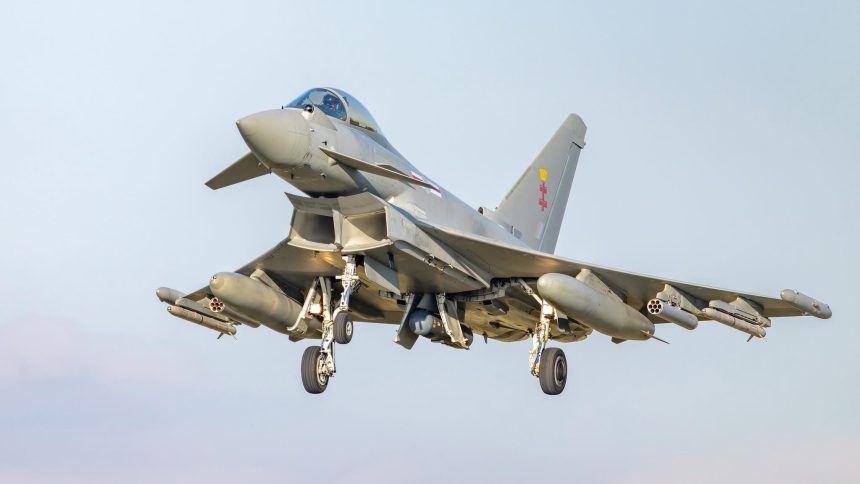
An RAF Typhoon was pictured at BAE Systems Warton carrying two seven round LAU-131 rocket pods, which can be used to fire APKWS guided munitions against surface and, importantly, air targets.
The images, taken by Tech Digital Photography, mark the first time that we’ve seen a Typhoon outfitted with a rocket pod in the flesh. While rocket pods were integrated with many aircraft that the Typhoon has ended up replacing, until relatively recently these were largely for unguided rockets in an air to surface role and deploying such a non-precision weapon from a fast jet no longer aligned with the operating practices of many air forces.
Now, though, the introduction of the BAE Systems Advanced Precision Kill Weapon System II (APKWS II) guidance kit for Hydra 70 rockets over the past decade has granted such munitions a new lease of life. Initially envisaged as a way to precisely strike softer targets, preserving larger munitions for more valuable, hardened targets, the APKWS kit has now been well proven in an anti-air capacity against the emerging threat of small, inexpensive uncrewed aerial systems (UAS).
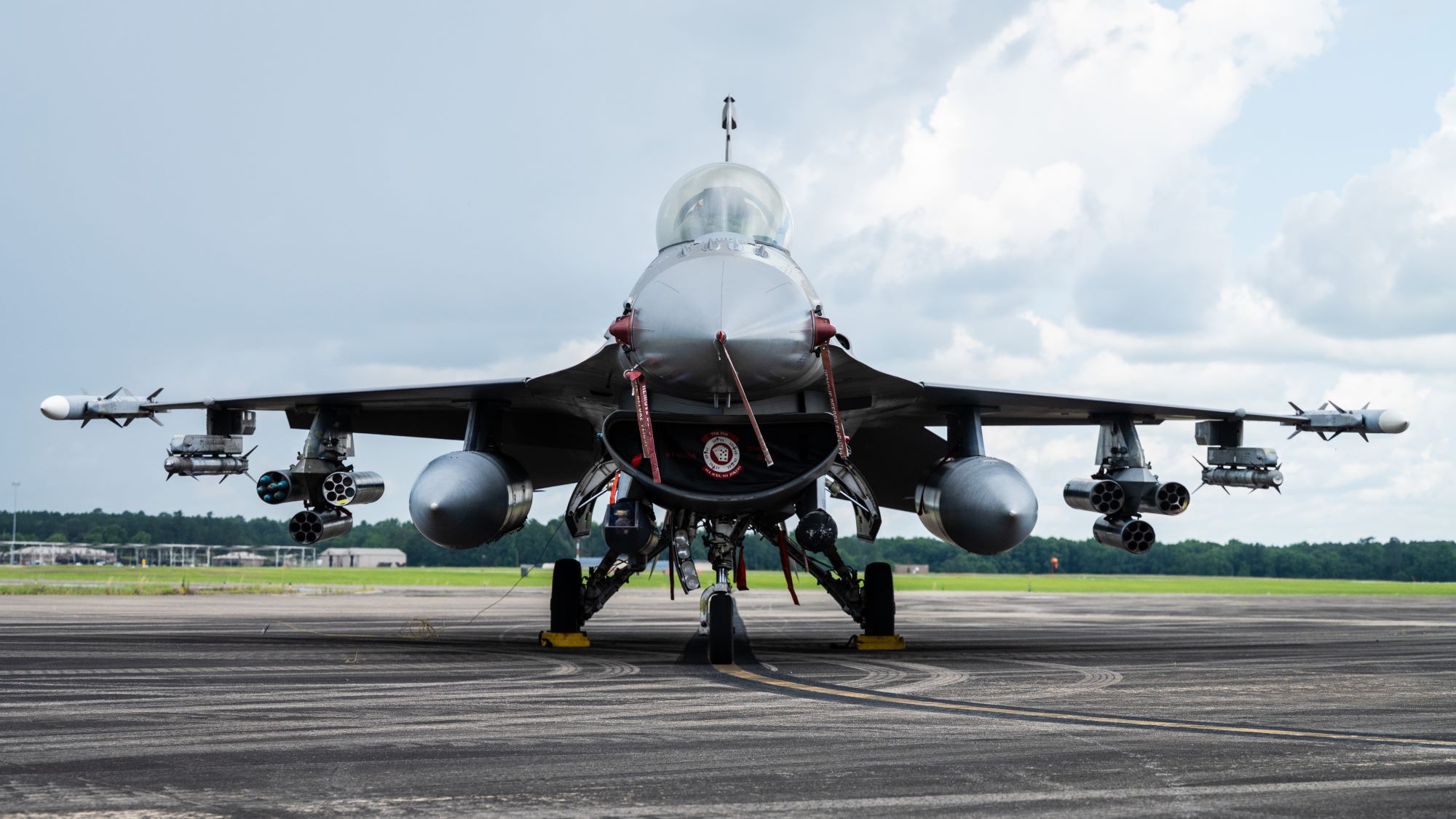
Recently integrated on mainline U.S. Air Force fighters like the F-16 Fighting Falcon and F-15E Strike Eagle, APKWS rocket pods are now very commonly seen carried by these aircraft into combat – including during the ongoing U.S. war with Iran. As well as being less expensive than dedicated air to air munitions like the AIM-9X Sidewinder, these rockets can also be carried in far greater quantities. This allows each aircraft to engage many more targets before needing to return to an airfield to be reloaded, an important factor when being faced with dozens or even hundreds of incoming drones.
BAE Systems has developed a dual mode laser/infrared seeker for APKWS for precisely this counter-UAS (C-UAS) purpose, which will eliminate the current need for continual lasing of the intended target.
With the UK Defence Investment Plan (#DIP) due Monday (or so I have been led to believe), we’re all expecting to be put out of our collective misery re #NMH. Another announcement I’ve been told to maybe expect is related to #APKWS rockets on the #Eurofighter Typhoon for low-cost… pic.twitter.com/RmAdpTWCQk
— Gareth Jennings (@GarethJennings3) December 12, 2025
The acquisition of APKWS II by the Royal Air Force for deployment from its Typhoon force has been strongly rumored in recent months, with anticipations that such a decision is due to be announced in the still heavily delayed Defence Investment Plan (DIP). The timely appearance of rocket pods on this Typhoon – marked with the insignia of the RAF’s 41 Test & Evaluation (TES) Squadron but thought to be in use directly by BAE Systems – should not be taken as a definitive confirmation of this plan, though, as BAE Systems already announced that integrating APKWS II was under consideration.
Any comment on the subject from the Royal Air Force itself has been tight-lipped.
Both UK and Germany tell me there are no current plans to equip @eurofighter #Typhoon with rockets for the counter-#drone mission, but not to say it won’t happen. Waiting to hear from Italy and Spain. 1/3 https://t.co/OSOKTcLKBT pic.twitter.com/EnXWFOYItJ
— Gareth Jennings (@GarethJennings3) June 25, 2025
These trials, then, may be BAE Systems getting out ahead of time with their anticipation of potential future orders by the RAF as well as overseas Typhoon operators. When any procurement decisions are then made, the weapon will be available for use far more quickly.
View this post on Instagram
Tech Digital Photography’s images do in fact appear to show that live firing trials of some form have begun, with the Typhoon pictured on the ground with a single round carried in the starboard pod. When the jet is pictured on approach to the airfield, the same pod is empty.
View this post on Instagram
Timely Appearance
The debut of rocket pods for the Typhoon comes at a particularly coincidental time, given recent events in the Middle East. Of course, aircraft already integrated with APKWS II have been carrying these into combat amid the threat of Iranian drones, but RAF Typhoons flying from Qatar and RAF Akrotiri have instead had to rely solely on AIM-132 Advanced Short Range Air to Air Missiles (ASRAAMs) as their short-range infrared guided air to air missile.
USAF F-15E in full counter drone loadout for Epic Fury. 4 X AIM-120, 4X AIM-9, 28 FALCO APKWS laser-guided rockets + the 20mm. Jet is clean aside from that, so likely has nearby tanker support and can get to where it needs to go fast.
Image via CENTCOM screencap pic.twitter.com/kTvlQCNYBr
— Tyler Rogoway (@Aviation_Intel) March 4, 2026
Typhoons can carry only four ASRAAMs per sortie – the four partially recessed fuselage hardpoints being dedicated for larger radar-guided missiles like the AIM-120 AMRAAM or MBDA’s Meteor. With just two of the rocket pods, each Typhoon could carry 14 APKWS rockets into battle alongside two ASRAAM.
The massive cost of using ASRAAM in a C-UAS role has already been a point of criticism in the British press. While the cost calculations are not wrong – and the highly capable ASRAAM is indeed a massive overmatch for these low tier targets – this line of thinking does fail to consider the cost of not intercepting an incoming drone of missile, which could be far higher than the expense of an ASRAAM.
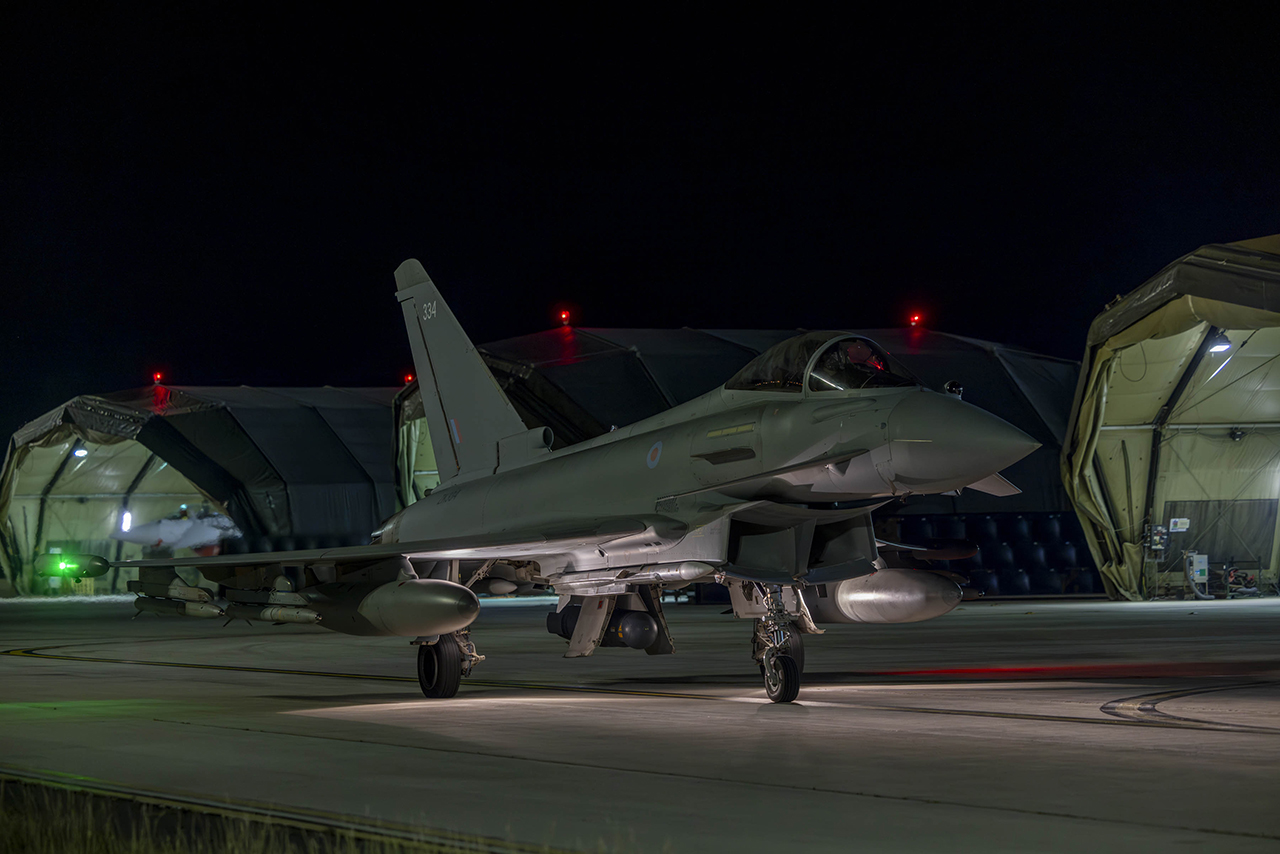
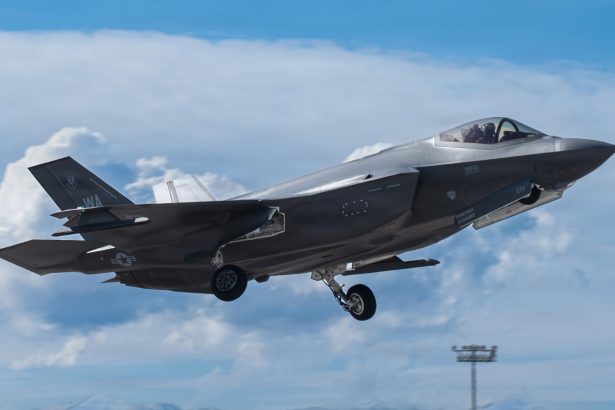
UK F-35Bs, which recently scored their first ever destruction of a hostile target when a Fleet Air Arm pilot destroyed an Iranian drone with an ASRAAM, would still have to use these higher tier missiles as rocket pods have not been integrated on this type. Theoretically, at the expense of full stealth characteristics (even more so than the already external carry only ASRAAM), there is no apparent reason why this integation could not take place, but it would have to be scheduled through the U.S. managed Integrated Test Force (ITF).
If the U.S. decides to follow this path, we may see this option emerge relatively quickly, but the UK is already plagued by delays to the integration of its weapons to the F-35B to such a point that the fleet’s only available air to ground weapon is the Paveway IV guided bomb.
On the Typhoon, as well as offering a new C-UAS option, integration of APKWS II adds another munition to its quiver for strike missions alongside the Paveway IV, Brimstone, and Storm Shadow cruise missile. Like with the earlier comparison to the AGM-114 Hellfire, softer targets like light-skinned vehicles, unprotected enemy emplacements, or even small boats can be targeted with APKWS without expending a valuable Brimestone or high-collateral Paveway IV. Many strikes of this nature have been carried out during Operation Shader in Iraq and Syria.
Many thanks to Tech Digital Photography for allowing the use of their images in this article. You can find them on Facebook and Instagram.