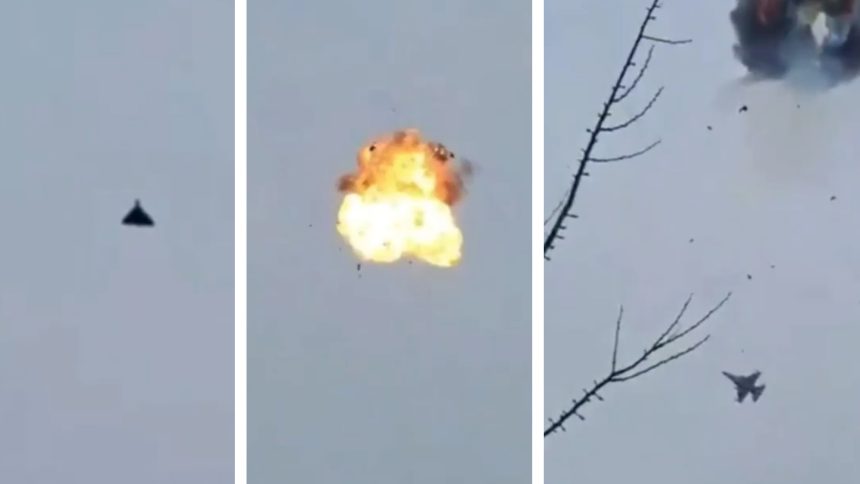
A Geran-2 (Shahed 136) attack drone is seen exploding in mid air shortly before an F-16 soars overhead, with the unmistakable sound of an M61 Vulcan cannon heard in the background.
This is at least the second time such a kill has been captured on video, though this new footage – first posted on Telegram – is the most clear that we’ve had so far. The Iranian-designed one-way attack drone flies almost directly overhead the person filming the video and then is suddenly engulfed in a huge explosion several times the size of the aircraft. An F-16, said to be one of those operated by the 107th Separate Aviation Wing of the Ukrainian Air Force, follows shortly after, pulling up and away from the explosion as the delayed sound of the aircraft’s rotary cannon reaches the camera.
An F-16 fighter jet operated by the Ukrainian Air Force intercepts a Russian Shahed/Geran-type long-range OWA-UAV with its M61A1 Vulcan 20mm auto-cannon.
BRRRRTTT moment pic.twitter.com/B2JFI3XC7U
— Status-6 (War & Military News) (@Archer83Able) February 8, 2026
Celebrations can be heard from those on the ground as bits of debris from the drone tumble through the air, apparently into a wooded area. Russia has employed the Shahed 136, which it designates Geran-2, extensively during its invasion of Ukraine and they first appeared in the second half of 2022. They have been used to attack critical infrastructure and military facilities, as well as civilian buildings. Modifications have even seen the 200 kilogram drones outfitted with anti-aircraft missiles.
Countering Drones
Relatively low cost compared to more advanced and much faster guided missiles, one-way attack drones are designed to be able to be used in large numbers either over time or simultaneously and cause rapid depletion in an adversary’s anti-aircraft munition stockpiles. The cost of an intercepting missile far outweighs the cost of the comparatively simple drone, so intercepts using gun ammunition is far more preferable whenever possible.
Anti-aircraft guns have seen a resurgence after many nations had written them off in favor of surface to air missiles (SAMs), with Ukraine employing DShK machine guns in tandem with searchlights in a tactic very reminiscent of scenes seen during the Second World War. More advanced developments involve the use of thermal imaging sights or searchlights that use infrared beams. Modern, larger caliber anti-aircraft guns like the German Gepard, developed in the 1960s – showing how long ago even newer models of anti-aircraft guns were developed – have also made their way into Ukraine’s inventory.
Ukrainian TDF forces in the north test out a portable antiaircraft searchlight system, primarily aimed at spotting smaller loitering munitions like the Shahed-136. pic.twitter.com/hCuTMHImGe
— OSINTtechnical (@Osinttechnical) March 11, 2023
Helicopters and fixed-wing aircraft have also used their guns to tackle the drone thread. This includes crew-served door guns as well as the nose mounted turrets of Mi-24 Hind attack helicopters. Piston-engined Yak-52 training aircraft have been called into service too, with the rear crew member apparently responsible for using a handheld weapon to shoot down drones much like in an early First World War dogfight. Recent footage shot by a French news crew showed the level of success attained by an Antonov An-28 with crew-served M134 miniguns, scoring over 150 drone kills.
French channel TF1 shows an An-28 passenger plane, armed with miniguns, shooting down Shahed drones over Ukraine. The aircraft’s crew, consisting of civilian volunteers, has shot down nearly 150 UAVs in total.https://t.co/WU2nuiIqpO pic.twitter.com/LhdwO623Ne
— WarTranslated (@wartranslated) February 5, 2026
The M61 Vulcan
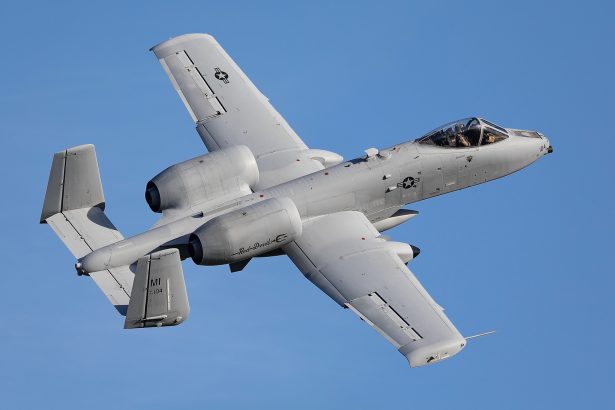
The M134 is effectively a scaled down version of the M61 Vulcan used by the F-16 to down the Russian drone. Rather than the 7.62mm ammunition used by the minigun, the aircraft cannon instead fires 20mm rounds at a rate of up to 6,000 per minute. The M61 first saw combat use in 1965 and has been in frontline service continuously since that date, fitted to aircraft as far apart as the F-104 Starfighter and the F-22 Raptor. It also features on the iconic Phalanx close-in weapons system (CIWS) carried by many warships and also adapted into a shore-based air defence system.
Although gun kills are far more preferable from an economic and logistics standpoint, saving more expensive and less expendable weapons for more sophisticated threats, it does force fighter crews into engagements at very low level against comparatively slow moving targets. This does present a much higher level of risk than the stand-off launching of an air to air missile – if successful, it is highly effective, but if mistakes are made this could quickly cause the loss of both the aircraft and, more importantly, its highly trained pilot.
Platforms like the An-28 mitigate this by making the weapon trainable – the aircraft can fly straight and level while the crew aims the weapon at the target. For an F-16, the pilot must instead point the nose of their jet at the target while also factoring in the high risk of collateral damage. If an attack is carried out from the same altitude or below, stray 20mm rounds could unintentionally cause severe damage on the ground and even threaten civilian lives. Instead, an attack would ideally be made from above, heading towards the ground, ensuring that stray rounds instead impact harmlessly into terrain.
Footage of a Ukrainian Air Force F-16 chasing down a Russian Kh-101 cruise missile. pic.twitter.com/uiACe7SjFd
— OSINTtechnical (@Osinttechnical) December 22, 2025
It’s not known exactly how many F-16s have so far been transferred into Ukrainian hands, though it is enough to sustain ‘daily’ sorties which by January 2026 had resulted in over 1,000 aerial kills of drones and cruise missiles. At least four F-16s have been lost, with three of these losses having taken place during drone attacks. In three out of these four known cases the pilot did not survive.
More F-16s, along with other aircraft both in the short and long term, are on the way, but the loss rate of current aircraft has to be kept sustainable by delicately balancing these higher risk missions against the operational necessity of using these assets rather than other aircraft or ground-based air defences (GBAD).