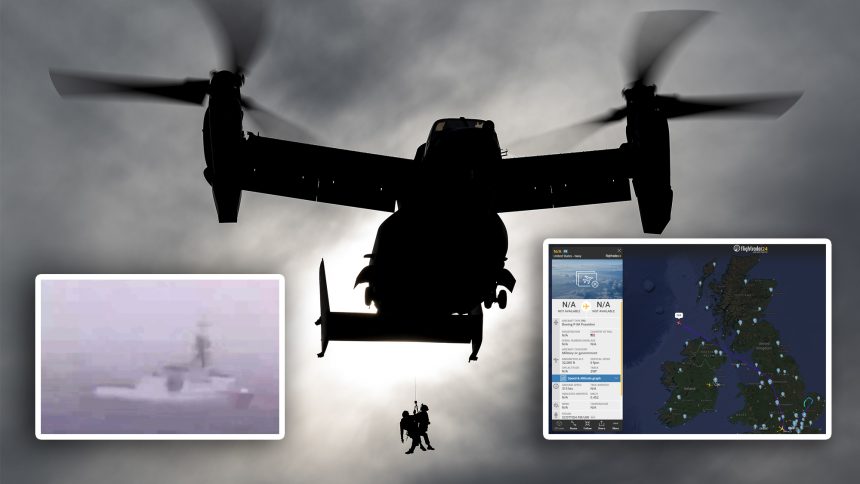
The Marinera continues heading through the Atlantic while watched by ISR aircraft and a USCG cutter. Meanwhile, special forces personnel train at Fairford, and a U.S. official tells WSJ that a Russian sub is lurking.
Footage released to Russian state-owned news outlet RT from the Marinera, previously named Bella 1, has confirmed that U.S. Coast Guard (USCG) assets have indeed pursued the evading oil tanker across the Atlantic. The sanctioned oil tanker was bound for Venezuela when U.S. forces attempted to board – the crew refused to allow the boarding, and made a quick about turn to head out into the ocean. We reported further on this saga previously, and looked into many of the movements that had so far then taken place – if you read this article and believe it has skipped over some important points, be sure to check there first in case we had already covered it.
The Russian state has repeatedly called on the U.S. and other parties to stop their pursuit of the vessel, and cease any and all efforts to seize it. State-owned Russian news sources claim the crew comprises Russian, Ukrainian, and Georgian nationals, and that the ship is empty and currently heading towards Murmansk.
We’re retweeting this as a legitimate video because we instantly recognize that eyesore of a rusty crane aboard the MARINERA. https://t.co/QtiQx0jDSC
— TankerTrackers.com, Inc. (@TankerTrackers) January 6, 2026
Based on the video, the cutter involved is one of the USCG’s ten active Legend class vessels, also known as the National Security Cutter. This is a fairly large 4,700t type of vessel, usually crewed by around 113 personnel and boasting a helicopter deck and hangar, Mk 110 57mm naval gun, a Phalanx close-in weapons system, and various crew-served weapon emplacements. They are also outfitted with electronic warfare systems, tactical datalinks, and 3D air search and surface search radars.
A USCG Legend Class cutter is chasing the now Russian-flagged oil tanker Bella 1 in the North Atlantic, with Russian media posting images of the cutter shadowing the tanker.
The US is reportedly planning to seize the ship after it attempted to run the blockade off of Venezuela. pic.twitter.com/FXFIR6BOXE
— OSINTtechnical (@Osinttechnical) January 6, 2026
The cutter’s presence does mean, as we talked about in the previous article, there is a friendly deck far out at sea which could be used in an emergency by rotary wing aircraft taking part in any move against the tanker. That being said, the Legend class’ flight deck is not large and would not be suited to be used as a staging post nor would it be able to cope if more than one aircraft experience a technical issue or fuel emergency. It could, though, provide search and rescue (SAR) coverage for these aircraft in case they needed to ditch. The level of SAR coverage available would depend on whether the cutter is carrying a helicopter or if it would have to rely solely on boats.
Alongside the cutter, a persistent effort by U.S. Navy P-8 Poseidons operating from RAF Mildenhall, as well as potentially from their regular forward operation base (FOB) at Keflavik in Iceland, has undoubtedly been keeping watch from the skies. On Jan. 6, a Royal Air Force RC-135W Rivet Joint also flew a mission towards the North Atlantic – it’s not known exactly what this mission was looking to gather intelligence on, though it could well have been scanning for any potential radio emissions made from or to the tanker or any nearby Russian vessels.
US Navy P-8s now flying almost around the clock out of RAF Mildenhall, UK and Keflavik, Iceland. Some great tracking resources to follow along: @ADSBex @liveatc @MarineTraffic and @AirNavRadar The P-8s use the callsign structure starting with 2 letters followed by 3 numbers. The… https://t.co/5DLTHaK8E3 pic.twitter.com/PbgqKZ2EoH
— Thenewarea51 (@thenewarea51) January 7, 2026
Even Irish Air Corps maritime patrol C-295s have flown a few missions out in that direction. The use of Irish airspace by the U.S. P-8s has been noted by the Irish media, which has aroused controversy. Assurances were even sought by an Irish air traffic controller handling one such aircraft that they had indeed secured the proper diplomatic clearance (often referred to as ‘dips’). Foreign military aircraft are not usually permitted to use Irish airspace during active operations.
US Navy P-8A #PM064 is also now heading out into the Atlantic, once again overflying Ireland with Shannon asking them to confirm they had diplomatic clearance.
168328 / #AE6892 https://t.co/8okTVb4OOE pic.twitter.com/M3YftJWRlL
— EISNspotter (@EISNspotter) January 6, 2026
Talks between the UK and Europe are reportedly ongoing as the former weighs whether to make join the U.S. in potentially staging a direct intervention against the tanker. Whichever way the UK Government decides, it is clear that the U.S. intends to use British soil to launch any operation, nevertheless requiring consent and therefore tacit approval from the host nation.
A potential extra reason for the constant presence of P-8s became apparent when the Wall Street Journal revealed that a U.S. official had told one of their reporters that a Russian Navy submarine was thought to have been tasked to shadow and monitor the tanker. It’s unlikely that this submarine would make any direct attempt to intervene in any potential raid, though as one of the premier intelligence platforms available to any nation it would have a clear use in keeping tabs on the situation without attracting as much attention as a surface vessel or aircraft.
Since runaway oil tanker MARINERA (formerly BELLA 1) has become a hot topic on this platform, it’s worth reiterating that the vessel isn’t carrying any oil cargo. It never docked in Venezuela; it came from Iran. See map of its route over past 7 months. https://t.co/pX3WfK0k4p pic.twitter.com/qLFkNlBRqW
— Christiaan Triebert (@trbrtc) January 6, 2026
From what can be gathered publicly, the tanker in question is running without any cargo. Blocked from entering Venezuela, it never picked up any shipment of oil. This makes the attention on it much more interesting, both from the side of the U.S. as well as from Russia. The ship switched its registry and flag to become Russian mid-voyage in an obvious attempt to deter interdiction. The question remains: what, if anything, is the Marinera carrying to warrant such a massive ocean-spanning operation to seize control of it?
The drama around this heap of scrap metal is so excessive that it raises the possibility that it is carrying a shipment of Russian weapons from Iran originally destined for Venezuela. https://t.co/MLydBLDu3j
— Oliver Alexander (@OAlexanderDK) January 7, 2026
Activity at RAF Fairford
Though the stream of C-17s has slowed, RAF Fairford in Gloucestershire, UK, has continued to be a hive of activity. We can once again confirm that there are five MH-60M Black Hawks and two MH-47G Chinooks on the ground at the base – reports on the exact numbers, especially in mainstream media, have differed, but this is what has been seen and photographed on the ground.
While the Nightstalkers have remained quiet since the single test flight by an MH-47G in the middle of the night shortly after their arrival, CV-22B Osprey tiltrotor aircraft from the 7th Special Operations Squadron (SOS), 352nd Special Operations Wing (SOW) at RAF Mildenhall have been more active. On Jan. 6, one of these Ospreys took part in an exercise with what appear to have been special forces personnel.
Footage shows insertion training underway at RAF Fairford, UK, potentially indicating preparations for a boarding operation targeting the crude oil tanker Marinera. pic.twitter.com/Vmfh4vnfPk
— GMI (@Global_Mil_Info) January 6, 2026
The exercise included the rehearsal of fastroping techniques as well as the transfer of supplies via the rope, which drops from the rear of the aircraft near the ramp. In the video embedded above, as shared by Global Mil Info, you can not only see a CV-22B arriving but three more airframes parked in the background and some of the numerous C-17s.
As we theorized before, based on our current knowledge of the operation the CV-22B, with its greater range, speed, and more efficient ability to loiter, would appear to be the more suitable aircraft to use for any move against the Marinera compared to those flown by the Nightstalkers. As with the 160th’s aircraft, the CV-22Bs can be refueled in midair by the 352nd SOW’s MC-130J Commando IIs, which can in turn be refueled by Mildenhall’s KC-135 Stratotankers.
There are some suggestions that this influx of movements and activity at Fairford is, instead of a preparation, actually a distraction. That the assets involved are conducting training while additionally acting to lure attention away from more important operations. Of course, there is absolutely no way of confirming this (or, indeed, refuting this) at present, and we do not know of any other areas where forces have been built up to stage such a ‘fake out’. But, given the recent case of Operation Midnight Hammer, we must acknowledge that anything could happen.
Other Interesting Movements
Both before and after our previous article, there were a number of other interesting aircraft movements into UK airfields which may be related to current events. They were not reported in our previous article due to space constraints, but we will go over some of them here.
First of all, as many have already noted, a U.S. Air Force C-40 visited RAF Fairford on Jan. 1, a couple of days before the flurry of C-17s began to show. This C-40 is painted in an inconspicuous scheme that resembles a civilian executive aircraft and carries none of the usual large, identifying serial numbers on the exterior. It is believed to be 21-0024 (also N972BJ), and has been linked to clandestine operations. It routed to Fairford via Rota, Spain, before which it had been in the U.S.
The C-40 into RAF Fairford overnight caught by Tom earlier today – no markings @SR_Planespotter @EISNspotter @Andyyyyrrrr https://t.co/6lO57yvq3D
— Saint1 (@Saint1Mil) January 1, 2026
Away from the closely watched RAF Fairford, at Bristol Airport, a nominally civilian-registered Gulfstream IV arrived after dark on Jan. 4. This aircraft, N478GS, is officially registered to L-3 IS LLC. In theory a subsidiary of L3 Technologies, now part of L3Harris, this specific company is thought to be used a shell for U.S. Government agencies to register aircraft. N748GS has been alleged before the European Court of Human Rights to be involved in detainee rendition flights operated by the U.S. Central Intelligence Agency (CIA).
L-3 IS LLC Gulfstream IV #N478GS is inbound to Bristol Airport from Norfolk. This aircraft has previously been linked to US Govt agencies.
N478GS / #A5DF79 pic.twitter.com/JVv1a3xJwh
— EISNspotter (@EISNspotter) January 4, 2026
Though the first thought upon reading that might have been that it had been positioned in order to transport detained crew members following a seizure of the Marinera, this is quickly quashed by the aircraft returning from Bristol to the U.S. the following day. It arrived at Bristol from Fayetteville Regional Airport (FAY) in North Carolina, and this is the exact same destination that it returned to. FAY has been linked by some, again, to CIA operations.
Also located in the city of Fayetteville is Fort Bragg, which, as we noted in previous reporting, is a major hub for U.S. Army special forces units, including the famous Delta Force. Instead of being used for detainees, then, could this flight have been used to transport a small number of personnel to what is, comparatively, a much more inconspicuous and lesser watched airport?
Back at Fairford, the aircraft already mentioned were joined by a CN-235, a C-295 and a C-146A Wolfhound on Jan. 6. all of these aircraft are operated by Air Force Special Operations Command (AFSOC). The C-295 flew from the U.S. as REACH 45, and the type is operated in USAF service by the 427th Special Operations Squadron at Pope Army Airfield (part of the Fort Bragg complex). The CN-235 is also operated by this unit. The C-146 – the military designation for a Dornier 328, meanwhile, is a local visitor.
USAF 427th SOS C-295W #RCH45 (17-0601) is also now making its way over to RAF Fairford direct from St. John’s, working Shanwick Radio HF 8879. https://t.co/OcXwQ3rz4O pic.twitter.com/YYz8MklB8F
— EISNspotter (@EISNspotter) January 6, 2026
Recently based at RAF Mildenhall, the C-146’s purpose was given at the time as providing a training aircraft for MC-130J crews as well as being able to act as a more discreet operational platform for inter-European missions that might involve landing at civilian airports. It arrived at Fairford from Mildenhall as DADDY 11 and spent only a few minutes on the ground before departing north for RAF Lossiemouth in Scotland. The exact purpose of this visit is unclear.
It should be noted here that one other aircraft that arrived at RAF Fairford on Jan. 6 was a U-2 Dragon Lady ‘spy plane’. While obviously an exciting catch for the spotters gathered to keep an eye on the airfield, the U-2 arrived at Fairford from Beale Air Force Base, California, on what was almost certainly a routine transit flight. The aircraft was missing the distinctive externally mounted sensor and communications pods usually seen on operational sorties, and base units even discussed the activities of U-2 aircraft at the base on social media on the very same day – while none of the other goings on were being documented in real time.
Three U-2 aircraft are currently present at RAF Fairford, and the base is a common stopover point for U-2s heading to and from operational bases further east as well as for U-2s flying real-world intelligence missions over Eastern and Northern Europe.