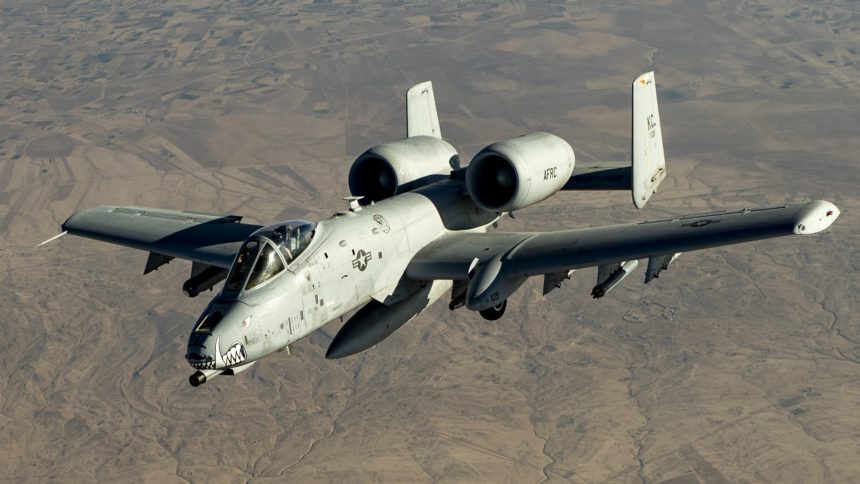
CENTCOM launched Operation Hawkeye Strike, striking over 70 targets with more than 100 precision munitions after two U.S. Soldiers and an interpreter were killed on Dec. 13.
The U.S. military has launched retaliation strikes against ISIS targets in Syria after two U.S. soldiers and an interpreter were killed on Dec. 13, 2025. In the night of Dec. 19, U.S. Central Command (CENTCOM) commenced Operation Hawkeye Strike at the direction of U.S. President Donald Trump, said a statement.
The A-10C Thunderbolt II aircraft of the U.S. Air Force were at the forefront of the operations, in face of the ongoing divestment. In fact, following the attack on U.S. forces, the A-10s were among the assets which were shown responding in videos emerged on social media, conducting shows of force over the area.
CENTCOM forces launched fighter jets, attack helicopters and other assets to conduct the large-scale strike. pic.twitter.com/3szSo2u5rm
— U.S. Central Command (@CENTCOM) December 19, 2025
Operation Hawkeye Strike
The operation was named “Hawkeye Strike” as tribute to the two soldiers killed in the attack, which were part of the Iowa Army National Guard. Iowa is also called the Hawkeye State.
U.S. President Donald Trump vowed retaliation for the killing of the U.S. soldiers. Secretary of Defense Pete Hegseth called the strikes a “declaration of vengeance.”
Earlier today, U.S. forces commenced OPERATION HAWKEYE STRIKE in Syria to eliminate ISIS fighters, infrastructure, and weapons sites in direct response to the attack on U.S. forces that occurred on December 13th in Palmyra, Syria.
This is not the beginning of a war — it is a…
— Secretary of War Pete Hegseth (@SecWar) December 19, 2025
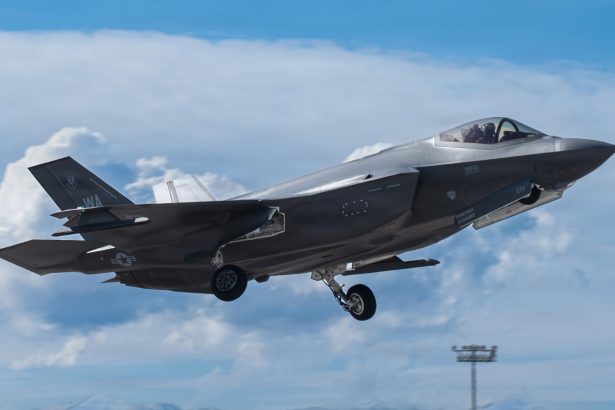
The operation was a joint effort which saw fighter jets, attack helicopters, and artillery, supported by Jordanian fighter aircraft. Among the assets involved were A-10C Warthogs (as the aircraft is known among the crews), F-15E Strike Eagles, AH-64 Apaches and M142 High Mobility Artillery Rocket Systems (HIMARS), supported by C-17s and KC-135s.

Images shared by CENTCOM on the DVIDS network show that A-10s and F-15Es were loaded with four Joint Direct Attack Munitions (JDAM) each, while the AH-64s were armed with AGM-114 Hellfire missiles. According to some reports, the HIMARS might have employed the MGM-140 Army Tactical Missile System (ATACMS).
Tonight, U.S. and Jordanian forces struck 70+ ISIS targets in Syria with 100+ precision munitions. Peace through strength. pic.twitter.com/XWWvfqBBFT
— U.S. Central Command (@CENTCOM) December 20, 2025
The operation saw all assets striking more than 70 targets at multiple locations across central Syria. CENTCOM says more than 100 precision munitions were employed against known ISIS infrastructure and weapons sites.
“This operation is critical to preventing ISIS from inspiring terrorist plots and attacks against the U.S. homeland.” said Adm. Brad Cooper, commander of CENTCOM. “We will continue to relentlessly pursue terrorists who seek to harm Americans and our partners across the region.”
The command described Operation Hawkeye Strike as the latest effort against ISIS in response to the death of the U.S. service members.

Dec. 13 Attack
On Dec. 13, 2025, a deadly ambush near Palmyra in central Syria targeted a joint U.S.–Syrian patrol supporting counter-Islamic State (ISIS) operations. The attack, carried out by a lone gunman affiliated with ISIS, struck as the forces were conducting a key leader engagement in an area not fully under government control, said the reports.
A U.S. Servicemember writes the names of the two soldiers with the Iowa National Guard who were killed in last week’s ISIS-affiliated attack in Central Syria; Sgt. Edgar Brian Torres Tovar, 25, and Sgt. William Nathaniel Howard, 29, along with a brief message, on a munition used… pic.twitter.com/LiJ1TB1SpW
— OSINTdefender (@sentdefender) December 20, 2025
Two U.S. Army soldiers and one U.S. civilian interpreter were killed in the attack, and three American service members were wounded. Syrian state media and security sources reported that two members of Syria’s security forces were wounded during the ambush as they returned fire and engaged the attacker, who was subsequently killed by the Syrian partner forces on the scene.
The incident marked the first U.S. military fatalities in Syria since the end of the Assad regime. CENTCOM says that, in the days after the attack, U.S. and partner forces conducted ten operations in Syria and Iraq which resulted in the deaths or detention of 23 terrorist operatives.
An A-10C Thunderbolt II “Warthog” Close-Air Support Attack Aircraft with the U.S. Air Force is currently making low passes and deploying flares over the city of Palmyra in Central Syria, where three Americans were killed in an ambush earlier today by ISIS. pic.twitter.com/DBWknGNZyv
— OSINTdefender (@sentdefender) December 13, 2025
These operations are not isolated. In fact, they are part of an ongoing effort since the relations between the two countries improved, which saw U.S. and partner forces in Syria conducting more than 80 operations over the last six months to eliminate terrorists.
A-10 on the Frontlines
The A-10’s divestment has been controversial as the Air Force has been trying to get rid of it for years, with the Congress intervening to avoid losing a critical CAS capability. The controversy stems from the A-10 not being survivable in modern contested environments with Anti-Access/Area Denial (A2/AD) networks, while it still remains highly capable in permissive scenarios such as the ones often found in the CENTCOM and AFRICOM Areas of Responsibility (AOR).
The retirement date has been subject to multiple variations throughout the years, with the service aiming to retire all the 162 A-10s still in inventory in FY2026, rather than gradually phase them out until 2029 as initially planned. However, the now approved National Defense Authorization Act rejects the Air Force’s plan and only allows the retirement of 59 A-10s.
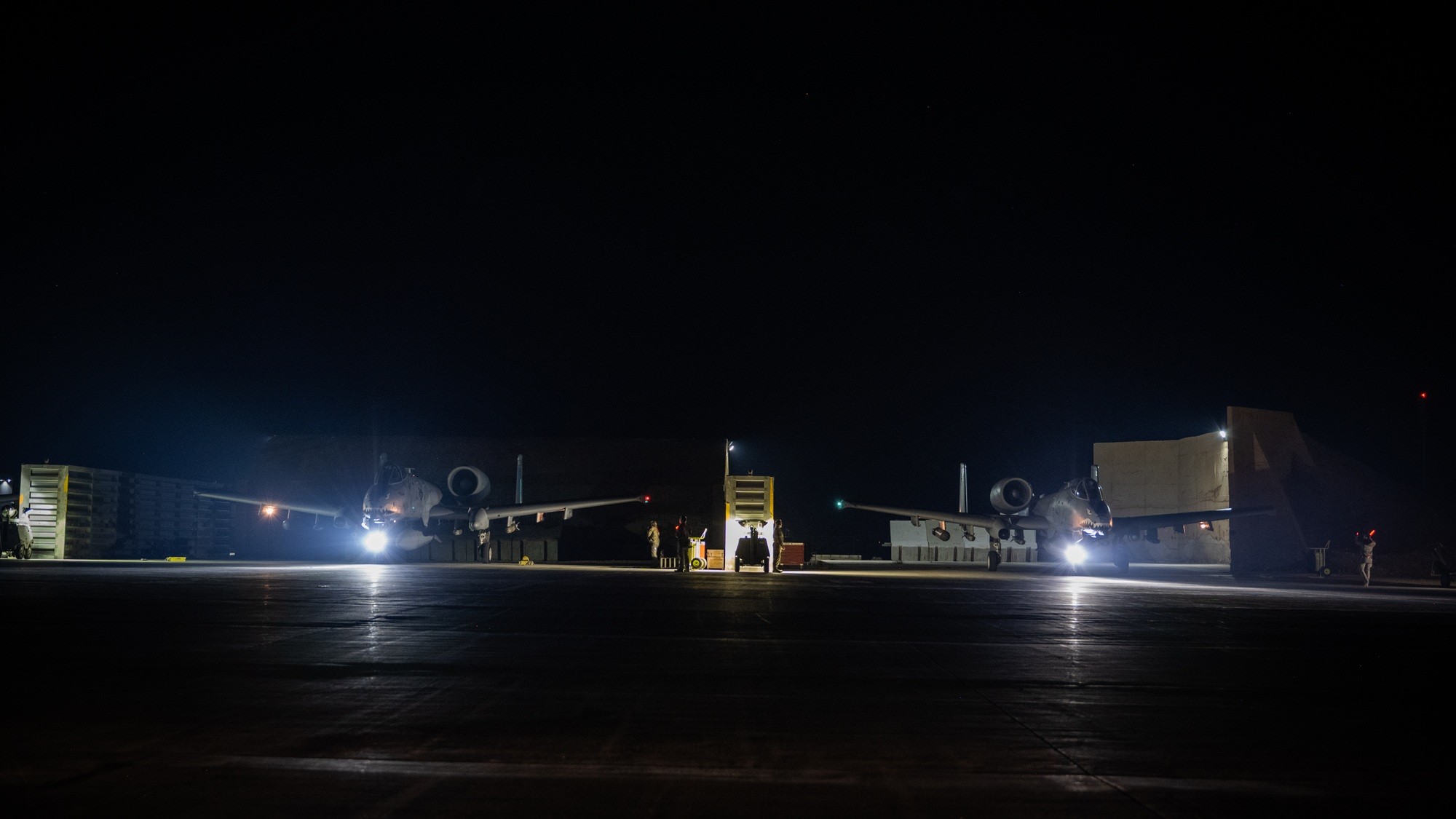
Even with the ongoing divestment, which recently saw the inactivation of the type’s test detachment and the Air Force Reserve Command’s (AFRC) Formal Training Unit, the A-10 is still on the frontlines, supporting U.S. Soldiers deployed in combat areas. Notably, the A-10 maintained an almost continuous presence in the CENTOM AOR.
While in the AOR, the Warthogs has also been used in a Counter UAS role and has shot down hostile One Way Attack (OWA) drones, as shown by kill markings earlier this year on A-10s from the 124th Fighter Wing of the Idaho Air National Guard, stationed at Gowen Field Air National Guard Base, Idaho. These aircraft have been replaced in the CENTCOM AOE by the A-10s of the 23rd Wing stationed at Moody Air Force Base, Georgia.
Many would ask why use the A-10, a slow aircraft built for Close Air Support, to intercept drones. The answer can be found in the captions of the U.S. Air Force used to describe the jet: “The A-10 can loiter near battle areas for extended periods of time and operate in low ceiling and visibility conditions.”
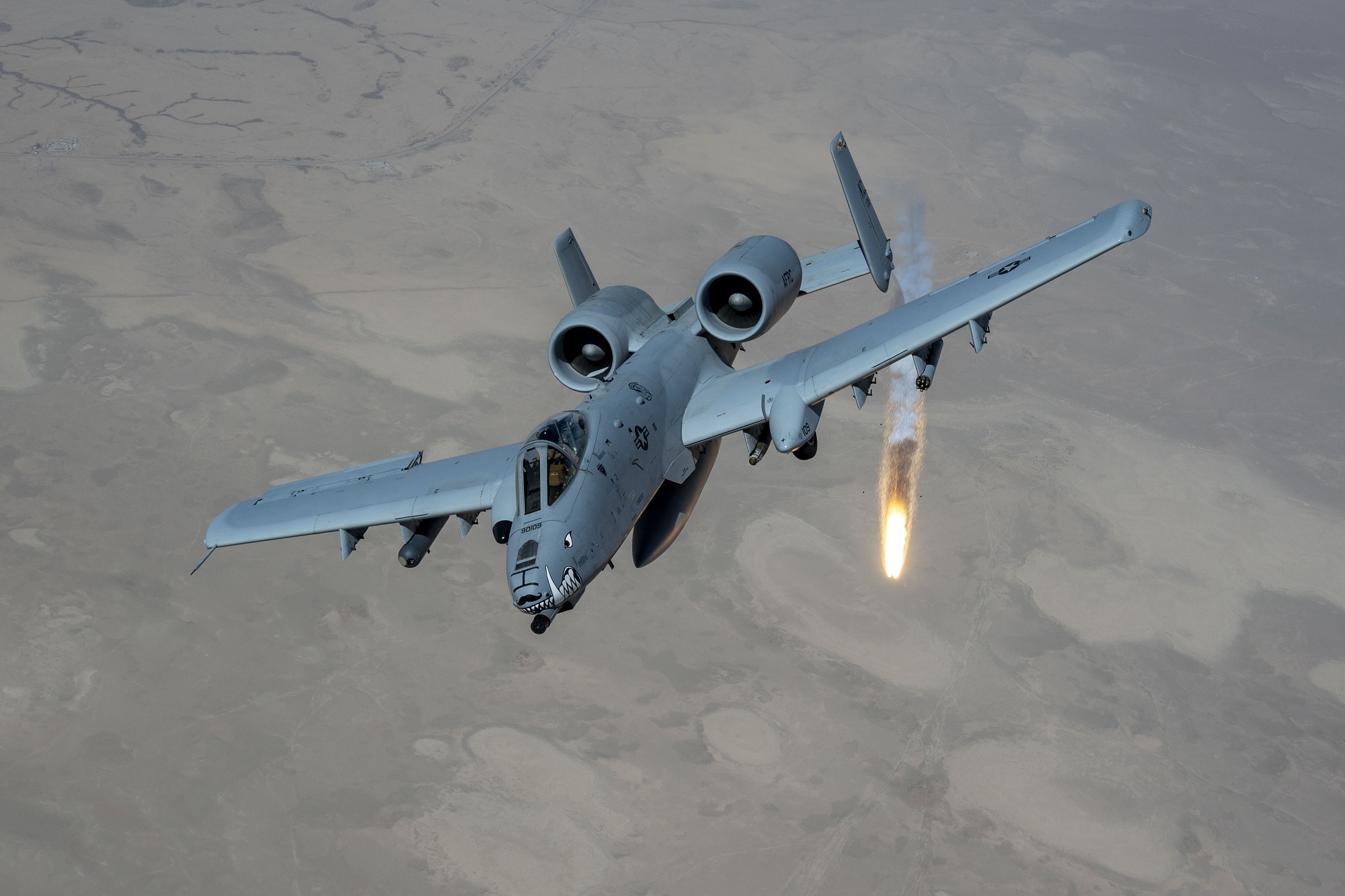
The photos showed the A-10s flying with a relatively light load, which included two GBU-54 Laser JDAM guided bombs and a LAU-131 A/A pod with seven AGR-20 rockets, also known as APKWS II (Advanced Precision Kill Weapon System). The latter, in the upgraded AGR-20F FALCO (Fixed-Wing Air-Launched Counter Unmanned Aerial Systems Ordnance) variant, is the weapon of choice for U.S. F-15Es and F-16Cs employed in a Counter-UAS role in the CENTCOM AOR.
For Operation Hawkeye Strike, the A-10s were seen loaded with four 500 lb JDAM bombs each, in addition to the Litening targeting pod and an external fuel tank.
The Coalition’s Evolving Relationship with Syria
Since the downfall of Bashar Al-Assad’s regime in Syria in 2024, and the implementation of a new interim transitional government led by Ahmed al-Sharaa, the country’s previously hostile relationship with the U.S., UK, and other allies in the Operation Inherent Resolve coalition have gradually warmed. Sharing a common goal in the elimination of ISIS, or Daesh, across the Middle East, and the establishment of democratic government for the people of Syria, official diplomatic relations between Syria and the United States were reinstated in September 2025.
Very little is understood about the extent of US-#Syria security ties — which are more advanced & operationally-tested than is commonly known.
My NEW @AlMajallaEN piece goes into exclusive detail on the “game-changing” new relationship:https://t.co/tfptHZlwO4
— Charles Lister (@Charles_Lister) November 17, 2025
President Trump, in a statement regarding Operation Hawkeye posted on social media, said that the Syrian government had given its full support to the U.S. airstrikes. Syria’s Ministry of Foreign Affairs also commented on its continuing fight against ISIS, and that it “invites the United States and member states of the international coalition to support these efforts”.
The Syrian Arab Republic invites the United States and member states of the international coalition to support these efforts in a manner that contributes to the protection of civilians and the restoration of security and stability in the region.
4/4
— وزارة الخارجية والمغتربين السورية (@syrianmofaex) December 19, 2025
This marks a significant change compared to previous operations, where strikes conducted against ISIS forces have simultaneously contended with Syrian government forces or forces belonging to their allies, such as Russia. Russian jets have previously harassed U.S. drones operating over Syria on a regular basis.
Alongside special operations launched against Syrian government forces in response to the Khan Shaykhun and Douma chemical attacks, U.S. and coalition forces also directly targeted Al-Assad’s military on several occasions where they threatened or attacked allied personnel.
Hostility from regime forces meant some areas of Syrian airspace, for example near Damascus or the Russian positions on the country’s Mediterranean coast, were not readily accessible by coalition air power due to the potential anti-aircraft threat. For any forces transiting into the combat area from the west, for example, this required detours via friendly airspace over Israel and Jordan, or via Turkey.
The most recent missions flown by Royal Air Force MQ-9B Protector RG1s from RAF Akrotiri, on the island of Cyprus, demonstrate the evolving situation. Rather than taking the traditional routing, which has been seen used by Typhoons and Voyager tankers for over a decade, via Israel, the aircraft routed directly east, over Lebanon, and to the north of Damascus.
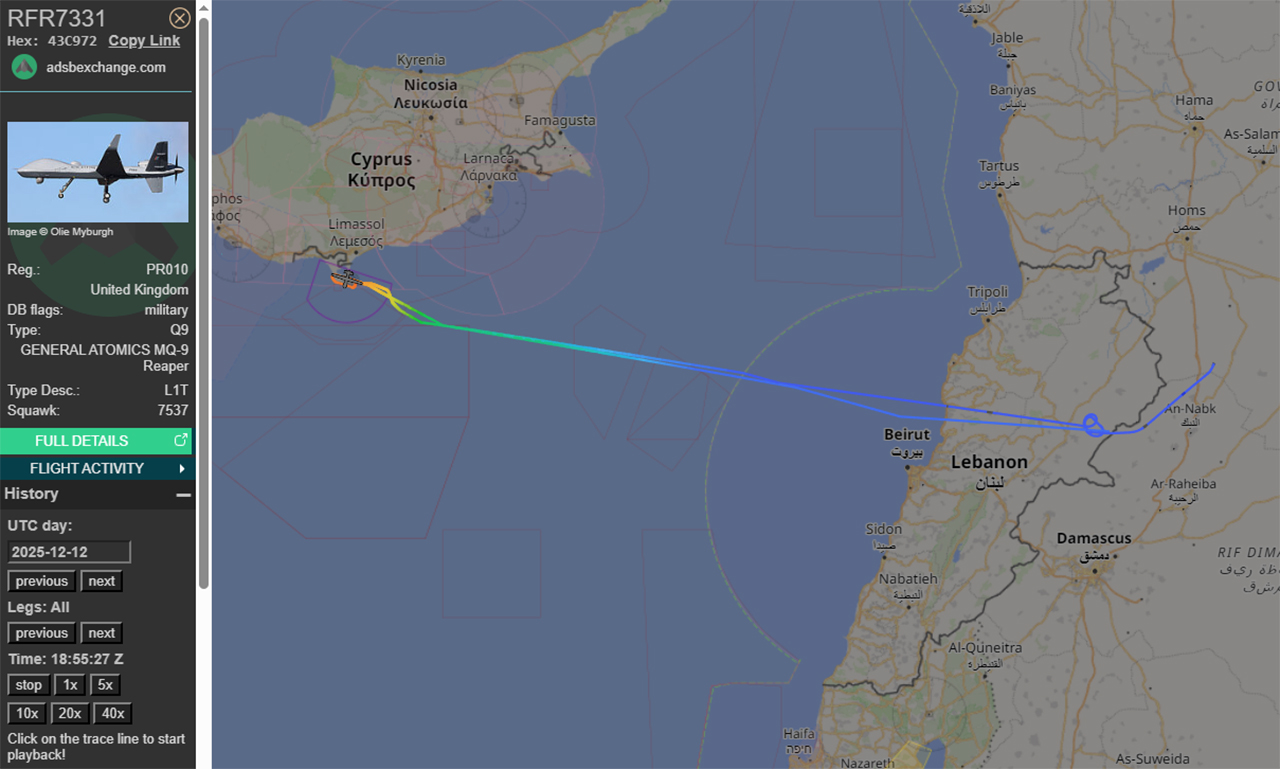
Additionally, on some occasions, the drone can be seen circling prior to entering Syrian airspace. This is commonly seen when military aircraft are awaiting the proper diplomatic clearance to enter a country’s sovereign airspace, and it would not likely be something that happened were the flights still being conducted without the consent of the Syrian government.