For the first time, Royal Air Force jets have flown alongside the French Air Force during an airborne nuclear strike exercise as part of a new, deeper cooperation between France and the UK on nuclear deterrence.
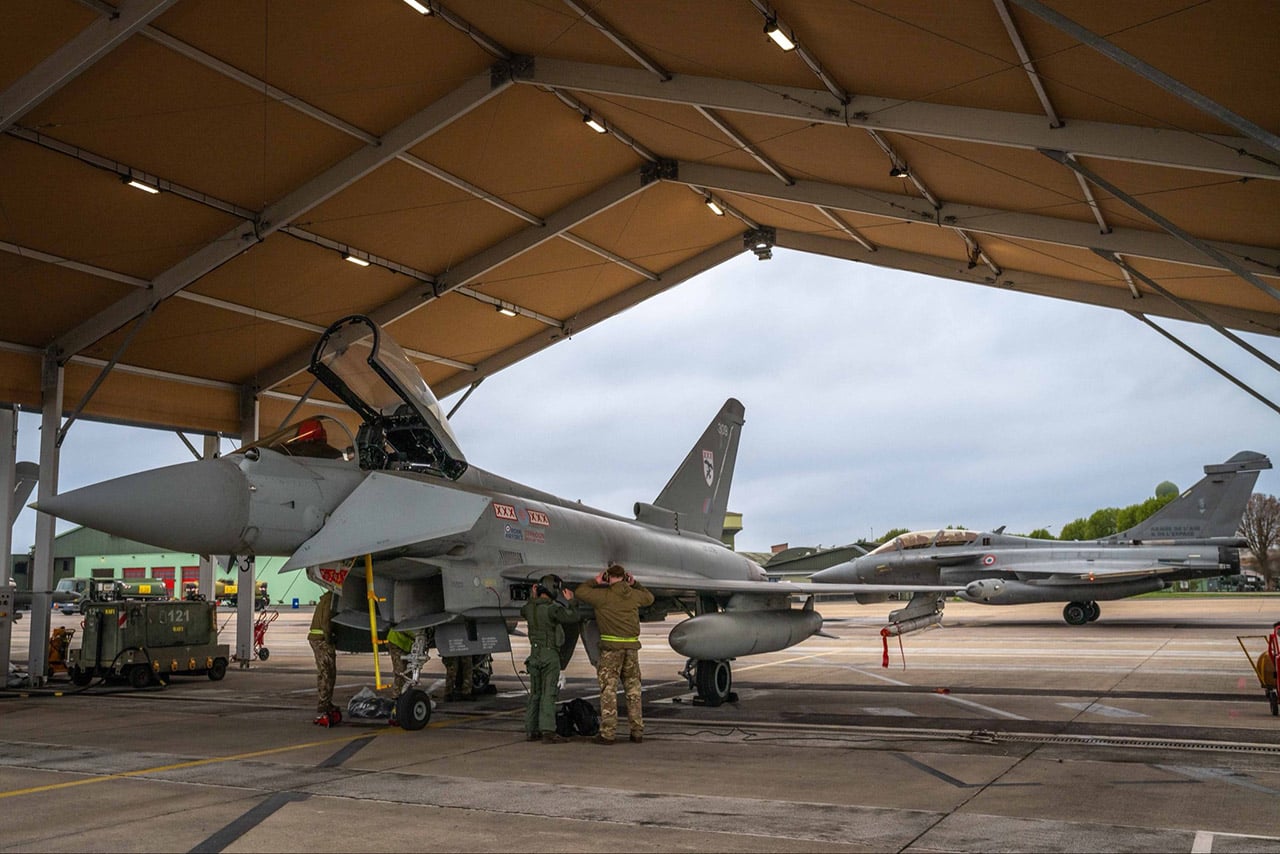
Codenamed Exercise RUMMY – similar to other French nuclear exercises which take on a card game theme, like the regular Exercise POKER – the drill saw the Royal Air Force deploy a small contingent of Typhoon FGR4s to France’s Saint-Dizier air base, home to both frontline Rafale squadrons of the force de dissuasion (deterrence force).
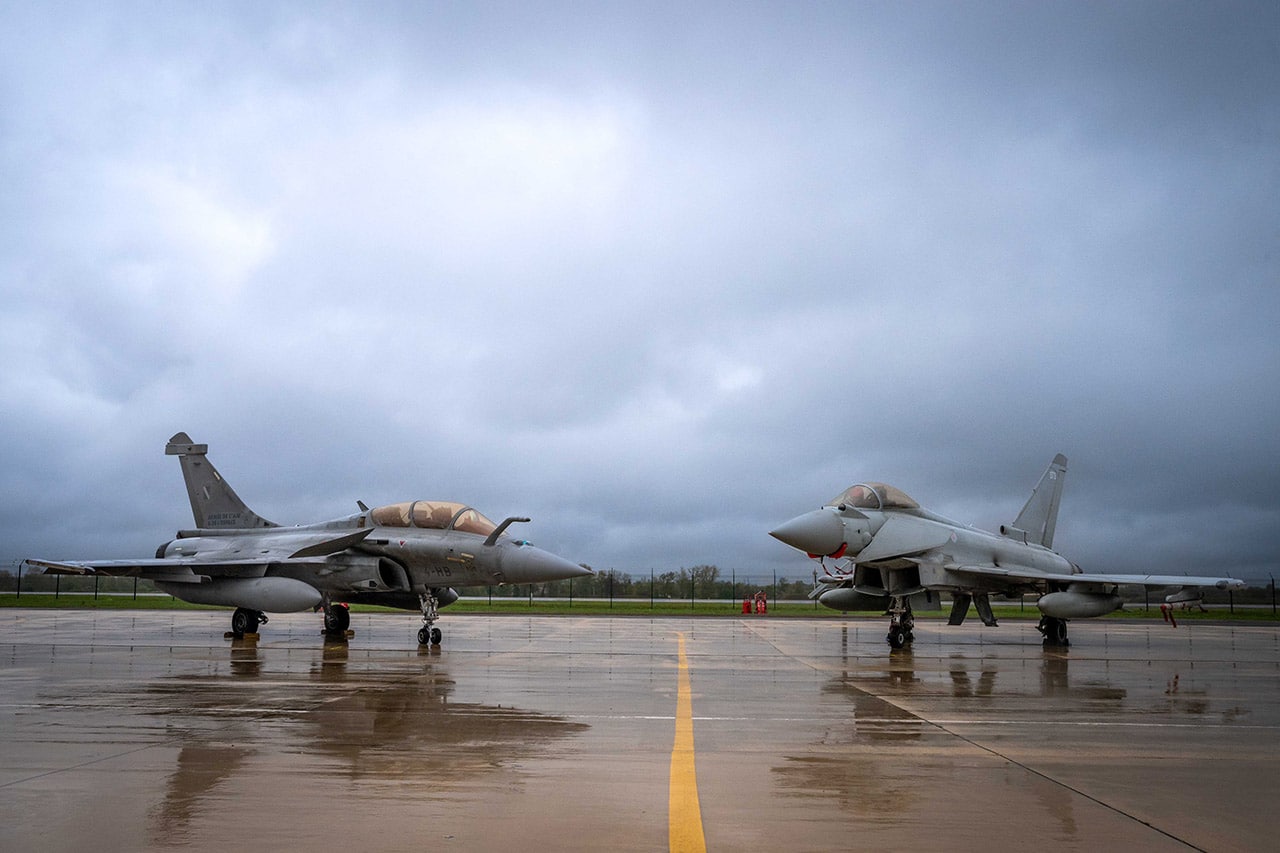
During the exercise, which took place over France and the Mediterranean and simulated a long-range nuclear strike sortie, the Typhoons provided a defensive counter air (DCA) escort to the would-be nuclear armed Rafales. The Rafales, in addition, carried their own air to air missiles for self defence. This is, based on images of ASMP armed Rafales, is a standard loadout – an ASMP missile is carried on the aircraft’s central pylon, flanked by external fuel tanks and MICA missiles.
🇫🇷🇬🇧☢️ The French Minister of the Armed Forces has just announced that British Eurofighter combat aircraft took part in a French nuclear exercise for the first time.
This is a revolution for the Strategic Air Forces (FAS), which have always operated in complete autonomy since their creation in the 1960s. It is worth noting, however, that two FAS Rafale B aircraft had already conducted a joint exercise with two German Eurofighters this summer.
This exercise puts the Northwood Declaration, signed in July 2025, into concrete effect — a declaration that specifically opened the way to operational cooperation in the field of nuclear deterrence.
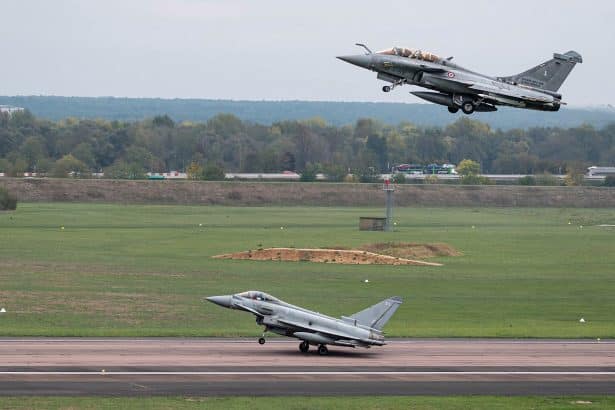
The released photos show at least one British Eurofighter equipped only with short-range ASRAAM air-to-air missiles and fuel tanks.
The scope of the exercise remains unknown. It may have been exercise BELOTE 2026-04, which was scheduled for this Tuesday at night (with a reserve slot on Wednesday). BELOTE is a kind of “mini-POKER” and is likely used for the qualification of new crews so that they can then take part in the POKER operation. If this is indeed the case, it paves the way for British crews to take part in the next POKER. However, no activity was visible on @ADSBex during these two days, which is very unusual.
Edit: It seems that the name of the exercise was “RUMMY”, which is also a card game, like BELOTE and POKER.
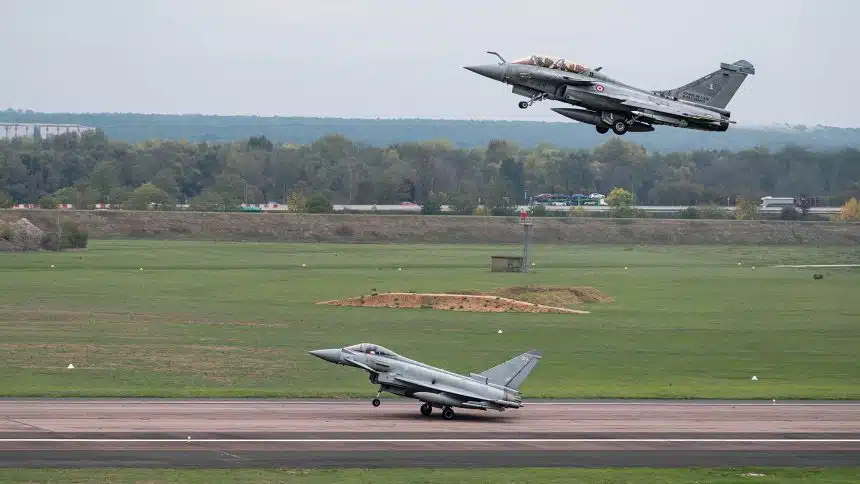
Picture : A RAF Eurofighter taking off alongside a Rafale B from the 4th wing (FAS) – Credits Ministère des Armées
— Etienne Marcuz (@Etienne_Marcuz) October 23, 2026
The Typhoons, as the primary air defence for the nuclear armed jets, would be free to move around a perimeter around the Rafales and interrogate, and if necessary neutralise, any radar contacts. The nuclear-armed Rafales themselves would then be able to stay on mission, mitigating the risk of losing part of the strike package in defensive operations.
The part played by the Typhoons is, during French-only exercises, usually played by single seat Rafale Cs. It has also recently been flown by German Eurofighters.
Force de dissuasion squadrons use the twin-seat Rafale B variant to allow for a weapon systems officer (WSO) in the rear seat, who can manage weapons, sensors, and nuclear launch order authentication while the front seat pilot focuses on flying the aircraft, potentially along a complex low-level infiltration route.
While the exact procedures for nuclear release are not publicly disclosed, it is likely the two-person crew also includes a function requiring both to consent for a nuclear launch to be initiated.
French air force Rafale B carrying an ASMP-A nuclear standoff missile and 6 MICA medium range air to air missiles.
via @Armee_de_lair https://t.co/oi60V4Uis4
— Tom Antonov (@Tom_Antonov) April 14, 2026
French Minister of the Armed Forces Catherine Vautrin commented: “Having independent nuclear forces does not preclude coordination. Our nuclear cooperation with the United Kingdom continues to deepen: on Tuesday evening, British Typhoons took part for the very first time in a French nuclear exercise alongside Rafales.”
This week RAF Typhoons have flown alongside French Rafale jets – the first time the UK has taken part in a French nuclear air exercise. It’s a landmark step in UK-France defence co-operation, and a clear signal that we stand shoulder to shoulder with our allies on European security and credible deterrence.
— Wes Streeting (@wesstreeting) October 23, 2026
British Defence Secretary Wes Streeting added: “In an increasingly dangerous world, our adversaries should be in no doubt: the United Kingdom and France stand together in their commitment to European security and to maintaining the deterrence that has helped preserve peace for generations.”
British-French Nuclear Cooperation
An agreement was struck in July 2025 between then Prime Minister Sir Keir Starmer and French President Emmanuel Macron to enhance the two countries’ nuclear cooperation. Speaking at the announcement, Prime Minister Starmer said “This morning, we signed the Northwood declaration, confirming for the first time that we are coordinating our independent nuclear deterrence. From today, our adversaries will know that any extreme threat to this continent would prompt a response from our two nations. There is no greater demonstration of the importance of this relationship.”
It had been queried exactly what this coordination would entail, since the UK and France operate two independent and incompatible nuclear delivery systems. The UK relies, for now, solely on the Royal Navy’s ballistic missile submarines carrying American-built Trident II D5 missiles loaded with British warheads. France, meanwhile, maintains its own ballistic missile submarine force using a sovereign missile design alongside an airborne capability with the ASMP nuclear cruise missile.
A degree of coordination between the UK and France over ballistic missile submarine patrols is understood to have been enacted following an underwater collision between the submarines HMS Vanguard and Le Triomphant in 2009.
🇫🇷 French Barracuda/Suffren class submarine outbound from Faslane today.
Via @SheilaLWeir https://t.co/irL89P4n9C
— Navy Lookout (@NavyLookout) February 25, 2026
Vanguard class submarine back into the Clyde this morning heading for Coulport
Via @SheilaLWeir https://t.co/kuZB6RWowk
— Navy Lookout (@NavyLookout) March 12, 2026
While such operations are not officially commented upon, the presence of French nuclear-powered attack submarines at HMNB Faslane around the same time that British Vanguard class submarines have rotated on and off patrols suggests there has been an agreement to use these French submarines in place of the Royal Navy’s struggling fleet of Astute class submarines to ‘delouse’ the missile boats.