The U.S. Air Force is using virtual reality to help B-52 student pilots master aerial refueling before their first live flight, reducing the time, sorties and costs needed to reach proficiency.
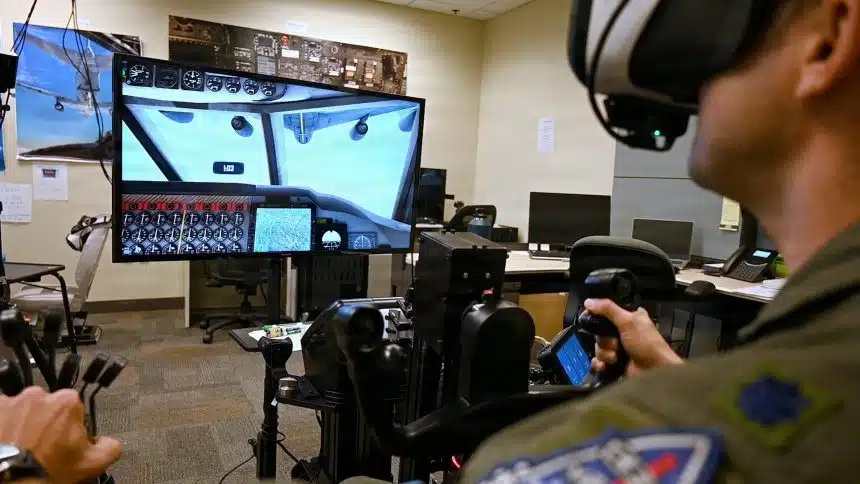
The U.S. Air Force is incorporating a virtual reality (VR) training device into the training of B-52 Stratofortress student pilots, helping them prepare for aerial refueling, one of the bomber’s most demanding flying tasks, before they take to the air. The system provides an accessible way to practice aerial refueling without requiring a tanker, a flying aircraft or the associated operating costs.
Known as the Experiential Air Refueling Lightweight Simulator (EARL), the device is being used at Barksdale Air Force Base, Louisiana, where the B-52 Formal Training Unit prepares new pilots. According to the Air Force, students who trained with the device after it was integrated in the syllabus have been able to secure contact with the tanker “on their very first live flight.”
B-52 student pilots are mastering aerial refueling in virtual reality before their first live flight—cutting training sorties & saving critical flight hours.
See how we use advanced tech to prepare our heavy bombers for the fight: https://t.co/d5ZY39jOyH https://t.co/iMN6WXyV1o
— U.S. Air Force (@usairforce) October 20, 2026
Bringing Aerial Refueling Practice to the Ground
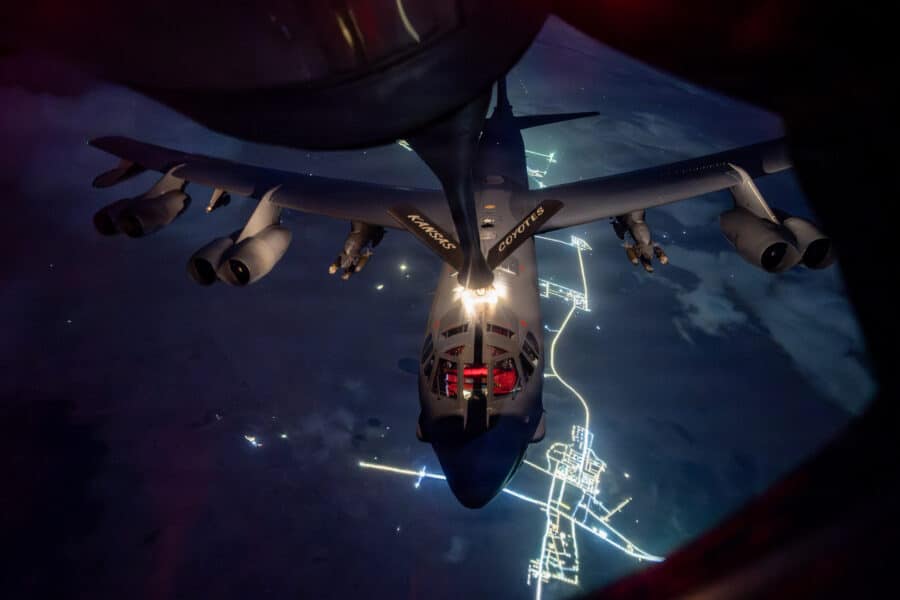
Aerial refueling is a particularly challenging skill for B-52 pilots. Similarly to other aircraft, the B-52 must maintain a precise position relative to a tanker, and small control inputs and anticipatory corrections are essential to maintaining the correct position for contact with the refueling boom.
However, the bomber’s inertia complicates the maneuver, and the response to the pilot’s inputs is anything but instantaneous. Students thus need to learn how to anticipate the bomber’s behavior, instead of reacting to it.
For years, during the first refueling training mission, student pilots would get the aircraft into position roughly 50 feet behind a tanker’s boom and hold that position from 20 to 30 minutes, without attempting contact. That also comes with a cost, as the B-52 burns approximately 3,000 gallons of fuel per hour, according to the press release.
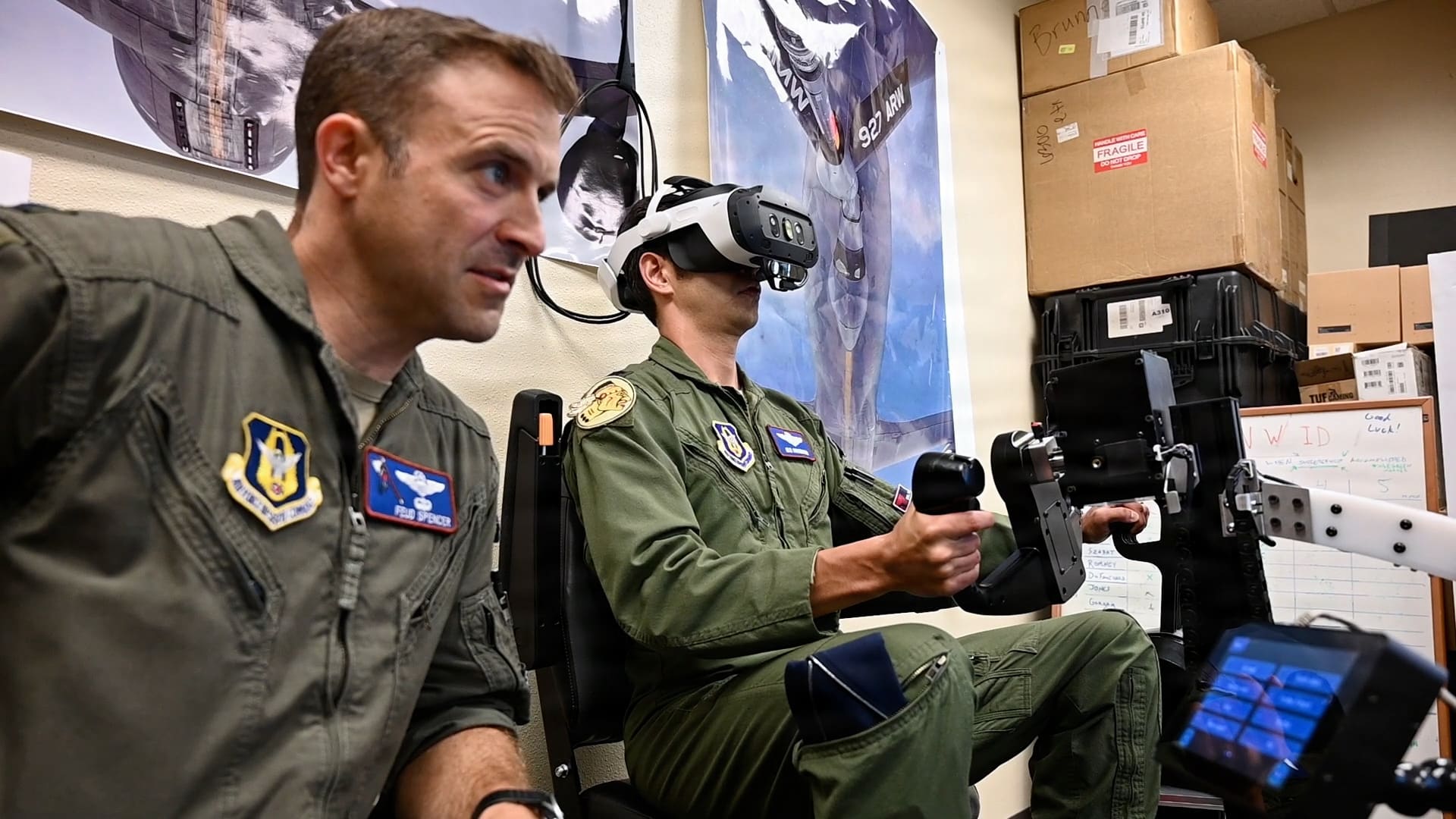
Lt. Col. Brandon Wolf, a B-52 instructor pilot with the 93rd Bomb Squadron, described the challenge, saying: “I’m trying to park a half-million-pound aircraft into a twelve-foot box in the sky.”
The training would also be subject to a tanker’s availability, unpredictable weather, maintenance delays, and compounding fuel costs. These constraints would create a challenge themselves.
“Air refueling was the long pole in the tent for our training pipeline,” Wolf said. “It was very difficult for students to master in the allotted flights we had. We had to go to heroic efforts to get everyone graduated on time.”
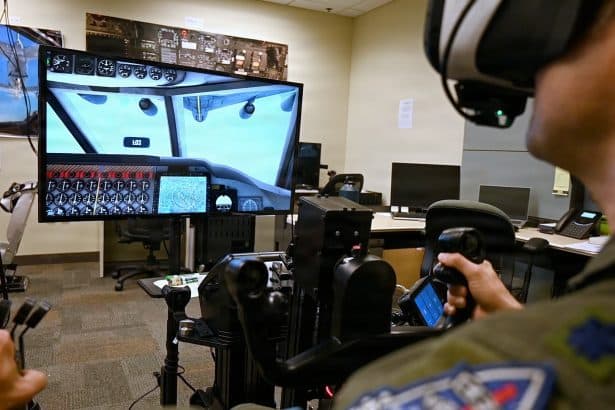
EARL provides an additional opportunity to practice the task before students encounter it in the aircraft. The setup combines a VR headset with a custom set of throttles and a control yoke mounted to a chair, allowing trainees to experience a simulated aerial-refueling approach on the ground.
The system was developed by Specular Theory, a small technology company, in collaboration with Wolf. EARL is not intended to replace actual flight training, but instead helps students to prepare students for it, allowing them to become familiar with the required control inputs and visual cues before attempting the maneuver with a live tanker.
Why the Training Method Matters
EARL is not being used as a standalone system, but was integrated in a specific syllabus. The instructional approach, called Integrated B-52 Unit Flight Familiarization (I-BUFF), was developed with support from researchers at Louisiana Tech University.
It integrates VR practice into the training process, with instructor guidance helping students develop the skills required for aerial refueling. The team also collected data to evaluate EARL’s effectiveness.
The results were examined in a study involving 233 B-52 student pilots. According to the Air Force, trainees who followed the structured VR curriculum required an average of 1.7 fewer sorties and 39 fewer minutes of flight time to achieve aerial-refueling proficiency than those trained using traditional methods.
“Cutting nearly two sorties saves real money, but more importantly, we’re reinvesting that time in other parts of training,” Wolf said. “More time in the range simulating weapons employment, and doing landings, because we’re not as constrained by how much air refueling, we still need to check off.”
These results suggest that VR can help reduce the amount of live flying required to master a specific training task. Additionally, with students developing familiarity with the task before their first live attempt, instructors can concentrate on refining their performance in flight rather than introducing every aspect of the maneuver for the first time.
Cognitive workload and safety of flight
Col. Aaron Bohl, commander of the 307th Operations Group, explained that the introduction of the VR training helps increase the safety of air refueling.
“Really for me, especially as a commander, it’s the safety element,” Bohl said. “Students are now working on the fine-tuning of air refueling before their first time behind a live aircraft.”

One of the most important factors is the cognitive overload.
“Wrestling 20 to 30 pounds of physical force through the yoke while strapped into a parachute and breathing through an oxygen mask is exhausting enough,” explained the service. “Doing so while reading a tanker’s position and calculating split-second corrections creates immense cognitive overload.”
Air Force Global Strike Command Striker STEEL program Chief Scientist Dr. Tucker Readdy further explained how the cognitive skills could influence safety of flight. During aerial refueling, students must constantly track three separate points of visual reference.
“The real difficult cognitive skill is change detection,” Readdy said. “If those three points are aligned, then you should stay connected to the boom, and fuel is good.”
This also needed training on its own. In fact, the release says that initially the VR device was provided without a formal curriculum, resulting in low student engagement. Readdy’s team introduced cognitive training on top of the physical task, intentionally dialing up the mental workload as students improved, simulating high-stress scenarios that would be too dangerous to deliberately test in a live jet.
The addition led to a breakthrough, with statistically significant performance difference as data indicates that pilots who trained with EARL excelled in comparison to their counterparts. “You can absolutely pull the classes that had training on the trainer versus those that did not,” Readdy said.