The test evaluated cargo equipment aboard SpaceX’s Starfall capsule as the U.S. Air Force continues researching commercial rocket-based logistics to enable rapid deliveries anywhere on the globe.
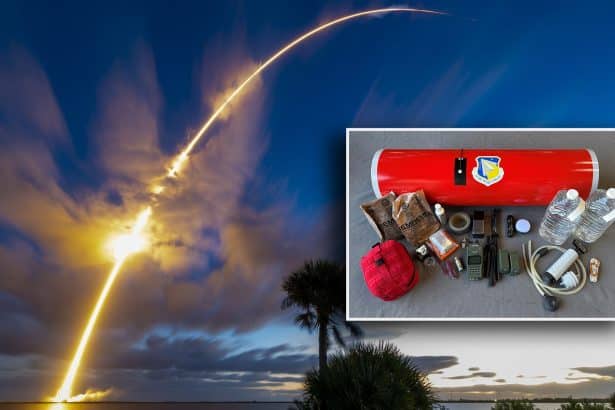
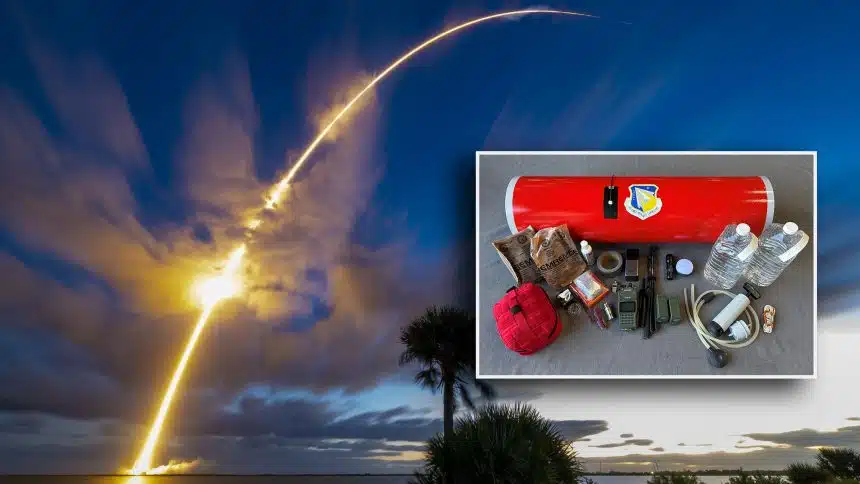
The U.S. Air Force Research Laboratory (AFRL) is continuing to investigate the use of commercial rockets for rapid military cargo deliveries. On October 20, 2026, a SpaceX Falcon 9 launched the Bandwagon-5 rideshare mission from Space Launch Complex 40 (SLC-40) at Cape Canaveral Space Force Station, Florida, carrying a Starfall capsule equipped with cargo-related test hardware.
According to AFRL, the trial evaluated an “agile pod” aboard a specially instrumented SpaceX Starfall capsule to measure temperature, shock, and vibration in the cargo environment. The pod, designed to host various loads for point-to-point deliveries (P2D) anywhere on Earth, carried representative mission equipment, with images released by AFRL showing items including military Meals, Ready-to-Eat (MRE) packets, a first-aid kit, water bottles, and communications equipment.
Additional equipment identified by the press release included electronics and survival equipment, such as a satellite-communications-enabled tracker, batteries, a reverse-osmosis desalination unit, and emergency medical equipment. Engineers also conducted a fit check of a UNI-PAC III life raft inside the Starfall capsule to assess its potential use in future tests.
@SpaceX @SLDelta45 A UNI-PAC Ill life raft was also fit tested for the Starfall capsule & can be flown in future tests. #AFResearchlab is continuing to assess #RocketCargo capabilities for quickly transporting critical DoW materials to locations across the globe. Learn more: https://t.co/1B0fOdc2bF https://t.co/JiuVBhVzZk
— Air Force Research Lab – AFRL (@AFResearchLab) October 20, 2026
In addition to SpaceX, AFRL has engaged with several other commercial companies rocket-based cargo delivery and related reentry technologies, including Blue Origin, Rocket Lab, Sierra Space, Anduril, Varda Space Industries, Inversion Space and Outpost Space. The companies are involved in different efforts under the broader high-priority Vanguard program called Rocket Cargo.
Rocket Cargo evaluations
The test hardware flew aboard SpaceX’s Bandwagon-5 rideshare mission, which carried a total of 32 payloads into orbit, including Starfall, according to SpaceX. The mission used the Falcon 9, SpaceX’s partially reusable two-stage rocket, with the booster capable of landing back vertically for reuse.
Department of the Air Force’s (DAF) technology executive office and AFRL chief Brig. Gen. Douglas P. Wickert said the launch demonstrated AFRL’s partnership with industry “to burn down risk, collect hard data and deliver war-winning technologies for the operational force.”
🔄 🚀 Launch Pad Playback 🚀 🔄
SLD 45 supported this morning’s Falcon 9 Bandwagon-5 launch, demonstrating the rapid-response capabilities and operational flexibility of the #EasternRange 🌎
2026 Launch Count: 6️⃣ 0️⃣
@usspaceforce I @ussf_ssc https://t.co/KwxosSzcEA
— Space Launch Delta 45 (@SLDelta45) October 20, 2026
“This was a critical achievement to demonstrate the potential of Rocket Cargo delivery for point-to-point rapid global mobility for the Future Force,” said Adam Remaly, director of the AFRL Technology Transition Office. “The cross-discipline collaborations and ability to unleash the speed of our defense industrial base are key to maximizing capability and winning the future.”
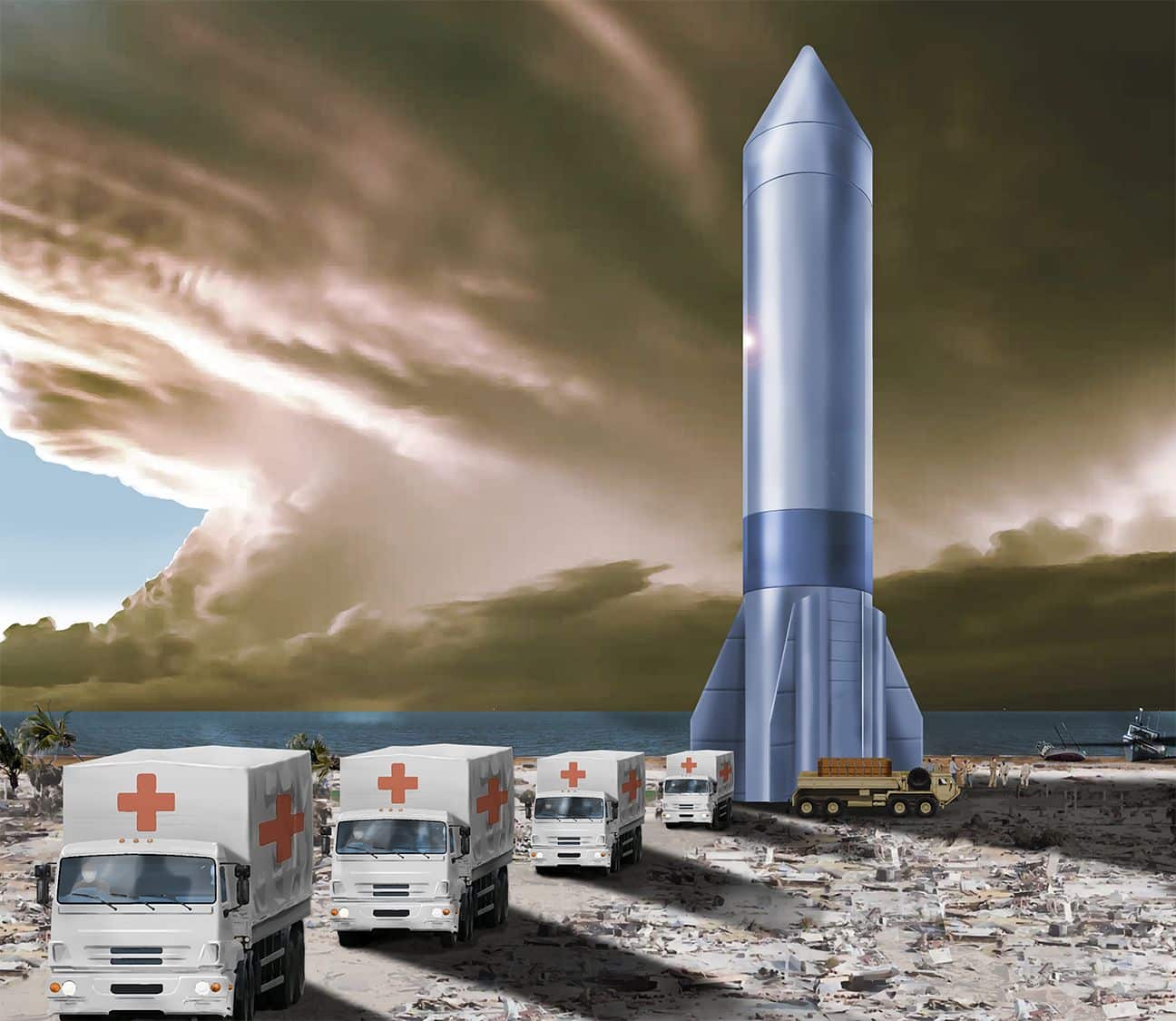
AFRL described Rocket Cargo as a research and development effort to assess the “viability of using large commercial liquid-propellant rockets to rapidly deliver materiel anywhere on the globe on tactical timelines.”
AFRL explained that potential applications include resupplying forces at remote or contested locations, supporting expeditionary operations where conventional transport infrastructure is unavailable, and delivering emergency supplies for disaster relief or other crises. These remain prospective uses that the program is evaluating.
AFRL said further iterative testing will assess the technologies needed to deliver critical cargo rapidly and at scale to locations around the world.
Falcon 9 launches the Bandwagon-5 rideshare mission to orbit from Florida https://t.co/StXyXyvdMZ
— SpaceX (@SpaceX) October 20, 2026
Background
The U.S. military has been exploring the use of commercial rockets for rapid global logistics for several years. On Oct. 7, 2020, then-U.S. Transportation Command (TRANSCOM) chief U.S. Army General Stephen R. Lyons outlined the concept during the National Defense Transportation Association’s virtual Fall Meeting.
Gen. Lyons said during the NDTA’s virtual interaction:
“Think about moving the equivalent of a C-17 payload anywhere on the globe in less than an hour. Think about that speed associated with the movement of transportation of cargo and people. There is a lot of potential here and I’m really excited about the team that’s working with SpaceX on an opportunity, even perhaps, as early as [20]21, to be conducting a proof of principle. I had no sense for how fast SpaceX was moving, but I’ve received their update and I can tell you they are moving very rapidly in this area.”
While Lyons highlighted the ability to haul a C-17’s worth of cargo anywhere in the world in less than an hour, questions remain over the concept’s cost, scalability and its legal, geopolitical and strategic implications. The Department of the Air Force (DAF) subsequently included the Rocket Cargo effort within its Vanguard programs.
The program is “solely focused on leveraging commercial rocket capabilities as a leased service […] for global logistics, to include improvements in delivery cost and speed compared to existing air cargo operations,” AFRL said. The Air Force’s proposed budget for FY 2022 sought $48 million in funding for the initiative.
The research effort has since evolved. While the original Rocket Cargo Vanguard focused on the potential use of large commercial rockets to transport substantial cargo loads, the Air Force and Space Force are also pursuing smaller reentry capsules through AFRL’s Payload Delivery System (PDS) program. The joint effort is examining challenges associated with transporting cargo through space, surviving reentry, and delivering it to austere locations on land or at sea.
On March 3, 2025, a Notice of Intent (NOI) by the Department of the Air Force announced plans to prepare an environmental assessment for a proposed Rocket Cargo test and demonstration site at Johnston Atoll in the North Pacific, around 860 miles southwest of Hawaii. The proposal called for two landing pads capable of supporting “up to 10 reentry vehicle landings per year over four consecutive years.”
In July 2025, however, the department placed the environmental assessment on hold while AFRL considered alternative locations for the demonstrations.
According to Breaking Defense, the U.S. Air Force and Space Force began joint funding of the PDS program this year, with the Air Force fiscal 2026 budget slating $30.6 million and the Space Force’s $21.2 million. The Air Force asked for $32.3 million in its FY2027 request; the Space Force asked for $16.5 million.