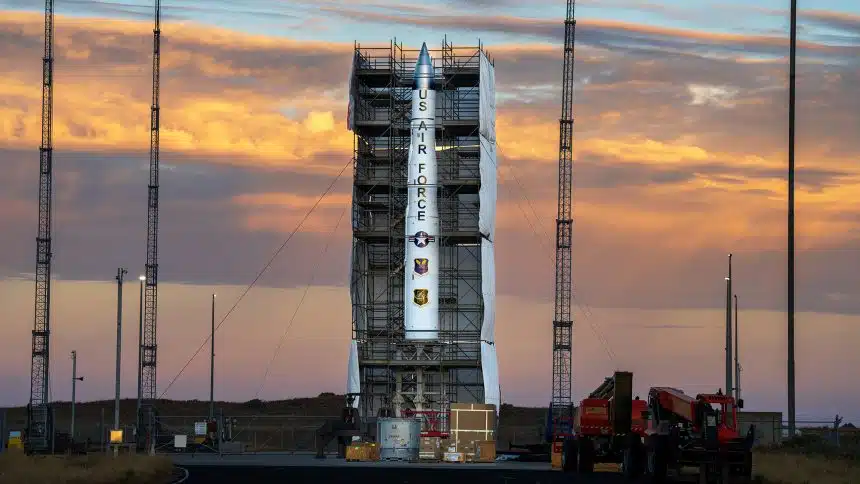
An LGM-35A Sentinel intercontinental ballistic missile (ICBM) has been vertically stacked at Vandenberg Space Force Base, California, as preparations continue ahead of the missile’s anticipated first test launch next year.
The LGM-35A Sentinel, built by Northrop Grumman, is due to replace the U.S. Air Force’s venerable force of LGM-30 Minuteman III missiles which have stood on alert, loaded with nuclear warheads, since 1970.
Initial deployment is penned in for the early 2030s, providing the scheduled 2027 test launch proceeds according to plan. As The Aviationist has reported previously, the Sentinel program has had its fair share of issues, including huge cost overruns as well as the relatively recent decision not to re-use existing Minuteman silos. Sentinel missiles, fitting to their name, are expected to sit silently in their silos on duty until at least 2075.
The completion of the Sentinel’s vertical stacking was the result of a four month program of transportation and testing, verifying all of the major components as well as ensuring the readiness of handling processes and personnel. Individual parts of the Sentinel stack have been tested extensively in isolation, including test firings of the solid-fueled first, second, and third stages.
The Mk21A reentry vehicle that will sit on top of the missile in service and carry the nuclear payload has been tested using Minotaur I launch vehicles. Current plans are for each missile to carry a single warhead, though the theoretical launch payload for the missile is widely thought to be able to support multiple warheads and/or decoy and countermeasure systems. Similarly, the Minuteman III was designed with the capability to deploy as many as three independently targetable warheads but current doctrine limits each missile to one warhead.
A Minotaur I rocket carrying an unarmed US Air Force Mk21A reentry vehicle launches from Vandenberg Space Force Base in California on June 17. Mk21A will be mounted atop Sentinel intercontinental ballistic missile and will carry a W87-1 nuclear warhead.https://t.co/0MADDKG76S pic.twitter.com/HCrscRfFB5
— Ryan Chan 陳家翹 (@ryankakiuchan) July 2, 2024
“Sentinel is no longer conceptual or designs for what the nation’s next-generation ICBM looks like; it’s a physical, fully integrated system that is one major step closer to being ready for flight testing,” said General Dale White, Director of Critical Major Weapon Systems for the Department of Defense. “While this is a significant achievement, we will keep driving, firmly focused on delivering a modernized, credible strategic deterrent that will safeguard the nation and its allies well into the future.”
“This is more than a milestone, this integration demonstrates our commitment to moving forward with the pace necessary to modernize the ground-based leg of our nuclear triad and deliver critical capability to the warfighter,” he added.
The first flight test Critical Design Review for the LGM-35 was completed alongside the stacking event by 719th Test Squadron of the Air Force Test Center (AFTC) and Northrop Grumman. The 719th TS, headquartered at Hill Air Force Base, Utah, oversees testing, evaluation, modernisation, and life extension for all U.S. Air Force ICBMs.
We’re moving with speed and scale to deliver Sentinel to the @USAirForce – accelerating the path to flight test with a fully integrated Sentinel missile assembly and successful Critical Design Review. Learn more: https://t.co/neDmHIVoHF pic.twitter.com/67b1HMqLVW
— Northrop Grumman (@NGCNews) September 14, 2026
Northrop Grumman’s vice president and general manager for strategic deterrent systems, Amanda Davis, said: “This vertical assembly demonstrates the momentum toward test launching Sentinel in 2027 and having missiles on alert by the early 2030s, ensuring the United States’ ground-based nuclear capabilities remain strong and reliable for decades to come.”
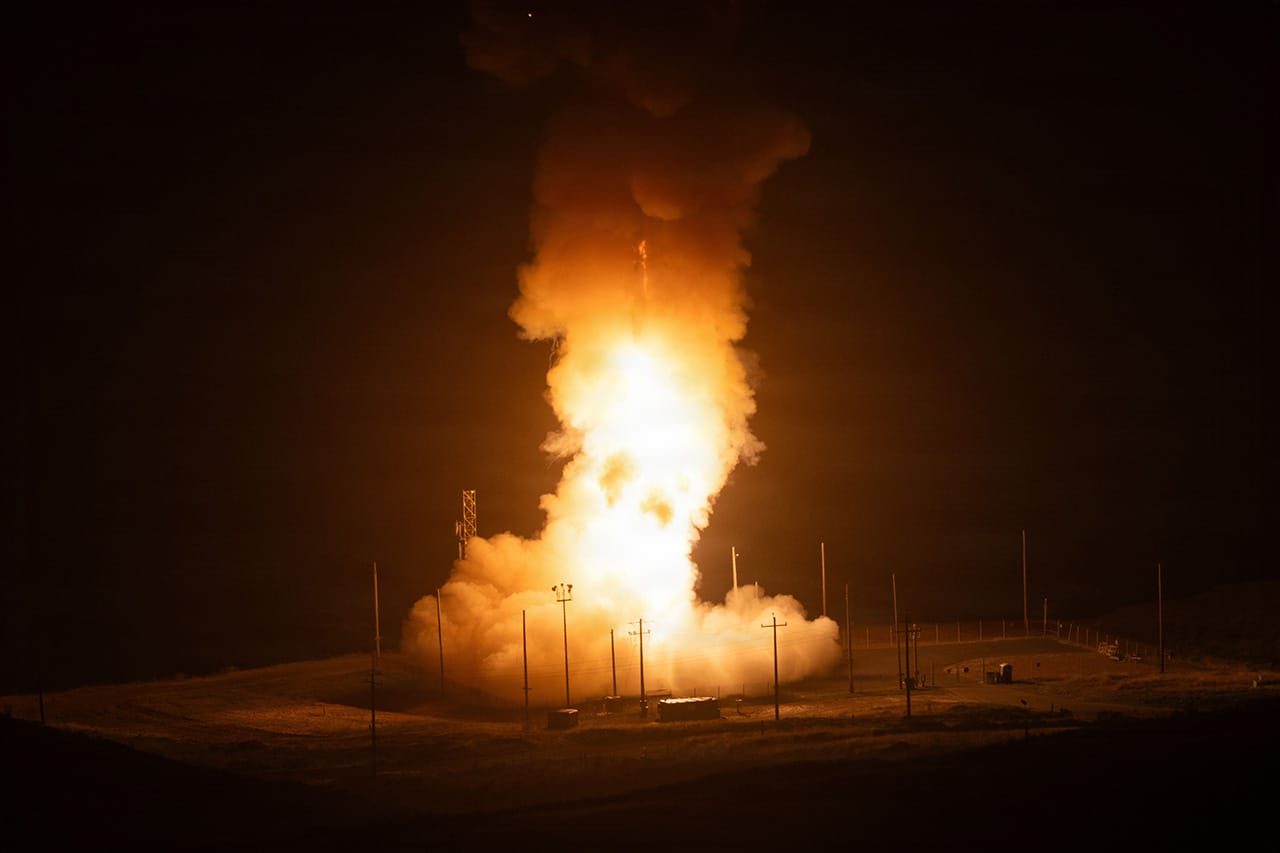
The first test launch, at least, will be conducted from above ground. For Minuteman III test launches, Vandenberg is equipped with a number of Minuteman III-style silos, and presumably the same will apply for the Sentinel in the future. The first prototype Sentinel silo is currently being developed by Northrop Grumman in Utah.
🚀The LGM-35A Sentinel ICBM program is rapidly moving from digital design to tangible reality, marked by the recent groundbreaking for a full-scale launch silo prototype in Promontory, Utah. #Nuclear #readinesshttps://t.co/YUaMu3D26m pic.twitter.com/RcKy5UGRJJ
— U.S. Air Force Materiel Command ✈️ (@HQ_AFMC) April 1, 2026
634 operational Sentinel missiles are to be procured by the U.S. Air Force, not including 25 missiles dedicated for developmental use. These 634 missiles will support a frontline force of 400 missiles, allowing units to be rotated in and out for maintenance and upgrades over time.