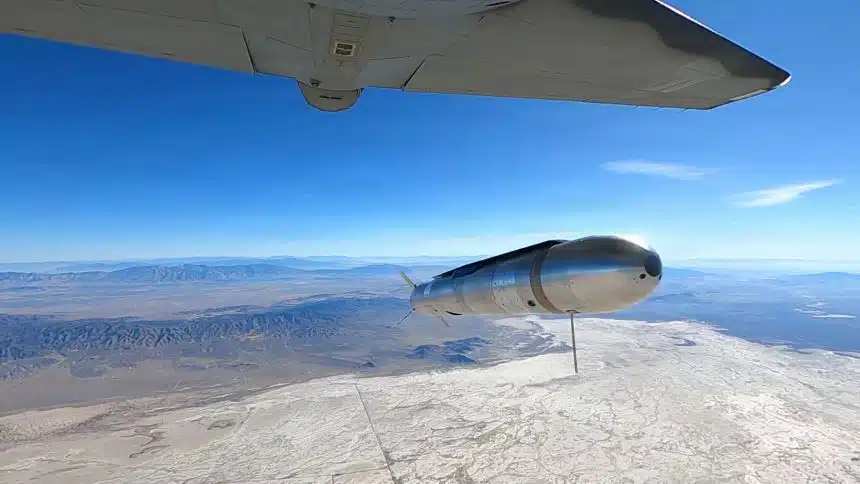
The AFSOC said the latest combat evaluation took place this spring within U.S. Africa Command’s area of responsibility, with the missile employed from an AFSOC platform in a “test configuration.”
The AGM-190A Havoc Spear small cruise missile underwent a new combat evaluation this spring, with the weapon employed from an AFSOC platform in a “test configuration”, the Air Force Special Operations Command (AFSOC) announced on Sep. 14, 2026. Held in the Africa Command’s (AFRICOM) Area of Responsibility (AOR), the trial “successfully met requirements to become an available weapons system for broader real-world use across a variety of special operations and conventional aircraft,” the AFSOC said.
The command did not release details about the specific platform employed, although the videos show it was a C-130 variant. It is also unclear whether a live warhead was used during the trials.
The footage shows a flash and explosion-like effect immediately after the Havoc Spear impacts the target in one of the three B-roll test videos. The videos were released on Sep. 14.
This is the third known round of tests, following December 2023’s captive carry trials and the guided flight tests in November 2024. The missile also received the new AGM-190A designation, as Leidos had announced on Feb. 26, 2026. Until then, it was known as the Black Arrow small cruise missile.
Read the full story here ⬇️ https://t.co/BPkgKmnjpI
— Leidos (@LeidosInc) September 14, 2026
The AGM-190A reflects the U.S. military’s growing interest in affordable, adaptable stand-off weapons that can be rapidly developed and modified for different missions. Its modular design is intended to support rapid upgrades and adaptation to changing requirements.
Latest tests
AFSOC said the U.S. Special Operations Command (USSOCOM), working with Leidos, developed the AGM-190A under a Cooperative Research and Development Agreement (CRADA). This enabled moving “faster than standard acquisition timelines to field innovative capabilities like Havoc Spear to the warfighter.”
An AC-130J Ghostrider gunship was used in the first two trial campaigns. The latest videos show a special operations variant of the C-130, however it is not possible to determine whether this was an AC-130J.
Similar to the previous tests, the Havoc Spear appears to have been released off a Rail Launch Tube (RLT) from the rear ramp of the aircraft, after which it descends several meters before the motor kicks in, and it eventually strikes the top of a marked structure.
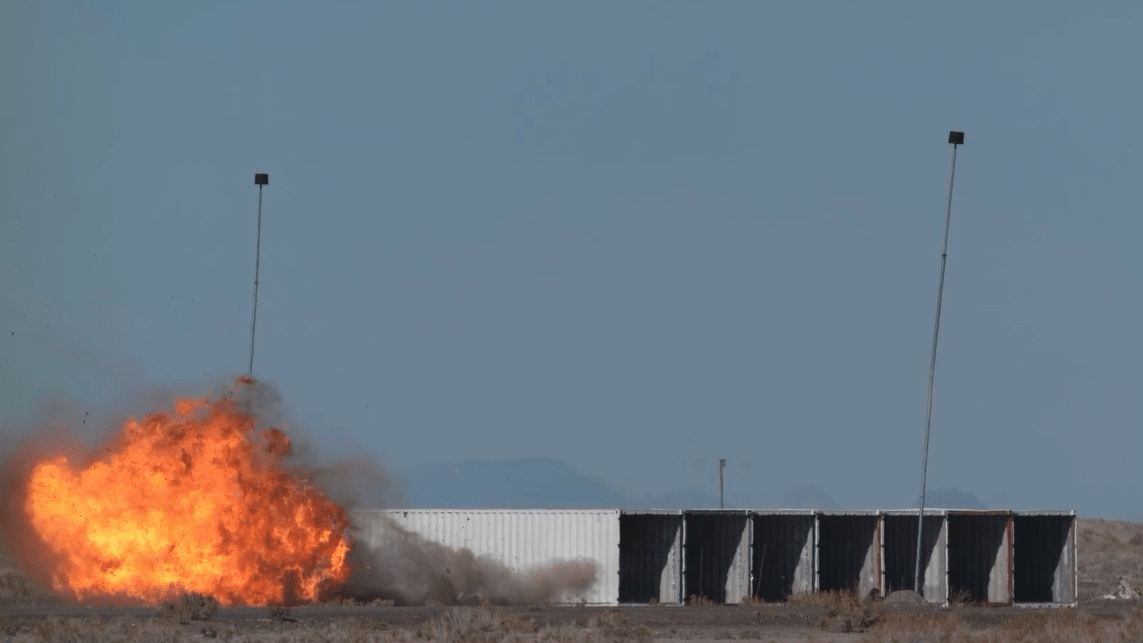
The videos show the test captured from several cameras – inside, around the aircraft, including separate viewpoints tracking the Havoc Spear and the aircraft. Another viewpoint appears to show the missile being tracked by an electro-optical/infrared sensor and, ultimately, the impact on target.
A closer inspection of the AFSOC imagery shows what appears to be a transparent window in the missile’s nose, possibly indicating the presence of an electro-optical seeker that could have been used with the apparent laser illumination of the target. However, neither the seeker type nor the weapon’s guidance method in this test has been publicly confirmed.
Affordable, scalable and versatile missile
AFSOC commander Lt. Gen. Mike Conley said the Havoc Spear’s “range and capabilities expand standoff options, giving commanders a versatile tool to neutralize threats without putting platforms or personnel in immediate danger.” Conley added “It’s also not lost on us the value of being able to test a new weapon system in combat – and prove its success on the battlefield early on in the process.”
U.S. Air Force Gen. Dagvin Anderson, commander of AFRICOM, talked about the AGM-190A’s relevance in his AOR: “We work every day to disrupt the networks that have made Africa the epicenter of global terrorism. These successful operational assessments prove we will continue to bring the unique capabilities only the U.S. can provide in order to defend U.S. interests alongside our partners.”
AFSOC’s director of strategic plans, programs and requirements Col. Robert Johnston referred to the CRADA, describing how it marked a departure from “traditional acquisition pipelines.” This comes as the AFSOC is exploring “more agile, lesser-known pathways to modernization to deepen industry partnerships, leverage calculated risks, and rapidly deliver capabilities to our warfighters.”
[NEWS] Leidos announces the ‘Black Arrow’ has successfully completed first tests. https://t.co/Uq0d3Ovj4Q
— Leidos (@LeidosInc) October 3, 2024
The release touched upon the AGM-190A’s use cases, saying the missile will “enhance lethality, create dilemmas for adversaries, and reinforce AFSOC’s commitment to maintain a decisive advantage against emerging threats across all domains.”