The U.S. State Department approved a possible Foreign Military Sale to Italy of the air-to-air variant of the APKWS-II, which would include over 5,000 guided rockets.
The U.S. Defense Security Cooperation Agency (DSCA) announced that the State Department has approved a possible Foreign Military Sale (FMS) to Italy of the air-to-air variant of the Advanced Precision Kill Weapon System-II (APKWS-II). The deal would include 5,031 Guidance Sections Single Variant Air-to-Air Advanced Precision Kill Weapon System-II WGU 59B/B for an estimated total cost of $364 million, which equals €311.66 million.
Additionally, the approved package includes LAU-131 A/A launchers, Mk-152 high explosive warheads, MK66 rocket motors, proximity fuzes, WTU-1/B practice warheads, and inert MK66 rocket motors. As usual, also included are engineering, technical, and logistics support services.
“The proposed sale will improve Italy’s capability to meet current and future threats by strengthening its homeland defense and serving as a deterrent to regional threats,” said the DSCA. “This enhanced capability will protect Italy and local allied land forces and will significantly improve Italy’s contribution to NATO integrated air missile defense.”
The statement by the DSCA did not include which armed force will receive the weapon, if the sale is finalized. Also, there is no indication about the platform which would use it, however the specific mention of the air-to-air variant is notable.
APKWS for Italian Typhoons?
The mention of the air-to-air variant of the APKWS-II rockets could point to the weapon being eyed by the Italian Air Force to equip its fighter jets for Counter Unmanned Aerial Systems (C-UAS) missions. Last year, a service spokesperson told Janes’ Gareth Jennings that the Italian Air Force was “not looking at acquiring any additional mission-specific systems to counter the UAS threat.”
@ItalianAirForce also “not looking at acquiring any additional mission-specific systems to counter the UAS threat”. Depending on what the Spanish have to say, could be a short conversation for the Eurofighter CEO.
— Gareth Jennings (@GarethJennings3) June 26, 2025
At the time, the UK similarly said it did not have plans to equip its Typhoons with rockets for the C-UAS mission. Less than a year later, the Royal Air Force deployed operationally the APKWS-II aboard its Typhoons, following a quick integration campaign.
What a difference a year makes – after every @eurofighter partner operator told me in 2025 that they had no plans to fit #APKWS for counter-#drone, @BAESystemsAir tells @JanesINTEL and others at Warton today that there is now strong interest from all 10 partner and export…
— Gareth Jennings (@GarethJennings3) June 18, 2026
It should be noted that, as part of an Implementing Arrangement, the Italian Air Force and the Royal Air Force are working to increase the interoperability in the maintenance and logistics of their common Typhoon fleets, as well as the integration of their assets when employed in the same operational context. Last year, Italian Typhoons also deployed to the UK to conduct integration trials of the Paveway IV, a weapon already used by the RAF on its Typhoons.
In line with last year’s statements, the integration of the APKWS-II rockets on the Italian F-2000 fleet (as the Eurofighter Typhoons are designated in Italy according to the MoD’s Mission Design Series) was not previously announced and does not figure in publi government documents. However, should this be confirmed, the integration might take advantage of the lessons learned by the RAF.
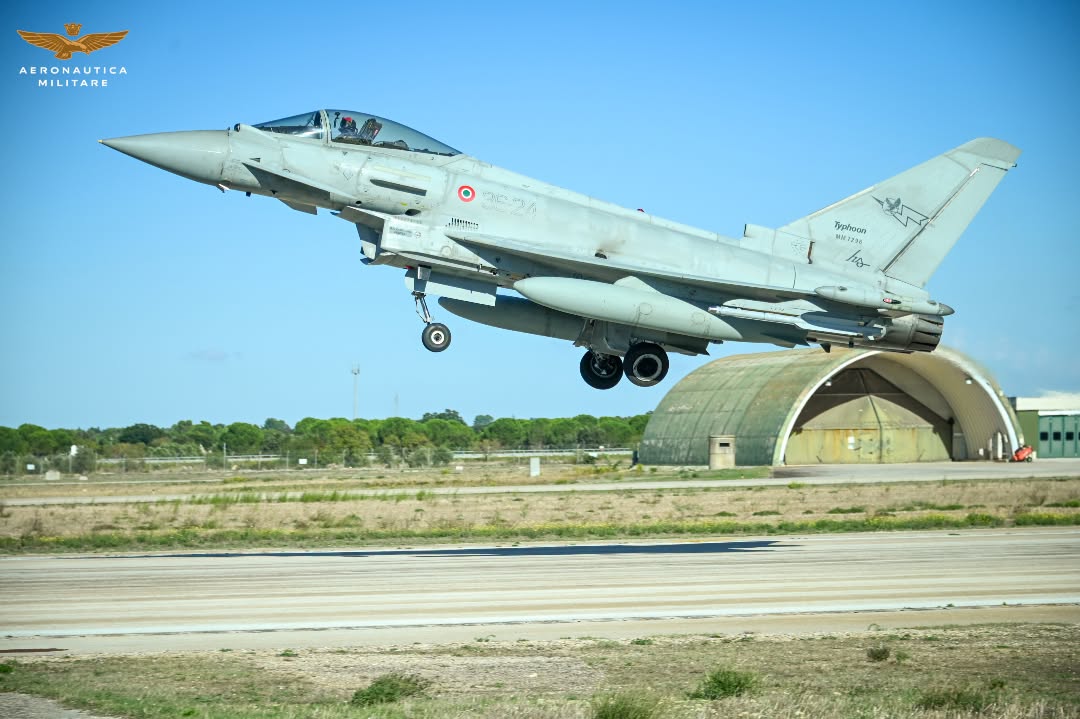
The Italian Typhoons currently rely on their standard armament for the C-UAS mission, including AIM-120 AMRAAM and Meteor radar-guided missiles, AIM-2000 IRIS-T IR-guided missiles and the 27 mm Mauser BK-27 cannon. Earlier this month, one of these weapons was used to shoot down a unidentified drone which entered Latvia’s airspace during a NATO Baltic Air Policing mission.
The APKWS
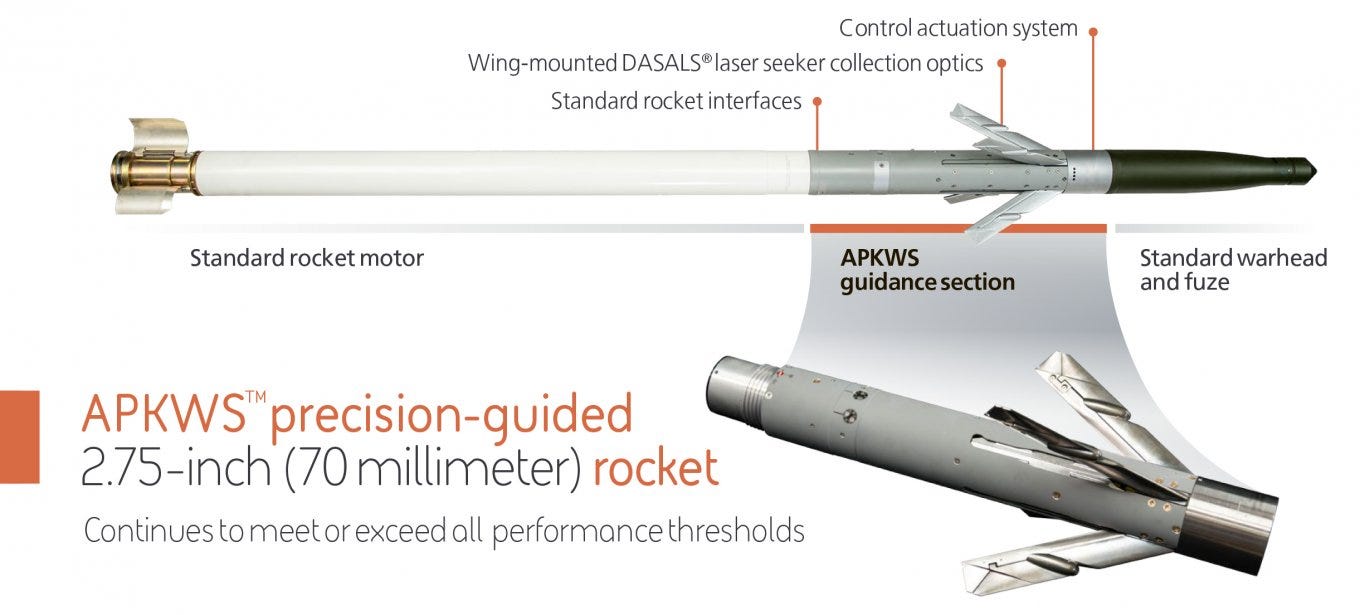
The AGR-20 Advanced Precision Kill Weapon System II (APKWS II) is a conversion of the Hydra 70 unguided rockets which adds a laser guidance kit to the baseline weapon, turning it into a precision-guided munition (PGM). By adding a guidance section to a cheap rocket (inserted in the middle of the rocket, between the 10-pound high-explosive warhead at the front and the Mk66 Mod 4 rocket motor at the rear), BAE Systems created a low-cost smart munition that can be used in the air-to-ground role.
First MoD (Crown Copyright) images and video of the @Eurofighter Typhoon and #APKWS combo now in operational counter-#drone use with the @RoyalAirForce‘s 9 Squadron at RAF #Akrotiri in Cyprus, and across the wider the Middle East… pic.twitter.com/TcyshWplQm
— Gareth Jennings (@GarethJennings3) May 16, 2026
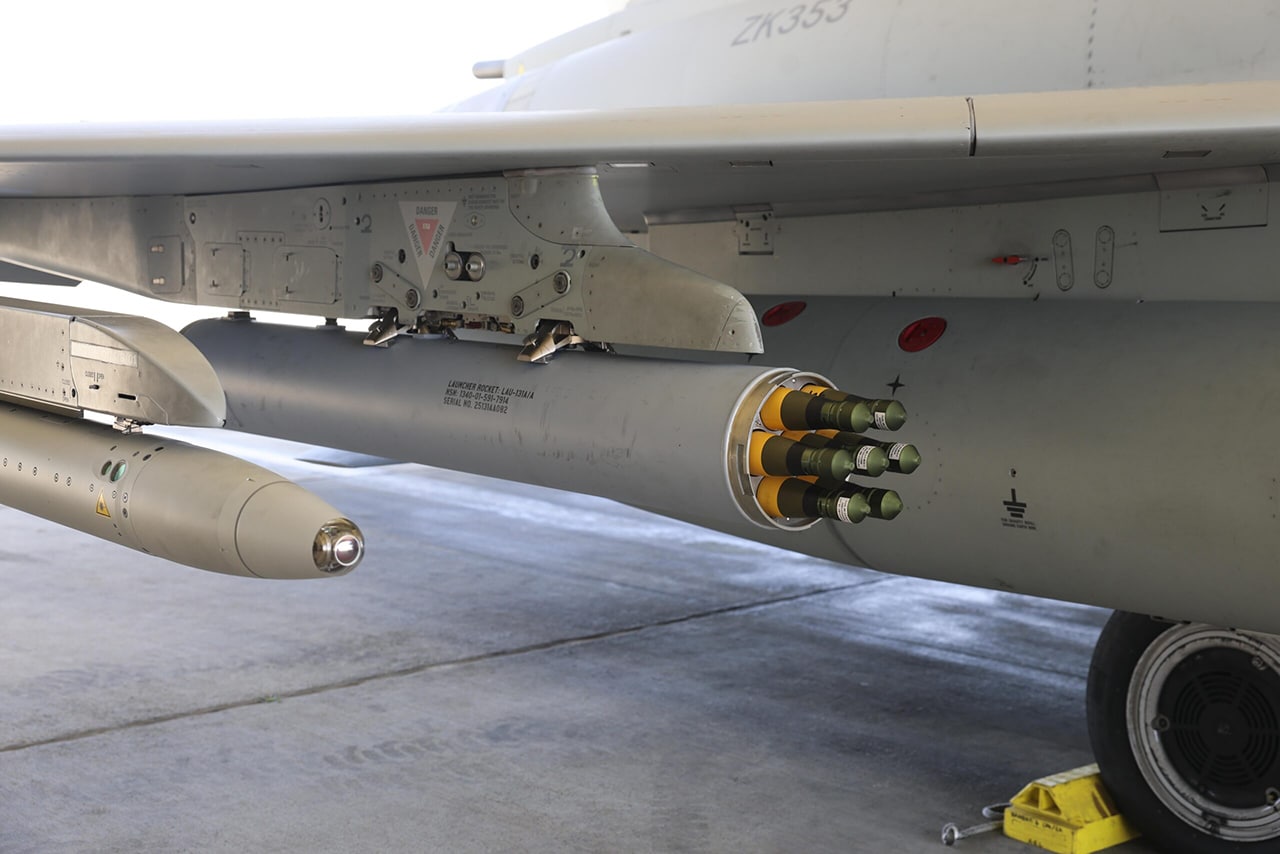
The guidance section of the APKWS includes four foldable wings with wing-mounted laser seeker collection optics with a wide field of view which enable to engage both moving and stationary targets. BAE Systems says that “no modifications are required to the rocket, firing platform or fire control system,” with the only known modification being a longer variant of the LAU-131/A 7-round rocket launcher normally employed by the U.S. Air Force, called the LAU-131 A/A.
Further developing an air-to-air capability out of these older rockets was an impressive feat for the U.S. Air Force, which was the first to test and deploy the new capability, opening to the possibility to engage targets at a very small fraction of the cost of other existing missiles. The high cost of the interceptors against these cheap targets and the magazine size of the launching platforms have been two of the main concerns highlighted by forces countering these attacks.
A current beyond visual range radar-guided AIM-120 Advanced Medium Range Air-to-Air Missile (AMRAAM) is priced at more than $1 million each, and an AIM-9X Sidewinder Block II has a price tag of around $420,000. On the other hand, the guidance section of an APKWS II only costs around $15,000, with the full APKWS II round only costing a few thousand dollars more (to include the warhead and the motor).
The low cost of the APKWS II comes with some restrictions, as the weapon is shorter ranged than the current air-to-air missiles, and the warhead is also smaller. However, against slow and cheap targets like drones, the AGR-20 can provide a highly cost-effective weapon.
Moreover, the APKWS II can provide fighter jets with deeper magazines for air-to-air munitions, as they can be carried in a 7-shot rocket pod on a single hardpoint that could otherwise take only a single missile. This feature could come in hand while facing swarm or saturation attacks from enemy drones, a tactic that has already been used by Russia in their aggression of Ukraine, by Iran in their attacks on Israel and sometimes on a smaller scale even by the Houthis.