The new UMPK kit, strapped on to a FAB-500T bomb, has an elongated body with improved aerodynamics and space for a small turbojet motor.
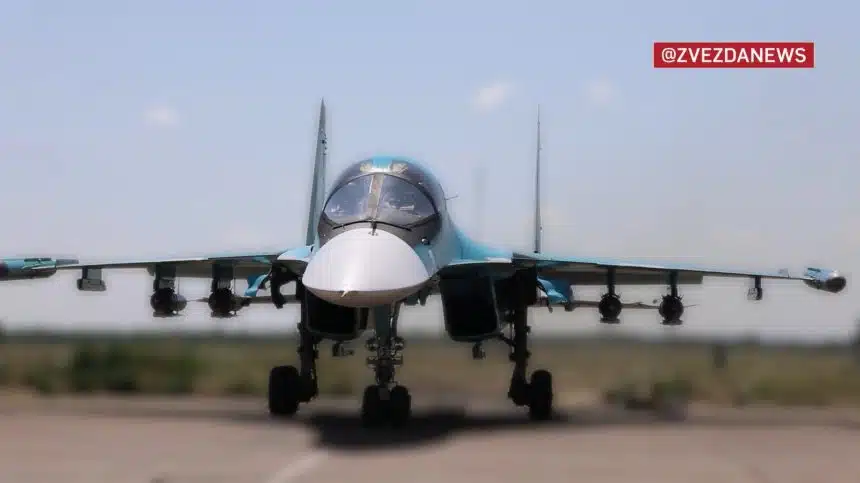
Russia’s Su-34 Fullback fighter-bombers are now flying carrying four bombs equipped with the improved (UMPB/UMPK) glide bomb kits. The new kits have an elongated body that has the potential to carry a small jet motor.
The first official videos from the Russian Ministry of Defense’s, published on Jul. 15 and Jul. 24, 2026, show the Su-34 dropping the bombs.
15th July 2026 (Russian MoD) pic.twitter.com/zwRengtxPy
— Piotr Butowski (@piotr_butowski) July 24, 2026
The kit is bolted onto the FAB-500T unguided munition – as it can be seen stencilled in Cyrillic/Russian on the bomb’s body – with the entire system identified by Russian ‘mil bloggers’ and military analysts as the UMPB-5/UMPK-5R or the UMPB-PD.
The new bomb appeared for the first time in October 2025 in the Poltava Oblast, in northeast Ukraine, as a near intact, unexploded weapon. At the time, at least some of the photos of the wreckage appeared to show the remains of a turbojet.
Улучшенная российская авиабомба ФАБ-500Т с УМПК, летит 100+ км, а такая же, только с реактивным двигателем, на 200+ кмhttps://t.co/cqA1xDsIyx #всрф #нанотехнологии https://t.co/As2Ba2tkhu pic.twitter.com/v1n0iA3N7U
— Necro Mancer (@666_mancer) October 21, 2025
A close-up of the engine revealed it to be a commercial-off-the-shelf SW800Pro-Y made by Chinese company Swiwin. The images from the same wreckage showed the inscription UMPK-5R.
Photos of the turbojet engine found on Russia’s new UMPB-5R bomb. It’s a commercial-off-the-shelf SW800Pro-Y made by Chinese company Swiwin. A similar model is used in the Banderol and possibly in the new version of the UMPK.https://t.co/bWw595N2ROhttps://t.co/3EMUSPpN5Y pic.twitter.com/AQPGDIgEyG
— John Hardie (@JohnH105) October 23, 2025
Russian MoD videos
The latest visuals do not clearly capture the bombs’ rear end to verify the presence of an engine’s exhaust. This would have helped determine if these weapons were powered or not.
Both the engagements in the videos took place in the jurisdiction of Russia’s Zapad Army Group (Zapad Group of Forces), covering Ukraine’s northeastern regions of Kharkiv and Lugansk. Both the releases saw the Russian MoD officially identifying the Su-34 and the UMPB/UMPK glide bomb – something it has been doing for some time – but it did not specify whether it was jet-powered or not.
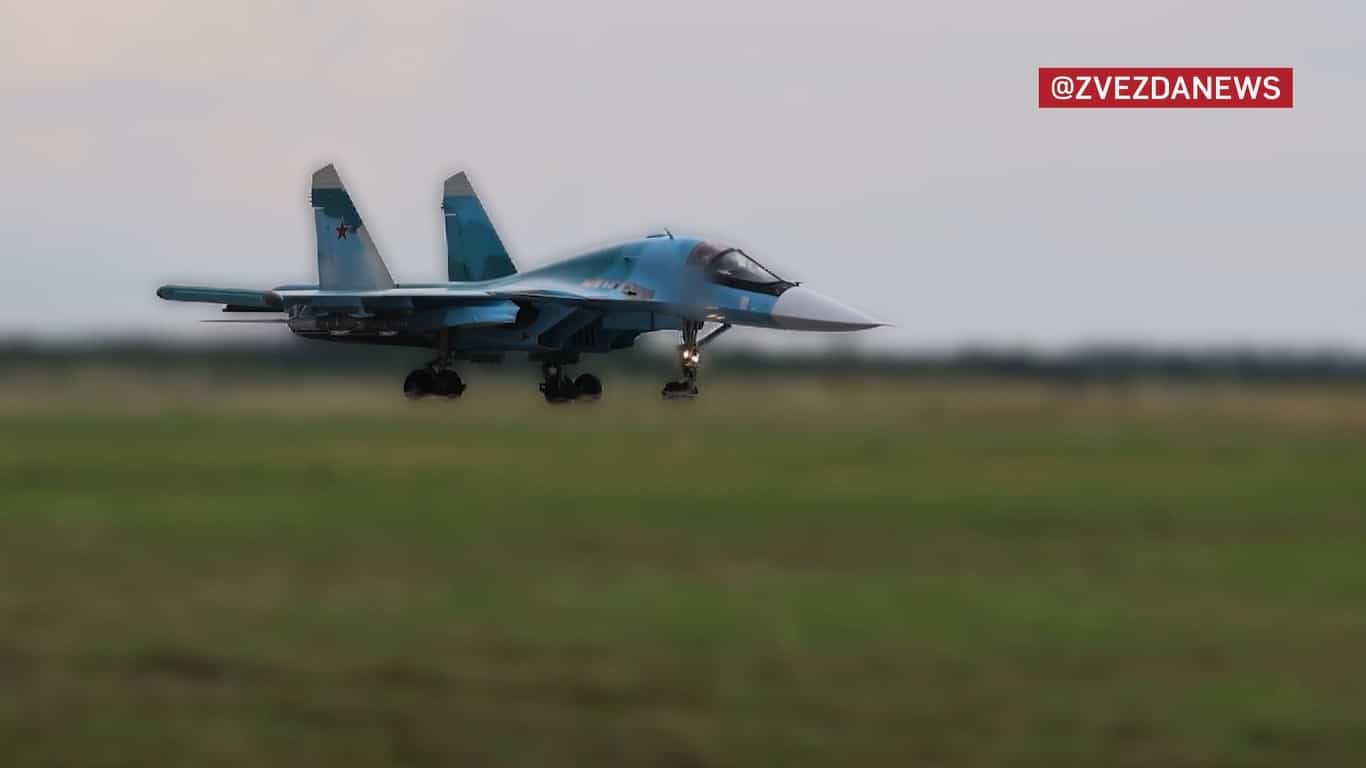
The Jul. 15 engagement saw the Su-34 striking the “personnel and temporary deployment point of a Ukrainian Armed Forces unit” with “aerial bombs equipped with universal gliding and correction modules” after receiving “target coordinates from reconnaissance.” This targeting data could be from ground-based Joint Terminal Attack Controllers (JTAC)-like teams, using a combination of simple tactical battlefield surveillance drones and hand-held optical devices.
In the Jul. 24 release, the Russian MoD said the Su-34 “multirole supersonic fighter-bomber” destroyed a Ukrainian “militant stronghold” and “command post.” Both the videos showed all the four bombs being released, but not the ground targets being hit.
Other videos from this month showing the use of FAB-250, 500, 1500 and 3000 bombs with UMPBs capture overhead drone “objective control” footage of only the various ground targets being struck, but not the bombs being released. In other words, there are few videos where both the release and target destruction of UMPB-kitted glide bombs are captured together.
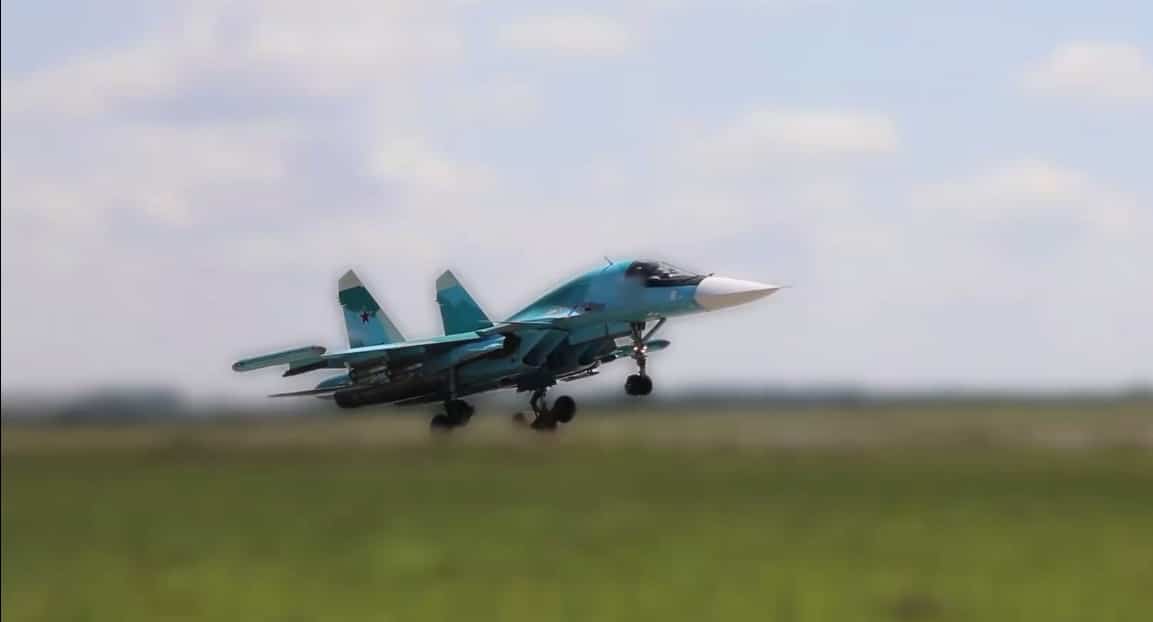
Su-34s have otherwise been seen in official and unofficial visuals flying with a mix of glide-bomb loadouts. A Jul. 13 RuMoD video showed a Su-34 taking off with four non-elongated UMPK kits.
A Jul. 17 image from the ‘AviamiR’ TG channel showed a Su-34 with a mix of the non-elongated UMPK kit-equipped FAB-250-270 bombs, and the more refined UMPK D-30SN – the Russian equivalent of the GBU-39 SDB.
A photo recently posted on the “Aviamir34” TG channel showing a VKS Su-34 series strike fighter parked in an aircraft shelter armed with UMPK-equipped OFAB-250-270 bombs and UMPB guided glide weapons (reportedly designated “UMPB D-30SN”).
This and other Russian TG channels have… pic.twitter.com/V0LCbsQhen
— Guy Plopsky (@GuyPlopsky) July 17, 2026
Other images from last year showed a larger D-30SN loadout.
Russia has begun putting a preformed frag casing on the UMPB D-30SN bomb.
While some have said the tail fins were also updated, this version was introduced in 2024 (see below).
The bombs in 2nd photo show 8/17/25 manufacture date.
(Links in alt text)https://t.co/wS3G4MMnBy pic.twitter.com/D5hp3Jmd7C
— John Hardie (@JohnH105) October 2, 2025
On a different note, the Su-34s in both the Jul. 15 and Jul. 24 videos appear to be the Su-34 NVO variant, that Russian military aviation analysts have noted have a small ‘bump’ on the spine, behind the cockpit. This has been assessed to be a Beyond Line-of-Sight (BLOS) satellite communication link.
Russian glide bombs
Kommersant reported in October 2025 that the latest version of the UMPK-kit has ranges of up to 100 km and can reach 200 km with a range-extending booster. While this claim should be treated with caution, anywhere close to this distance significantly enhances the standoff capability.
Without a jet motor, the new UMPK kit can take the FAB-500T to a distance of 95-100 km when dropped from 12 km and a speed of about 1,000 km/hour.
Undated photo (possibly recent), posted on the Aviahub TG channel earlier today, that clearly shows a pair of UMPB D-30SN glide weapons under the port wing of a VKS Su-34 strike fighter. pic.twitter.com/L5iPpor7Rq
— Guy Plopsky (@GuyPlopsky) June 19, 2025
The publication further added that the new UMPK-PD/UMPK-5R kit features an elongated body that improves aerodynamics, enlarged wings, redesigned rear fairings and a different wing deployment mechanism. The UMPK wings seen on the FAB bombs since last year are two-part fold out wings, with the entire bomb turning upward into flight position upon release.
The ISW (Institute for the Study of War), quoting Russian reports, had said that UMPK-kitted FAB-3000, FAB-250 and FAB-1500 have ranges from 50-60 km to 60-70 km, respectively. According to TASS, the range of early models did not exceed 50-60 km for the FAB-3000 and 40-70 km for the FAB-250, FAB-500, and FAB-1500.
In the past, Ukrainian media, quoting Armed Forces of Ukraine (AFU) officials, reported the use of such munitions against targets in the Kharkiv region (Lozovaya, approximately 90 km from the frontline) and the Sumy region (Khoten village, 10 km from the front).
The bombs are typically released by Su-34 aircraft.
A tandem 2-section wing with a folding main (front) section and a fixed tail section apparently gives extra lift.
Jamming of the satellite navigation system is difficult to achieve due to use of multi-element antenna arrays .
2/ https://t.co/78DaoweYOf pic.twitter.com/Zgb8DrbhRw
— Roy🇨🇦 (@GrandpaRoy2) September 25, 2025
Ukraine too has introduced its own glide bombs. However, we are yet to see visuals of that weapon in combat.