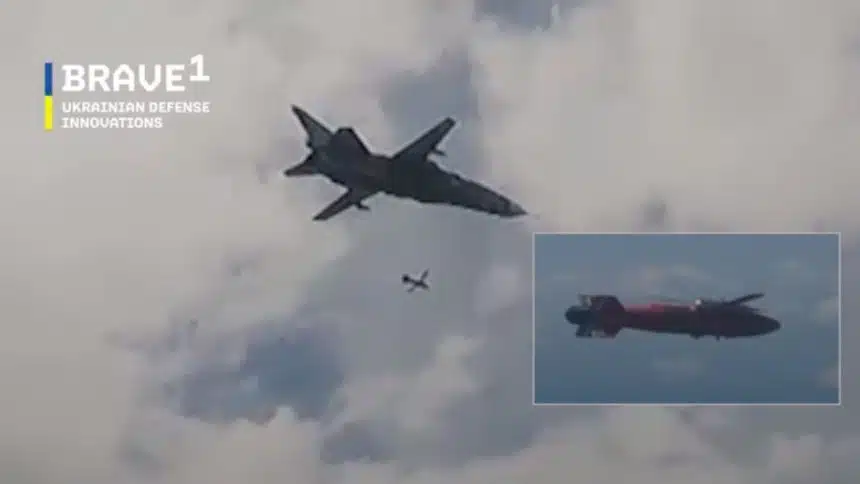
Ukraine has unveiled a new domestically-developed kit to convert a 250 kg drop bomb into a guided glide bomb to arm its fighter jets.
Ukraine has unveiled on May 18, 2026, a new domestically-developed glide bomb to be used in operations against Russia. Defense minister Mykhailo Fedorov and Ukrainian government defense technology collective Brave1 released a video of the bomb being dropped from a Su-24 Fencer during tests, before gliding and hitting a ground target.
The bomb developed by Brave1 participant DG Industry has finished all trials and is ready for deployment, Fedorov, Brave1 and the Ukrainian defense ministry said on X.
In the video taken by another chase aircraft, the kitted bomb, with large cruciform tail fins, is seen deploying its wings relatively fast after release. The weapon appears to have two lugs on the bottom, suggesting it turns upright to assume the correct flight orientation after being dropped, like similar U.S.-made and Russian-made weapons.
The first Ukrainian glide bomb from @BRAVE1ua is ready for combat deployment. Development took 17 months. The warhead weighs 250 kg. The Ukrainian glide bomb features a unique design created specifically for the realities of modern warfare.
Pilots are currently rehearsing… pic.twitter.com/Pnr15iTG9L
— Mykhailo Fedorov (@FedorovMykhailo) May 18, 2026
Ukrainian defense minister Mykhailo Fedorov said on X:
“The first Ukrainian glide bomb from BRAVE 1 is ready for combat deployment. Development took 17 months. The warhead weighs 250 kg. The Ukrainian glide bomb features a unique design created specifically for the realities of modern warfare. Pilots are currently rehearsing combat scenarios and adapting the new weapon system for use in real wartime conditions. Soon, Ukrainian glide bombs will be striking enemy targets.”
More details about the bomb in @BusinessInsider article:https://t.co/FpjbRa6eTL
— BRAVE1 (@BRAVE1ua) May 19, 2026
Brave1 stressed upon the short development timeline, current orders for the system and its tactical use:
“Ukraine had no guided aerial bomb. Now it does.
DG Industry, a Brave1 participant, has completed all required trials and declared the weapon ready for combat after 17 months of development. The bomb carries a 250 kg warhead, hits targets dozens of kilometers behind enemy lines, and was designed from scratch – not copied from Western or Soviet systems.
The Ministry of Defense has already placed its first order. Pilots are training now. Combat deployment is imminent.”
The first Ukrainian glide bomb from @BRAVE1ua is ready for combat deployment. Development took 17 months. The warhead weighs 250 kg. The Ukrainian glide bomb features a unique design created specifically for the realities of modern warfare.
Pilots are currently rehearsing… pic.twitter.com/Pnr15iTG9L
— Mykhailo Fedorov (@FedorovMykhailo) May 18, 2026
Ukraine’s and Russia’s current inventory of guided bombs
Ukraine already uses the French AASM-Hammer guided bomb, employed by its Russian-made Su-25 Frogfoot, MiG-29 and Su-27 aircraft. The country also employs the GBU-39 Small Diameter Bomb (SDB), which was used with great effect on Russian targets, owing to its resistance to electronic warfare and satellite navigation (SATNAV) jamming, and is also employed by the Western-provided F-16s.
Previously, Ukraine also unveiled another domestic glide guided bomb that emerged for the first time under a Su-24 Fencer strike aircraft in September 2024. This would contradict Brave1’s claim that Ukraine had no guided aerial bomb.
👀👀👀
A Ukrainian Sukhoi Su-24M bomber spotted with (I believe) previously unseen munition installed under its wing.
According to the original source, the video is dated to August 2024. The description says: “A bomber conducts a test flight to test a new guided aerial bomb.”… pic.twitter.com/LZsX5I4PxM
— Status-6 (War & Military News) (@Archer83Able) September 6, 2024
That system appeared to be an analogue of the Russian Universal Module for Planning and Correction/Unifitsirovannyi Modul Planirovaniya i Korrektsii (UMPC/UMPK) kits, strapped on to the RUAF’s FAB-250, 500, 1500 and the massive FAB-3000 drop bombs. However, it is unclear if this weapon has any relation to the new glide bomb, or whether the previous bomb has ever entered service.
Su-25 aircraft + AASM-250 Hammer guided bombs = destruction of the enemy.
📹: @United24media pic.twitter.com/YkXsV7NqWm
— Defense of Ukraine (@DefenceU) January 5, 2025
Russia also has other systems in this class, including a new jet-powered glide bomb that first emerged in October 2025, and the more advanced and refined UMPB D-30SN. The latter is considered comparable to the GBU-39 SDB.
The Ukrainian Air Force’s MiG-29 fighter jets are now equipped with suspended high-precision GBU-39 Small Diameter Bombs (SDB). These bombs enhance the aircraft’s strike capabilities, allowing for more accurate targeting and effectiveness in missions.#Ukraine #UkraineWar… pic.twitter.com/CjKcUr57Ke
— RobertFella 🇺🇸 🇺🇦 (@Bonkavision5) July 28, 2024
Previously, Ukraine has also been approved a Foreign Military Sale (FMS) of the Family of Affordable Mass Munitions-Lugged (FAMM-L) low-cost scalable standoff missiles, part of the Extended Range Attack Munition (ERAM) program. However, we have not yet seen evidence of the weapons being employed in the country.
I firmly believe that weapons often match the cost of what’s taken out via secondary effects if not directly, but at ~$250k (will drop with scale) and tens if not hundreds of these being employed by multiple platforms changes that cost imbalance equation drastically in every way. pic.twitter.com/E1wkqwOSSQ
— Abd (@blocksixtynine) April 17, 2026
More recently, the U.S. State Department approved on May 5, 2026, an FMS to Ukraine for 1,532 Joint Direct Attack Munition-Extended Range (JDAM-ER) kits, comprising 1,200 KMU-572 kits for 500 lb Mk-82 bombs and 332 KMU-556 kits for 1,000 lb Mk-84 bombs. Ukraine has been using the JDAM-ER since 2023, initially only in the GBU-62 configuration and later the GBU-63.
Tactical use
Ukraine has limited inventory of Western ammunition. A domestic alternative affords greater flexibility and preserving the armory for sustained operations.
As we have seen in the now four-and-a-half year war, Ukraine has largely been on the defensive, except for some periodic offensives. Its limited resources, however, hamper the ability to execute continuous combined air-land battle across the 700 km-wide front.
🇺🇸🇺🇦 Ngày 5/5/2026, Bộ Ngoại giao Mỹ đã phê duyệt việc bán hơn 1.500 bộ kit JDAM-ER cho Ukraine với giá khoảng 373,6 triệu đô la.
Gói tổng cộng 1.532 bộ kit JDAM-ER (Joint Direct Attack Munition – Extended Range) do Boeing sản xuất chính, bao gồm:
• 1.200 kit… pic.twitter.com/yNIhHc63FG
— c0mmand0 (@c0mmand0_2022) May 17, 2026
It can be safe to say that the bomb has been designed to be quickly integrated on the Ukrainian Air Force’s existing Su-27s, MiG-29s, Su-25s and Su-24s. There is no official word on whether it will be integrated on the Mirage 2000s and F-16s, although it cannot be excluded as Europe, which provided the aircraft, has thrown its strategic weight behind Ukraine against Russia.
The glide bomb can also leverage the vast array of cheap surveillance and strike drones Ukrainian industry has fielded over the years for dynamic targeting of Russian ground positions. Ukrainian ground troops could possibly take Joint-Terminal Attack Controller (JTAC) roles to guide attacks.
Eastern Ukraine, a Ukrainian Air Force MiG-29 Fulcrum drops a trio of US-supplied GBU-39 SDB guided bombs on a Russian assault group preparing to move on Ukrainian lines. pic.twitter.com/gLR854EX6z
— OSINTtechnical (@Osinttechnical) July 29, 2025
The only challenge therefore is the small inventory of Western- and Russian-made jets to operate the bomb. The former, however, are largely tied to hunting missions against Russian One-Way Attack (OWA) drones and long-range cruise missiles, with secondary ground attack roles.
Another minor, yet surpassable hurdle, is represented by the industrial resources. However, the small weapon might leave a negligible manufacturing footprint, allowing it to escape detection by overhead Russian airstrikes, with manufacturing and assembly could be spread out in indistinguishable structures and buildings.