According to a post by the popular FighterBomber Telegram channel, Russia has started the taxi trials of a twin-seat variant of the Su-57, with a new cockpit reminiscent of the Su-30 Flanker.
Claims emerged on May 16, 2026, mention a twin-seat variant of the Su-57 Felon is currently undergoing taxi trials. The information was shared by the leading Russian Telegram account ‘FighterBomber’, which has ties to many Russian Aerospace Forces (RuAF) units, supplying crowd-funded everyday military accessories and equipment.
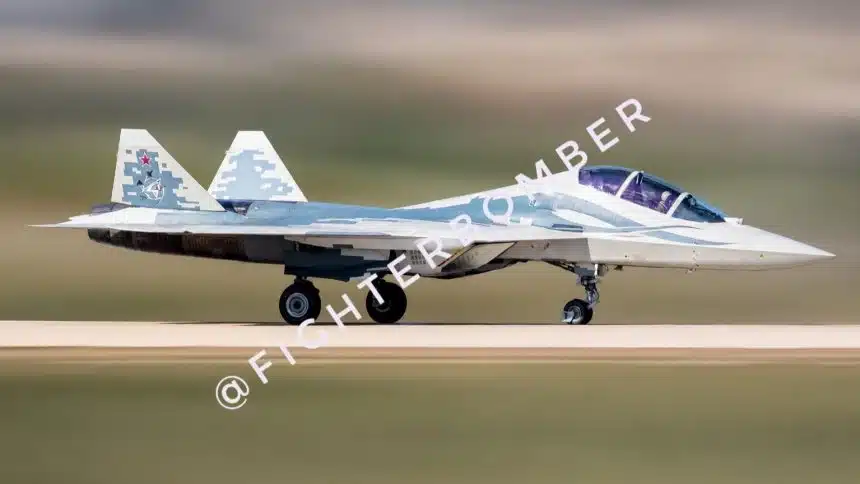
The same channel published a photo a day later, saying that it is the actual aircraft photographed during the test. It is currently not possible to verify the authenticity of the image.
The appearance of this new variant would therefore make the Su-57 the second fifth generation fighter with a twin-seater variant. In fact, the first was the J-20 with its ‘S’ variant (J-20S), first spotted in 2021.
With the unveiling of the two-seat variant of the Su-57- aka the Su-57D (?) – it appears that, following the J-20S (AS), there is now a second 5th-generation aircraft available in a two-seat configuration.
— @Rupprecht_A (@RupprechtDeino) May 17, 2026
FB also speculated possible designations for the aircraft. “Today, as part of the tests, the new two-seater modification of the Su-57 performed a rollover. We’ll see if it will be called Su-57D or Su-57UB. Alternatively, it could be called Su-57ED,” the post said.
The image
The image of the supposed twin-seater Su-57 is being reported by multiple sources as real. The background is heavily blurred, and it is thus impossible to verify the location where the photo might have been captured.
/Su-57D/
Image leaked by fighterbomber. https://t.co/odomnIodGJ pic.twitter.com/jzHcpG4meG
— George N. (@GeorgeN28581) May 17, 2026
Notably, no identification markings can be seen on the aircraft, which appear to have been edited, with only a small part visible behind the cockpit. Military aviation researcher Andreas Rupprecht however shared that the aircraft featured the bort number “055 Blue.”
Interesting hint … could be the modified T-50-5R and not T-50-4! 🤔 https://t.co/pG87BmDKFb pic.twitter.com/prtKaTiDXY
— @Rupprecht_A (@RupprechtDeino) May 17, 2026
This bort number is the same which was already used by the fifth flying prototype T-50-5, severely damaged by an engine fire in 2014 and rebuilt as T-50-5R, although there is still debate whether this was the T-50-5 rebuilt after the incident of the T-50-6 prototype completed with the salvageable parts from T-50-5. Either way, the bort number could point to the possibility that the twin seater Su-57 was obtained by modifying an existing airframe.
The cockpit arrangement is reminiscent of the Su-30, although the height difference between the two seats is more pronounced on the Su-57. The choice however would grant a greater visibility of the crew in the back seat.
A new logo can also be seen on the tail, feauturing the shapes of the Su-57 and the S-70 Okhotnik drone. A similar logo was painted on a previous prototype, although it is unclear if this points to a possible role of the twin-seat Su-57 in the management of unmanned aircraft.

There are no other differences immediately visible compared to the single seater Su-57. However, changes can be expected internally, as systems might need to be moved to make space for a second crew member and structural modifications are also needed to make it possible.
The role of the second crew member is still unknown, although the second seat would allow the presence on the aircraft of either an instructor pilot or a weapon systems officer. Going by a 2023 patent’s description, it is likely the focus is on the latter.
2023 twin-seat stealth fighter patent
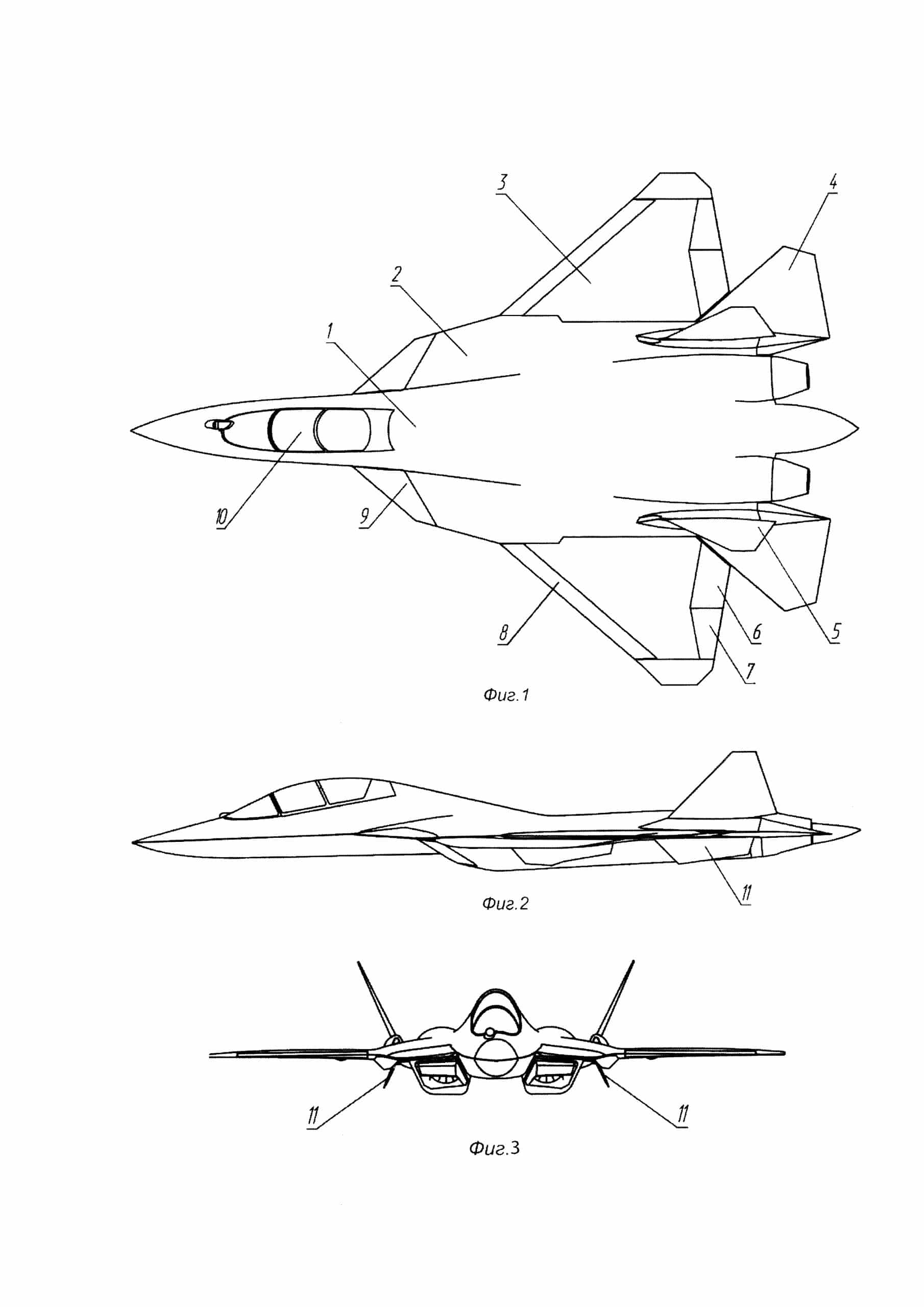
There had also been signs that a twin-seat stealth aircraft was in the works, going by a May 2023 patent filed with Russia’s Federal Service for Intellectual Property (FSIP). The patent, registered by the FSIP on November 17, 2023, is for a “multifunctional two-seat low-observable tactical aircraft,” appearing very similar to the Su-57 and Su-30.
2/ This Izvestia infographic, and the patent drawings below, provide a basic idea of the planned aircraft’s likely external appearance.https://t.co/hRWu3umxWa pic.twitter.com/rpL5shtAhq
— Guy Plopsky (@GuyPlopsky) November 21, 2023
The aircraft is “intended for the detection and destruction of air, surface and ground targets at supersonic and subsonic flight speeds in a wide range of altitudes, and also acts as an airborne command post for network-oriented operations of mixed groups of aircraft.”
The patent itself draws attention to the Su-30 family of jets, being the only twin-seat fully multirole aircraft in the RuAF inventory. The Su-34 Fullback, which is also twin-seat but with a side-by-side seating arrangement, is primarily an air interdiction bomber.
It is not known what relation the twin-seat aircraft in the patent has to the Su-57 and Su-30. We also do not know if the new twin-seat Su-57 is borne from this patent.
The patent might even be associated with a new stealth aircraft altogether, which we might learn about in the future. The patent itself could be an academic exercise to lay the theoretical research foundations for such a fighter, if the need arises, and shorten development timelines if the RuMoD and RuAF pursue such an endeavor.
The aerodynamic configuration described in the document is however very similar to the Su-57:
“A multifunctional two-seat low-observable aircraft with an integral aerodynamic configuration comprises a set of on-board equipment, a fuselage with an extension, wing consoles with high-lift devices on the leading and trailing edges, including flaperons, ailerons and rotating wing leading edges, consoles of an all-moving horizontal and twin-fin vertical tail, mounted on the side tail booms of the fuselage, a two-seat cockpit with a canopy, a fairing and a radar antenna fairing, located in the forward section of the fuselage, a power plant with two engines spaced horizontally and equipped with air intakes, located in engine nacelles, the axes of which are oriented at an acute angle to the plane of symmetry of the aircraft in the direction of flight. The aircraft is characterized by the fact that the wing consoles are smoothly connected to the fuselage, the fuselage extension is located above the engine air intakes and includes controlled rotating parts, the aircraft engines contain a jet nozzle with a deflectable thrust vector and a thrust reverser […]”
A lot of emphasis is laid on satellite-enabled advanced communications and tactical links that can operate in degraded environments and descriptions that suggest sensor fusion:
“The onboard equipment is designed to enable information interaction between different types of aircraft in the group, including the reception and transmission of data via high-speed communication channels and group communication, including via satellite communication channels, as well as the analysis of information received from its own systems and external sources with the subsequent issuance of recommendations to the crew and / or commands to the group of aircraft.”
The patent then mentions the Su-30 family as being closest to the aircraft in the patent, while noting other Western Gen. 4.5 aircraft two-seat jets:
“Currently, the following multirole two-seat tactical aircraft are known: Dassault Rafale, Eurofighter Typhoon EF-2000, Saab JAS-39NG Grippen, Boeing F/A-18F Super Hornet, McDonnell-Douglas F-15D, Cy-30MK family of aircraft, MiG-35. Of the above-mentioned analogues, the closest are the aircraft of the Su-30MK family.”
2/ These Su-57s were likely delivered last month. As I’ve previously noted, UAC often announces deliveries with some delay.https://t.co/i2KcIIoME1
— Guy Plopsky (@GuyPlopsky) February 9, 2026
Su-57 recent developments
The Su-57 is manufactured at the United Aircraft Corporation’s (UAC) Komsomolsk-on-Amur Aircraft Plant at Khabarovsk Krai in Russia’s far east, which, as of December 2025, delivered 24 airframes to the RuAF, according to the World Air Forces 2026 report.
UAC reported more deliveries in February 2026, with Russian military aviation analyst Guy Plopsky counting at least two airframes, taking the known count to 26. These airframes also have notably different – and possibly improved – Head-Up Display (HUD), self-defensive suites, new Missile Approach Warning Sensors (MAWS) and Directional Infrared Countermeasures (DIRCM).
During November 2025’s Dubai Air Show, one Su-57 airframe, T-50-9, also sported a single widescreen display in place of the older Multi-Function Displays (MFD).
4/4 …additional side-looking missile-warning sensors.https://t.co/DJrGgL1qPE
— Guy Plopsky (@GuyPlopsky) February 9, 2026
The Su-57 was also tested in December 2025 with the more powerful Izdeliye 177 (Product 177) engine. This is reportedly meant as an option for future production batches, and possibly to replace the older Stage 1 (Izdeliye 117) AL-41F-1S and Stage 2 (Izdeliye) AL-51F-1.
That creepy high pitched tone of Algeria’s Sukhoi Su-57E fighter jets. Algeria is currently the only country in Africa to operate 5th Gen stealth fighters. They have already received two Sukhoi Su‑57 aircraft and plans to acquire an additional 12 units. The Algerian Air Force is… pic.twitter.com/QLLDZNhaco
— Defense News Nigeria (@DefenseNigeria) March 16, 2026
[Su-57] Un chasseur Su-57 a été aperçu dans le ciel de Carélie.
(c) Kirill Fedorov pic.twitter.com/vYMJQ3zPPB
— La souris (@La_souris_DA) May 16, 2026
Earlier that year, photos revealed the interior of the Su-57’s rear, front and side weapons bays, and in December 2024 the aircraft was also spotted with one flat 2D thrust vectoring nozzle. Algeria has also been confirmed to be the first Su-57 customer for a full squadron of 12 units, with at least two seen so far.