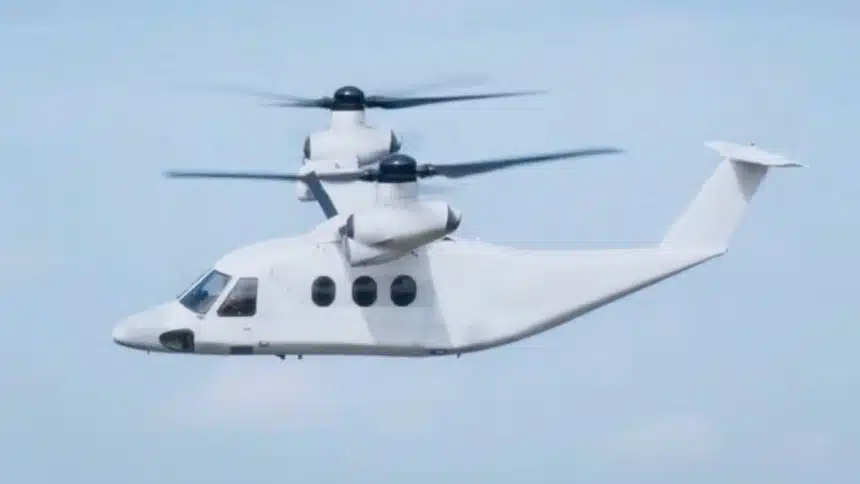
The Chinese tiltrotor that broke cover last year was recently captured in images during what appears to be more expansive test flights.
China’s first manned tiltrotor aircraft has now appeared in clearer images while in flight, nearly a year after it was captured off a screen while hovering at the beginning of testing. Visuals from Chinese social media shared by leading Chinese military aviation researcher Andreas Rupprecht and other users on X showed the helicopter in various angles from its port (left) side.
We noted in our previous report in August 2025 that the first picture appeared to show the tiltrotor in what appeared to be an engine start-up, lift off and hover test. No visuals existed at the time showing it in full flight.
Via ACuriousPLAFan/SDF:
„Said to be different shots of the tiltrotor technological demonstrator platform from Harbin AC, likely taken during its recent test flight. Posted by @数性体 on Weibo.“ pic.twitter.com/tAOwUfrHY4
— @Rupprecht_A (@RupprechtDeino) June 1, 2026
What the new image shows
Both the panel and the rotor hub, previously missing, can now be seen in the latest images, in what could be a test flight in more expansive envelopes. It is not clear when the latest flight captured in the new images took place, and it may have happened anytime after the first images emerged in August 2025 – or possibly even recently – before leaking on the internet.
A notable feature we observed back then was the tiltrotor’s moving prop-rotor configuration, similar to that of the MV-75 Cheyenne II, marking a full departure from the V-22 Osprey and Leonardo AW609 in which the entire engine nacelle pivots. The system is notably simpler in operation with less complex engineering and consequently simpler maintenance and improved safety.
Seems as if finally an image and video (see link) of Harbin’s / HAIG’s) tiltrotor technology demonstrator in flight has been leaked. https://t.co/JI4bKLPOqs pic.twitter.com/JzzWvFHyVZ
— @Rupprecht_A (@RupprechtDeino) May 31, 2026
Both the images also did not show a flight data probe (pitot) tube on the nose, or registration markings anywhere on the fuselage or the tail. This leaves open the question on how many prototypes have been produced by Hafei Aviation Industry, a subsidiary of Harbin Aircraft Industry Group (HAIG).
There is no official information on the aircraft on any of the state media like Global Times, Xinhua or China Daily. The only tilt-rotor reported in the Chinese press was by GT in July 2025, featuring a smaller tiltrotor, an eVTOL (electric Vertical Take-Off Landing) called AE200 by Chinese company Aerofugia, on the sidelines of the inaugural International Advanced Air Mobility Expo at Shanghai.
Janes also reported in February 2024 about the unmanned UR/R6000 tiltrotor, which appeared in a clearer image inside its developer United Aircraft’s factory a few months later in October. Both the AE200 and the R6000 also have pivoting prop-rotor hubs, suggesting how China has closely watched and incorporated the American experience with the type.
We are far from knowing whether the three aircraft have a military future, until images emerge of the aircraft in PLA military colors, markings or at one its bases.
联合飞机(united aircraft)の世界初となる6t級ティルトローターUAV”镧影R6000″1号機が芜湖航空产业园にて生産された。
R6000は旅客の場合10人の乗客を乗せ、最大離陸重量6t、最大巡航速度550km、最大巡航高度7620m、航続距離4000kmを発揮する。
同機は今年の珠海航展にて展示されると言われている。 https://t.co/c89ETG1Ihf pic.twitter.com/Fl3ft0cqgI
— お砂糖wsnbn (@sugar_wsnbn) October 14, 2024
The tilt-rotor in question particularly has two access doors and, with the six windows, suggests a seating capacity of anywhere between six to 12 persons. It is also admittedly small in size for military use, necessitating larger engines and a bigger airframe.
If adopted by the PLA, like the Ekranoplan, it can rapidly move men and material to China’s outposts in the South China Sea (SCS). However, the need for such a capability is not acute, given China’s current naval aviation, surface fleet and merchant marine fleet.
Other helicopters and future
From a commercial standpoint, the developers wouldn’t have invested in the tiltrotors until they had a market within China, to feed its growing urban mobility, air taxi, emergency services and connecting remote mountainous regions. As we noted in our previous report, the tilt-rotor could be marketed internationally for civilian use by corporations, as a cheaper alternative to Western systems, with a target being the offshore oil and gas sector.
Apparently we’ve got the clearest image of the Z-21, China’s new heavy attack helicopter so far.
However, besides some details that are now finally clearly recognisable, such as sensors, cockpit, rotor, & the engine nacelles including exhausts, some details also appear strange… pic.twitter.com/CG5FoTDr2d
— @Rupprecht_A (@RupprechtDeino) March 20, 2026
Politically, fielding such an aircraft also displays China’s technological prowess in developing the full range of fighter aircraft, space technology, warships, missiles and aircraft carriers to rival the West.
IMO one of the best Images of the Z-21 so far. pic.twitter.com/kKyILXHevM
— @Rupprecht_A (@RupprechtDeino) November 30, 2025
Lastly, China’s heavy-class attack helicopter, the Z-21, has also made some appearance since late last year, with the latest image shared by Rupprecht on Mar. 20 showing it in sharpest and clearest detail yet. The aircraft is bearing a PLA roundel marking on its tail boom, and also appears to be carrying quad-launchers for air-to-surface missiles.
As it seems, for the first time a Z-21 in white primer was seen.
(Via yuxiaochen/SDF) pic.twitter.com/RfhGoIofAd
— @Rupprecht_A (@RupprechtDeino) December 23, 2025
One such image emerged in November 2025 with a dome-like sensor on the main rotor hub and a black paint scheme. A December 2025 picture shows it with the tail number 6232, the dome missing and the aircraft bearing a white paint scheme, suggesting that more than one example is flying.