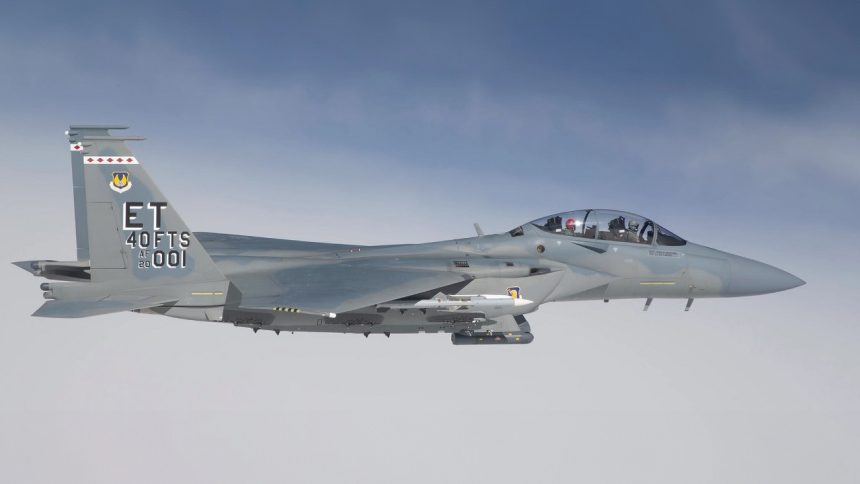
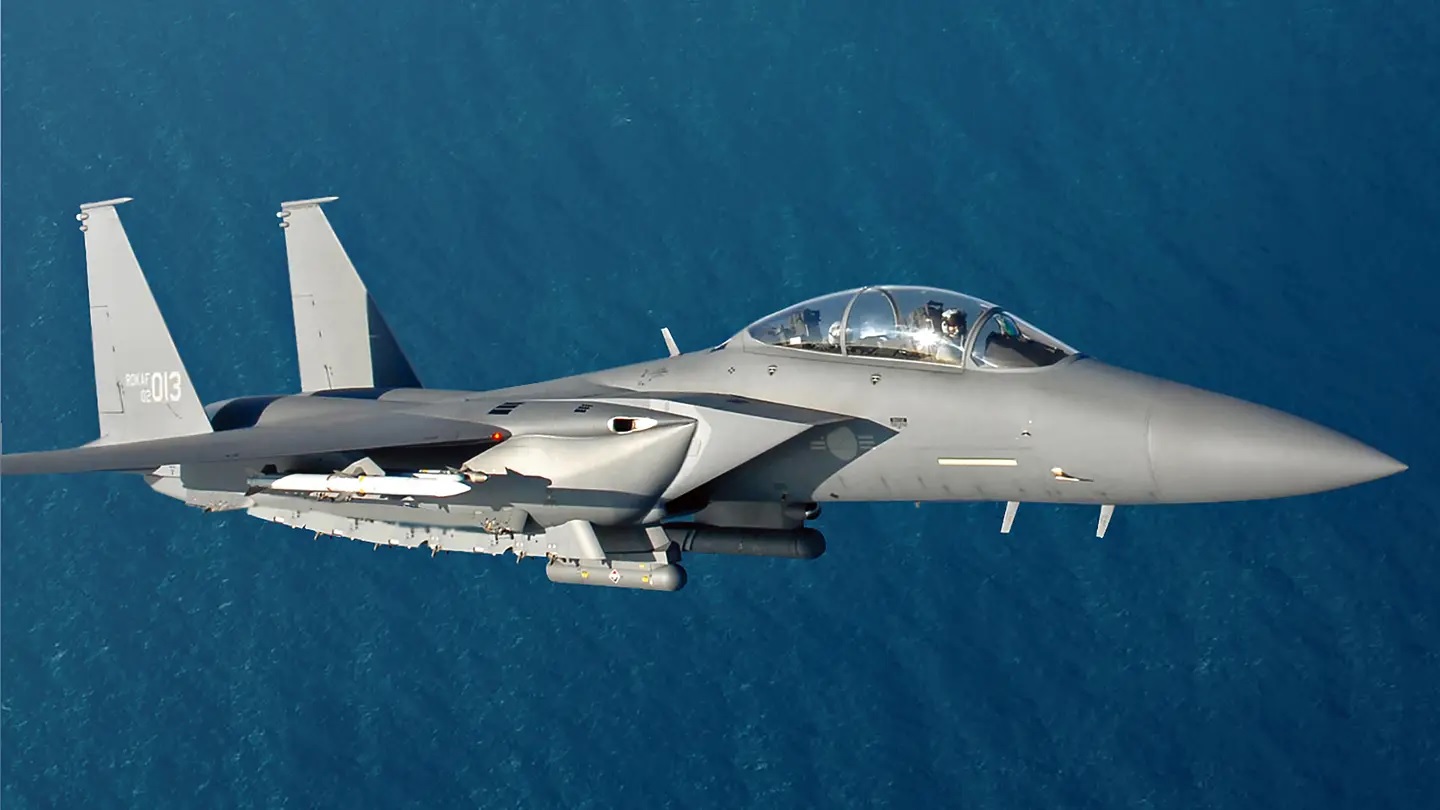
BAE Systems received a contract to deliver the AN/ALQ-250 EPAWSS to upgrade the Republic of Korea Air Force’s F-15K Slam Eagle fighter jets.
BAE System announced that it has received a contract from Boeing to provide the AN/ALQ-250 Eagle Passive Active Warning Survivability Systems (EPAWSS) for the upgrade of the Republic of Korea Air Force’s F-15K Slam Eagle fighter jets. The development follows the contract to Boeing earlier this year and the Foreign Military Sale (FMS) approval in 2024.
The upgrade program was launched in 2022 by South Korea’s Defense Acquisition Program Administration (DAPA), with the U.S. Air Force Life Cycle Management Center working with the U.S. industry on behalf of the ROKAF and DAPA. The goal is to upgrade the ROKAF’s F-15K Slam Eagle fleet to a configuration similar to the F-15EX Eagle II, significantly enhancing its long-range strike and survivability capabilities.
EPAWSS was included among the systems mentioned by the FMS notice. Until now, there was no confirmation that the EPAWSS will indeed be installed on the F-15K, as the systems mentioned in the notice do not necessarily reflect the systems that will effectively be part of a contract.
The new Electronic Warfare (EW) suite will provide South Korean pilots with 360-degree threat detection and increased number of countermeasures. In addition to enhancing the F-15K’s capabilities in hostile and signal-dense electromagnetic environments, EPAWSS will also increase the interoperability with the U.S. Air Force.

“We are working closely with Boeing, the ROKAF and regional industry teams to deliver the most technically advanced EW system for the F-15K aircraft upgrade,” said Phillip Casalegno, F-15 international program director at BAE Systems. “Our focus is on providing allies with EW capabilities needed to support regional stability and security.”
The AN/ALQ-250 EPAWSS
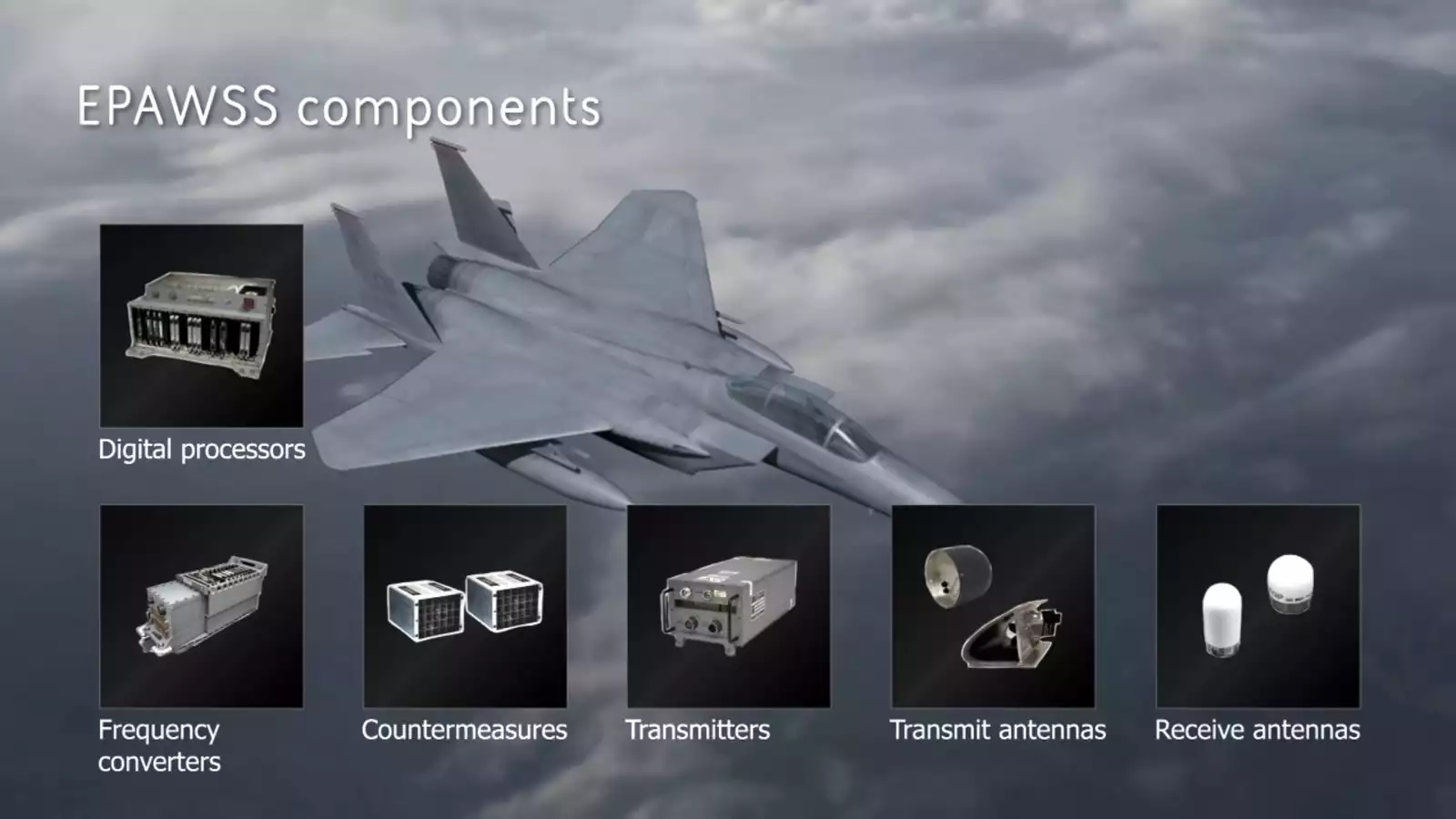
The Eagle Passive Active Warning Survivability System is a cutting-edge self-protection system intended to enable the F-15 to detect, identify, locate, deny, degrade, disrupt, and defeat air and surface-to-air threats during operations within highly contested environments. The system will replace the previous self-protection suite installed on the Strike Eagle.
EPAWSS is fully integrated with radar warning, geo-location and increased chaff and flare capability to detect and defeat surface and airborne threats in signal-dense and highly contested environments. Because of this, the system enables freedom of maneuver and deeper penetration into battlespaces protected by modern integrated air defense systems.
“EPAWSS is a leap in technology, improving the lethality and combat capabilities of the F-15E and F-15EX in contested, degraded environments against advanced threats,” said Maj Bryant “Jager” Baum, EPAWSS Test Director for the U.S. Air Force Operational Test & Evaluation Center (AFOTEC). “EPAWSS has set the baseline for EW within the fighter community.”
BAE Systems, the manufacturer of the system, notes EPAWSS is notably smaller and lighter than previous EW systems for the F-15, thanks to its fully digital technology. The company also says EPAWSS has broad instantaneous bandwidth and a high-speed scan capability to detect all RF threat classes, including low probability of intercept and modern agile threats.
EPAWSS also allows to increase the F-15’s chaff and flares capacity by 50%, with four more dispensers added in the EPAWSS fairings behind the tail fins (two for each fairing), for a total of 12 dispenser housing 360 cartridges. This improvement is important as in modern scenarios chaff and flares are often released preemptively to counter MANPADS (Man Portable Air Defense System), meaning that now the Eagle will have more countermeasures available for a better protection.
EPAWSS integrates cognitive electronic warfare to better discriminate the signals received by the system. This capability was demonstrated during the Northern Edge 2023 large force exercise test event, which tested EPAWSS’ ability to rapidly respond to previously unencountered electromagnetic threats. The tests challenged the system’s ability to process in-mission sensor data, create exquisite techniques, and optimize waveforms in real time.
In the Director, Operational Test & Evaluation report, it is mentioned that EPAWSS replaces three functionally obsolete F-15 legacy Tactical Electronic Warfare System components: the AN/ALR-56C Radar Warning Receiver, the AN/ALQ-135 Internal Countermeasures Set, and the AN/ALE-45 Countermeasures Dispenser Set. The system also integrates with the F-15 AN/APG-82(V)1 radar and Advanced Display Core Processor II mission computer.
The F-15K Upgrade
The contract awarded in early 2026 to Boeing, worth $2.806 billion, covers “the design and development of an integrated suite of aircraft systems to support modification of the F-15K,” reads the notice published by the U.S. Department of Defense. The U.S. Air Force Life Cycle Management Center is mentioned as the contracting activity, acting on behalf of the ROKAF and DAPA.
The notice further mentions that the work will be performed at Boeing’s facilities in St. Louis, Missouri, and is expected to be complete by Dec. 31, 2037. The timeline is broadly in line with what was initially planned by the DAPA, from 2024 to 2034, taking also into account the delay in the contract award.
The FMS authorized in 2024 mentioned an estimated cost of $6.2 billion, which would include both the design and development covered by the contract awarded to Boeing and the equipment and work for the upgrade of the aircraft.
As part of DAPA’s program, the Defense Security Cooperation Agency’s (DSCA) FMS notice says a number of components were requested for the upgrade, including 96 Advanced Display Core Processor II (ADCP II) mission system computers, 70 AN/APG-82(v)1 Active Electronically Scanned Arrays (AESA) radars, seventy 70 AN/ALQ-250 Eagle Passive Active Warning Survivability System (EPAWSS) electronic warfare (EW) suites and 70 AN/AAR-57 Common Missile Warning Systems (CMWS).
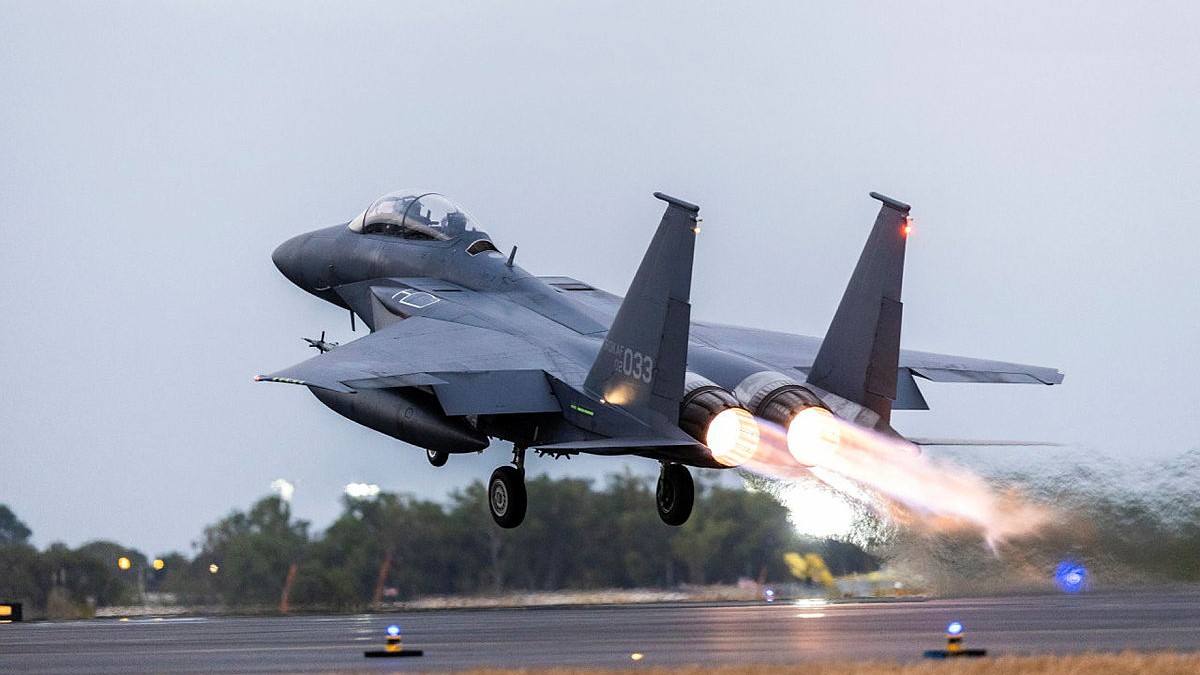
The components included in the sale indicate that the ROKAF intends to upgrade its entire fleet of F-15Ks to a configuration similar to the new F-15EX Eagle II currently being delivered to the U.S. Air Force. Interestingly, the Korean configuration will also include the CMWS, currently not installed on the EX, so the F-15K will also require some structural modifications to add the blisters on each side of the canopy rail where the sensors are installed.
The inclusion of aerial refueling support and aircraft ferry support in the FMS notice suggested that at least the initial aircraft could be ferried to the United States for the modifications before the rest are modified in country. The mention of the work to be conducted in St. Louis further points to that possibility.