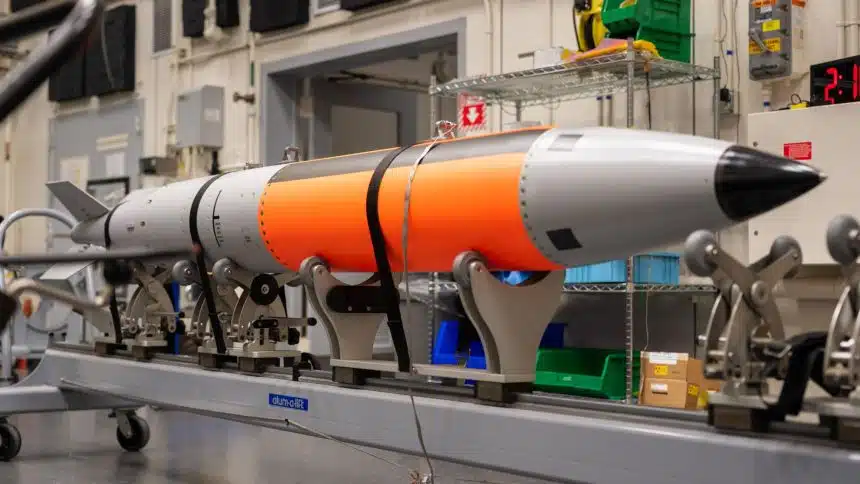
The National Nuclear Security Administration (NNSA) said it completed ‘Diamond stamping’ of the new B61-13 nuclear bomb, meaning it has met all the requirements of the rigorous certification process.
The U.S. National Nuclear Security Administration (NNSA) announced on Jun. 8, 2026 the “diamond stamping” of all the Canned Subassemblies (CSA) of the new B61-13 gravity nuclear bomb. The milestone was reached “three months ahead of schedule” at the Y12 National Security Complex located in Oak Ridge, Tennessee.
The NNSA explained in a press release that “‘Diamond stamping’ signifies that a weapon component has met all the requirements of NNSA’s rigorous certification process and is approved for deployment to the U.S. nuclear stockpile as ‘war reserve’ quality.” The milestone also comes a little over a year after the Sandia National Laboratories (SNL) revealed the B61-13’s first Joint Test Assembly (JTA) in March 2025, and the first completed bomb unit a few months later in May 2025.
The NNSA explained that the CSA component in a modern two-stage thermonuclear weapon includes the secondary stage capsule and “other parts sealed (canned) within a thin metal container made of stainless steel or aluminum alloy.” This is combined with the primary stage – the warhead’s nuclear explosive package.
🚨NNSA has completed “diamond stamping” of all planned B61-13 nuclear gravity bomb canned subassemblies (CSAs) for the current Fiscal Year—three months ahead of schedule at @y12nsc.
This early milestone underscores our commitment to delivering on President Trump’s national… pic.twitter.com/BH90dCktTz
— NNSA (@NNSANews) July 8, 2026
The B61-13 has been described as a “modern variant of the B61 nuclear bomb, the longest-serving and most versatile weapon in America’s nuclear stockpile.” The new bomb is designed to “defeat hard and deeply buried targets,” and will be certified for delivery by strategic bombers of the U.S. Air Force, including the new B-21 Raider.
The B61-12 Life-Extension Program (LEP) and the production of the new B61-13 are being carried out in a way that does not change the number of nuclear gravity drop bombs in the U.S. inventory. As we explained in a previous report about the B61-12’s LEP in January 2025, the B61-13 will replace some of the B61-7s in the current stockpile and the number of B61-12s to be produced will be lowered by the same amount as the number of B61-13s produced.
Important milestone
In the press release, NNSA Administrator Brandon Williams said the progress on the B61-13 program demonstrates the Nuclear Security Enterprise’s “ability to respond to evolving geopolitical requirements with speed and precision.” Williams further added that “completing the 2026 baseline deliverables ahead of schedule is a clear indicator of discipline and operational focus,” and “sends a message to our adversaries that our national defense remains agile, secure and effective.”
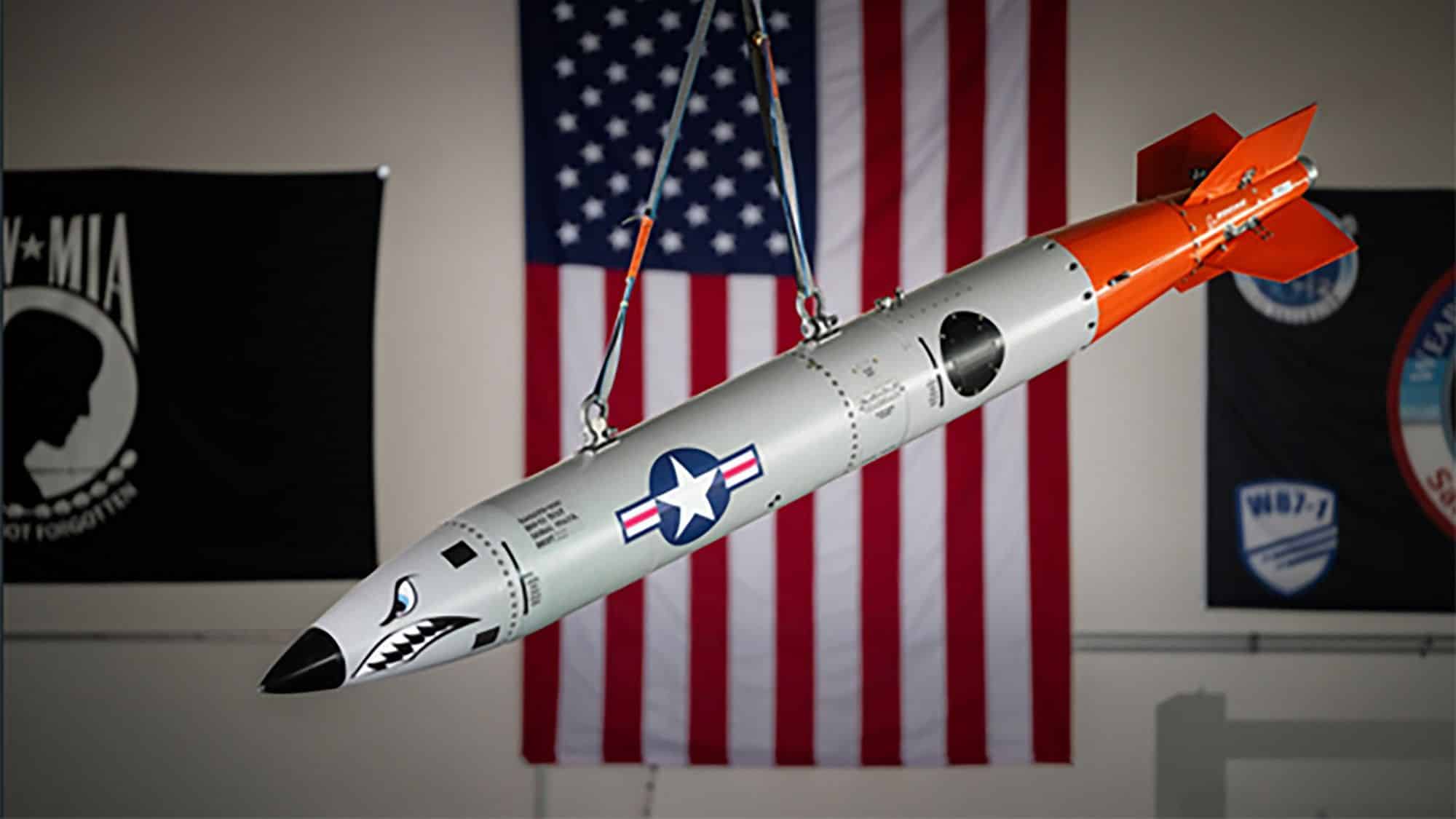
Additionally, a separate update on the SNL website reported 32 flight tests of inert weapons across the nuclear triad. Among these were “one air-launched cruise missile test with the W80,” conducted at the Utah Test and Training Range, and two B61-13 “earth-penetrator weapons.”
The agency generically mentioned “flight and ground tests,” but it is unclear if the B61-13 also underwent drop tests. Also, the mention of the W80 warhead suggests a test of the W80-1 warhead of the AGM-86 Air-Launched Cruise Missile (ALCM), or the W80-4 meant for the AGM-181 Long-Range Stand Off (LRSO) missile.
B61-13
The B61-13 uses the older B61-7’s warhead, which had a yield ranging from 10 to 360 kt, but also features enhanced safety and accuracy mechanisms and improved components. The B61-13 will reportedly have both lower and higher yield options, from 0.3 to 1.5 kt, and between 10 to 50 kt.
It was my honor today to stamp the first completed B61-13 unit at the @PantexPlant!
This achievement signals to our adversaries and allies alike that the U.S. is prepared to meet the challenges of today’s environment from a position of strength and security. pic.twitter.com/1kgT3OF5Fa
— Secretary Chris Wright (@SecretaryWright) May 19, 2025
A specific feature of the B61-13 is the ability to strike underground targets with “limited earth penetration capabilities […] through soft soil,” according to the Federation of American Scientists (FAS). After hitting buried targets, the B61-13 can explode with “yields equivalent to a surface-burst weapon of more than one megaton.”
An F-35A flying at supersonic speed carried out a drop-test of the new B61-12 guided nuclear bomb. The first in a series of tests to certify the F-35A to be capable of delivering the B61-12. https://t.co/mM3yNVeGBE Some 480 B61-12s will arm US and NATO aircraft. pic.twitter.com/CzMAj8BO4p
— Hans Kristensen (also on Bluesky) (@nukestrat) November 23, 2020
Like the B61-12, the B61-13 too will be put through grueling stress, shock, pressure, vibration, impact and environmental tolerance testing to assess that the bomb and its individual parts function as planned. These include being fired from a Davis Gun operated by SNL into an 8 feet deep pool, a Forward Ballistic Impact test on a high-speed rail-mounted track and, finally, tests from various aircraft.
Currently, the B61-13 is meant to be used only by the B-21 Raider stealth bomber.
B61-12 Forward Ballistic Impact
Source: Sandia pic.twitter.com/Sm1LRsy6oq
— Casillic (@Casillic) November 10, 2023
The development of the new weapon was first publicly announced in October 2023. By March 2025, SNL revealed the B61-13’s first Joint Test Assembly (JTA) – a test article without the live nuclear warhead for various ground trials, as well as aerial captive carry and separation trials.
In May 2025, the NNSA announced the production of the first B61-13 nuclear bomb at the Pantex plant in Amarillo, Texas. This came almost a year ahead of “the original target date and less than two years after the program was announced, making the bomb one of the most rapidly produced post-Cold War nuclear weapons,” the statement said.
B61-12 Forward Ballistic Impact
Source: Sandia pic.twitter.com/Sm1LRsy6oq
— Casillic (@Casillic) November 10, 2023
In the latest press release, the NNSA highlighted: “The newer variant features a higher nuclear yield, oriented to defeat certain harder and large-area military targets, providing additional flexibility to the President’s nuclear response options. The B61-13 is one of six ongoing warhead modernization programs that NNSA is executing to ensure the long-term reliability and effectiveness of the U.S. nuclear weapons stockpile.”