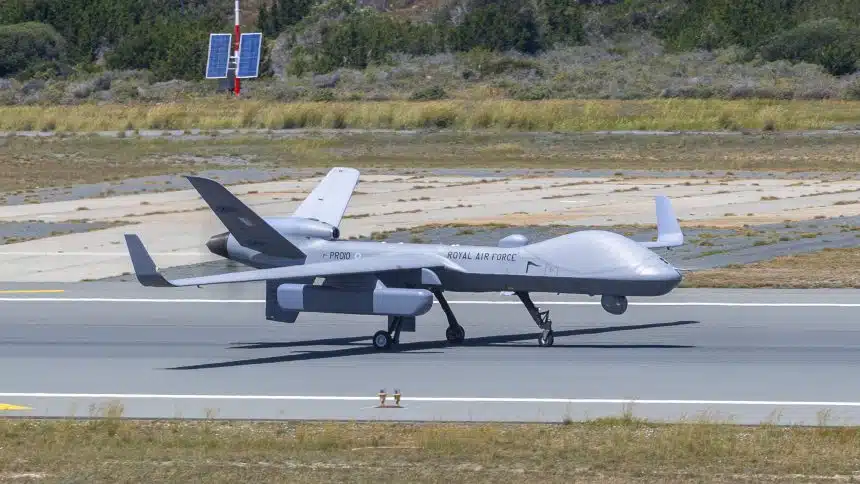
The UK Ministry of Defence has published new photos of the first deployments of the MQ-9B Protector RG1 to RAF Akrotiri on Cyprus, including some of the best official views of what is believed to be the ‘Outdragon’ SIGINT pod.
As we covered extensively on The Aviationist, the Royal Air Force’s new fleet of MQ-9B Protector RG1 aircraft – which replaced the MQ-9A Reaper – began operating from RAF Akrotiri during the second half of 2025. After a series of local sorties – which could be publicly tracked on flight tracking websites – the uncrewed aircraft commenced operations over the Middle East itself as part of the long-running Operation Shader.
Official comment on these operations was sparse – much like those regarding previous operations involving the MQ-9A Reaper, which flew from bases in the Middle East itself like Al Udeid in Qatar. Now, the Ministry of Defence (MoD) has published imagery of the Protector RG1 aircraft at Akrotiri via its official Defence Imagery service.
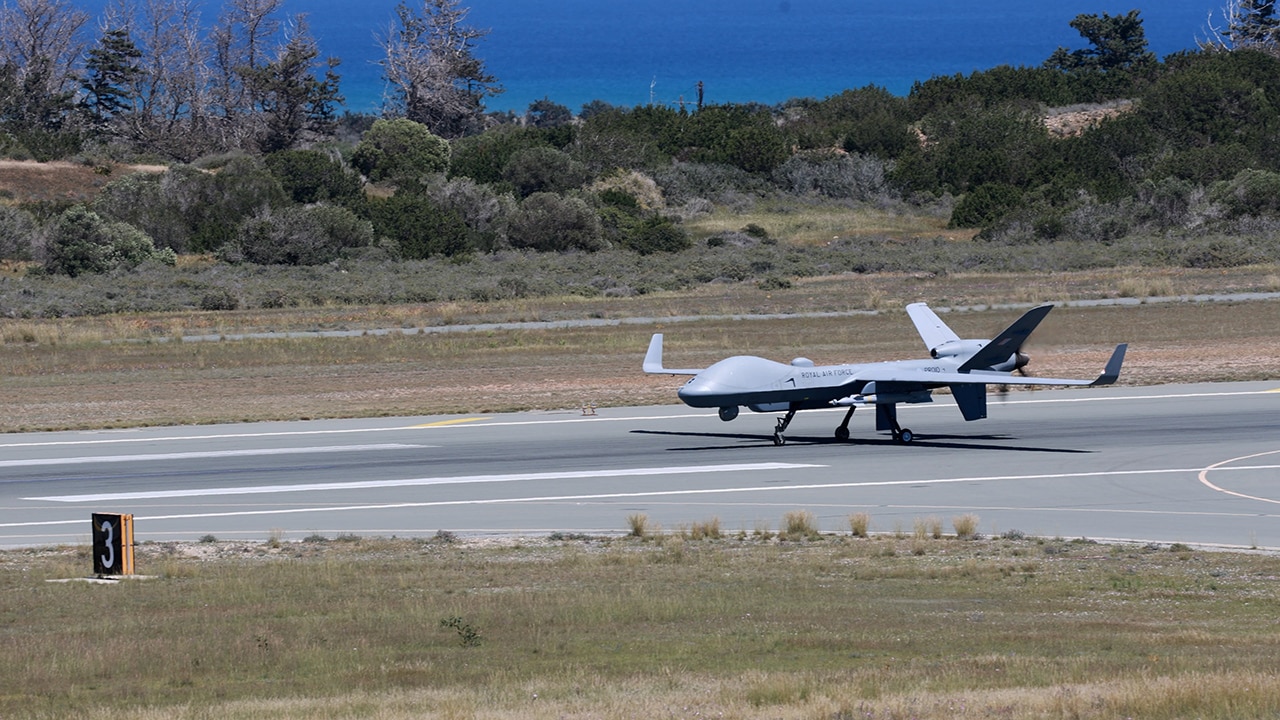
As well as providing the most official documentation of the operations so far, the images have also confirmed the active use of weapons and podded capabilities on the Protector RG1 platform. In a number of the photographs, taken – according to the camera EXIF data – in April 2026, a Paveway IV precision guided bomb can be seen carried by the aircraft under the port wing alongside a large, distinctive pod on the starboard wing.
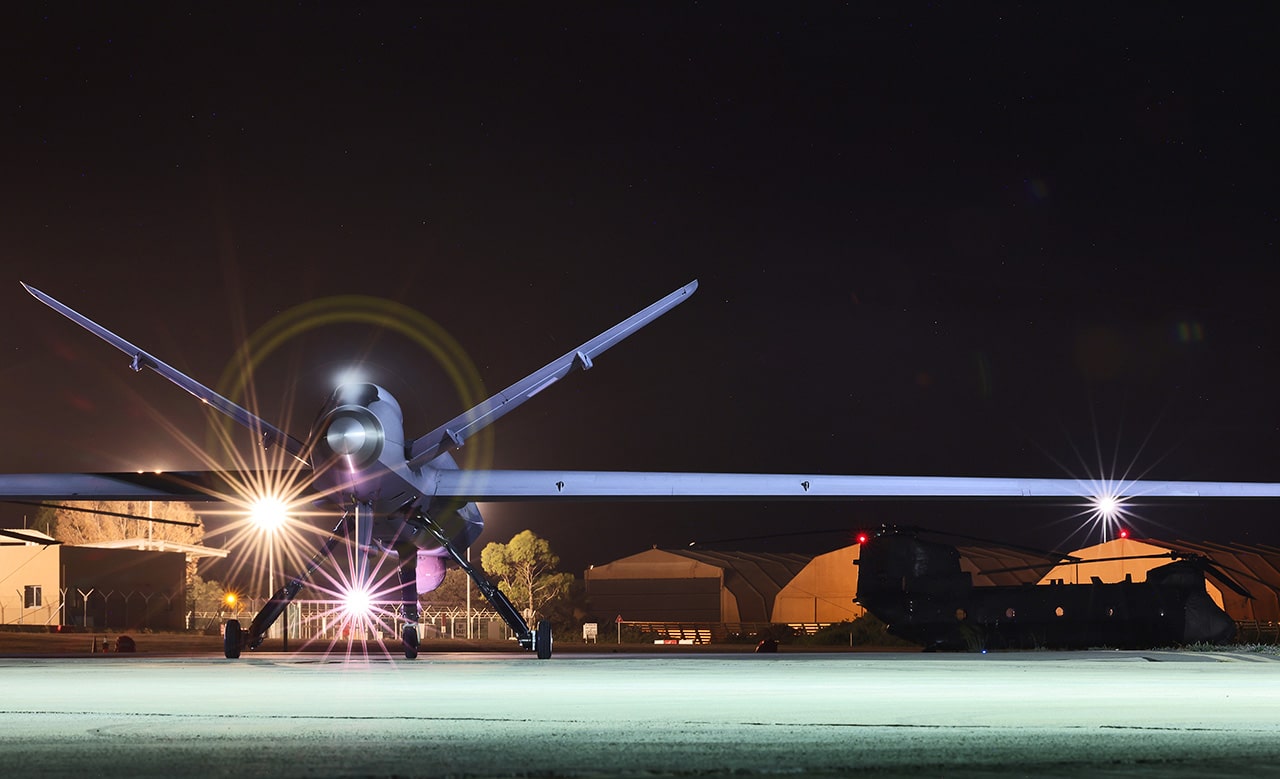
This pod is not an officially disclosed capability beyond intentionally vague statements regarding the MQ-9A and the Protector RG1’s suite of intelligence, surveillance, and reconnaissance (ISR) sensors, though it bears a strong resemblance to those seen previously on U.S. Reapers.
An update to this one from last year. A couple folks brought a series of images to my attention showing a blurred pod on board an MQ-9A in Kuwait a few days ago. An image set detailing the same training exercise but in July has what is most likely the same pod, unblurred. https://t.co/DhjSJ3uztH pic.twitter.com/Y49H9J0Tv0
— Emma Smith (@ameliairheart) August 29, 2023
For a brief time, the Royal Air Force’s own documentation for the Protector RG1’s loadouts (Form 725) was published openly on the official GOV.UK website. From this file, we can see a piece of equipment listed for station 8 on the starboard wing known as ‘Outdragon’ or ‘OD’. Newer versions of these forms are not publicly available.
In the images, a large blade antenna is also seen fitted to the centreline of the fuselage. This too is noted in the form, and features only on loadouts designated for ISR functions – including the ‘Outdragon only’ loadout.
The exact function of Outdragon is not able to be definitively confirmed, but its apparent pairing with a large blade antenna as well as the lack of any visible apertures for optical, infrared, or even radar-based sensors suggests that it could form part of what was described to Janes as a “comprehensive” signals intelligence (SIGINT) suite.
Other UK ISR Payloads
RAF Reapers were not unfamiliar to undisclosed payloads. As referenced in the Janes article listed above, and as featured in many official images of the RAF’s MQ-9s, in their later years they would apparently always carry two ‘cheeks’ on either side of the fuselage. Their exact nature has, similarly, not been confirmed, though U.S. Air Force budget documents have referenced the relocation of Air Handler (a mobile phone geo-location system) equipment from the ‘payload tray’ to the cheeks. Other documents have referred to them as ‘Air Handler cheeks’.
Whether this means the cheeks are exclusively for Air Handler, or whether they are configurable spaces for additional payloads is unclear. The length of each cheek, and the location on either side of the aircraft, would make them quite suitable as a replacement for a podded capability while providing a similar amount of space for equipment and a good field of view for any directional sensors.
The blade antenna mentioned above has been seen in use alongside these cheeks on the MQ-9A – if the blade is directly related to Outdragon, this could mean that the cheek antennas (which, as mentioned above, have been referred to as Air Handler cheeks) have previously also been used for Outdragon equipment. It might also suggest a connection between Outdragon and Air Handler.
🎥 Behind-the-scenes footage of the RAF Museum’s latest acquisition, the General Atomics MQ-9 Reaper, making its way onto the Royal Air Force Cosford airfield ready for the @cosfordairshow this Sunday! 🎉
This will be the first opportunity for aviation fans to see it on… pic.twitter.com/yHdqiPwSew
— RAF Museum (@RAFMUSEUM) June 12, 2026
These cheeks have not yet been seen on the Protector RG1, and notably they have remained on an MQ-9A Reaper airframe even after it was transferred to the Royal Air Force Museum for public display.
Self-Deployment
A Protector RG1 recently completed a first of a kind deployment flight from RAF Waddington in the UK through the airspace of various European nations and presumably to RAF Akrotiri. Previous deployments to Akrotiri have involved the disassembly of the aircraft, then shipment by air transport.
View this post on Instagram
This is made possible by the Protector RG1’s certification to operate outside of specially segregated airspace, having been granted a military type certificate. Unlike the MQ-9A Reaper, which never flew in UK airspace during its years of RAF service, the Protector RG1 is able to operate directly from RAF Waddington and self-ferry to a forward operating location or, if necessary, complete sorties in and around the British Isles.
Many thanks to Emma Smith for assisting with this article using her experience of the MQ-9’s wide and ever expanding array of external equipment. You can find her on X/Twitter and Bluesky.