U.S CENTCOM has confirmed that three F-15Es have been shot down after being mistakenly targeted Kuwaiti air defenses amid Iranian missile and drone attacks.
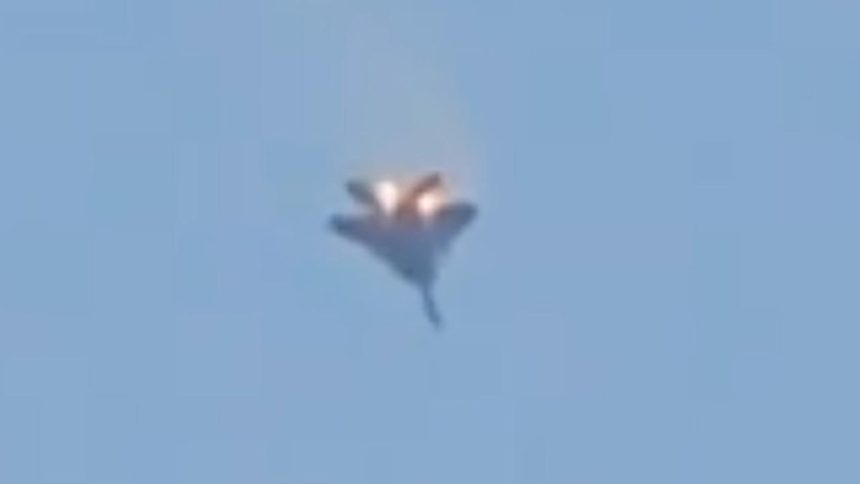
Videos emerged online in the morning of Mar. 2, 2026, show what was described as a U.S. Air Force F-15 being hit by surface to air fire, immediately catching fire and spinning out of control. The crew is seen ejecting, before the aircraft continues to spin towards the ground and crashes.
WATCH: Fighter jet crashes in Kuwait pic.twitter.com/Uhe6qTAdkd
— BNO News Live (@BNODesk) March 2, 2026
Photos then showed at least three different crew members safely on the ground, surrounded by reportedly Kuwaiti locals. However, the U.S. Air Force is currently employing the F-15E Strike Eagle in the region, which is a twin-seat aircraft.
Both the Pilot and Weapons Systems Officer (WSO) onboard the U.S. Air Force F-15E Strike Eagle that crashed this morning over Kuwait due to a “friendly fire” incident, appear to have survived, being found by locals and transferred to local authorities in Kuwait. pic.twitter.com/HyxpeI0QUL
— OSINTdefender (@sentdefender) March 2, 2026
pilots pic.twitter.com/wF9aoCs4rK
— C4H10FO2P ☠️ (@markito0171) March 2, 2026
Other regional partners operate the F-15 too, although their participation in the operations against Iran has not been reported. Among these operators are Saudi Arabia, with both single- and twin-seat F-15s, and Qatar, with twin-seats.
Another angle of this morning’s crash of an apparent shot down F-15 by “friendly fire” over Kuwait. pic.twitter.com/HCTXwW9vlq
— OSINTdefender (@sentdefender) March 2, 2026
According to some comments, the helmet of one of the crew members matches the one shown in a official photo of the 335th Fighter Squadron’s F-15Es out of Seymour Johnson AFB, North Carolina. This would further identify the aircraft and crews as belonging to the U.S. Air Force.
Impressive open-source sleuthing here. A partial helmet visible in an alleged photo of a downed F-15 pilot in Kuwait has been traced to the USAF 335th Fighter Squadron by @blocksixtynine. https://t.co/Glggzxq4rv pic.twitter.com/Qgyv7P92yO
— Christiaan Triebert (@trbrtc) March 2, 2026
Claims online immediately started attributing the incident to a possible friendly-fire, with some saying that a second F-15 might have been shot down. That would explain the presence of more than two crew members on the ground.
Indeed, the official X profile of the Kuwaiti Army published a post saying that “the official spokesperson for the Ministry of Defense stated that several US warplanes crashed this morning, confirming that all crew members survived.” According to the spokesperson, the crews are in stable condition and have been transported to the hospital for medical evaluation and treatment.
بيان رقم 7
صرّح الناطق الرسمي باسم وزارة الدفاع بأنه في صباح هذا اليوم سقطت عدد من الطائرات الحربية الأمريكية، مؤكداً نجاة أطقمها بالكامل.
وأوضح أن الجهات المختصة باشرت فوراً إجراءات البحث والإنقاذ، حيث تم إخلاء الأطقم ونقلهم إلى المستشفى للاطمئنان على حالتهم الصحية وتقديم… pic.twitter.com/HYX3LGqEX1
— KUWAIT ARMY – الجيش الكويتي (@KuwaitArmyGHQ) March 2, 2026
The post also stated that an investigation is in progress. At that time, CENTCOM had yet to confirm the incident, although the Kuwaiti MoD said it was coordinating with the U.S. to quickly return the crews to their home bases.
What happened?
The aircraft in the first video can be seen flying straight and level, before an explosion takes place. At this time, it is not possible to verify what exactly happened. Some claims mention the use of Short-Range Air Defense (SHORAD) systems with infrared-guided missiles.
This could be one of the many possible explanations. The F-15E is not equipped with Missile Warning Sensors (MWS) for infrared-guided missiles, thus the crew would not get a warning if one was flying towards them, compared to radar-guided missiles.
Also, the aircraft was reportedly flying over friendly territory in Kuwait, where the crew would not necessarily expect surface-to-air threat against them. Considering the aircraft was not flying at high altitude and it was not equipped with external fuel tanks, it is likely the F-15 was flying as part of the defensive effort against Iranian missiles and drones, which previously struck also Kuwait.
As we mentioned in our previous reporting, Iran is continuing to target neighboring countries which host U.S. bases, including Kuwait, Jordan, Qatar and the UAE. Hundreds on missiles and drones have been launched, with many intercepted by both aircraft and ground-based air defenses.
U.S. CENTCOM confirmation
U.S. Central Command has released a public statement confirming the friendly fire incident:
“At 11:03 p.m. ET, March 1, three U.S. F-15E Strike Eagles flying in support of Operation Epic Fury went down over Kuwait due to an apparent friendly fire incident.
During active combat—that included attacks from Iranian aircraft, ballistic missiles, and drones — the U.S. Air Force fighter jets were mistakenly shot down by Kuwaiti air defenses.
All six aircrew ejected safely, have been safely recovered, and are in stable condition. Kuwait has acknowledged this incident, and we are grateful for the efforts of the Kuwaiti defense forces and their support in this ongoing operation.
The cause of the incident is under investigation. Additional information will be released as it becomes available.”
At 11:03 p.m. ET, March 1, three U.S. F-15E Strike Eagles flying in support of Operation Epic Fury went down over Kuwait due to an apparent friendly fire incident.
Read more:https://t.co/i2y3Q3vo2E
— U.S. Central Command (@CENTCOM) March 2, 2026
The 2011 loss
While this is the first time F-15Es are lost to friendly fire, this is not the first incident occurred to a Strike Eagle during the opening stages of a conflict.
On Mar. 21, 2011, an F-15E Strike Eagle, 91-0304/LN belonging to the 492th Fighter Squadron, 48th Fighter Wing, Royal Air Force Lakenheath, United Kingdom, deployed to Aviano AB, Italy, crashed approximately 40 kilometres to the east of Benghazi. Both crew members, F-15 pilot Maj. Kenneth Harney and Capt. Tyler Stark, ejected safely: one was recovered by coalition forces while the other was recovered by the rebels. Remains of the aircraft were later destroyed so critical systems information and equipment could not be salvaged by foreign forces.
The investigation “found clear and convincing evidence that the cause of the mishap was the aircraft’s sudden departure from controlled flight because it exceeded the critical angle of attack during an Air Force-approved combat maneuver. Other contributing factors to this accident include the pilot conducting an AF-wide acceptable maneuver for the F-15E at a previously untested altitude and lateral asymmetry (unbalanced aircraft).”
Other Friendly Fire incidents
On Dec. 22, 2024, an F/A-18F Super Hornet, embarked aboard USS Harry S. Truman, was shot down in what the U.S. Central Command called “an apparent case of friendly fire”. The two aircrew members ejected safely and were rescued. One of the pilots sustained minor injuries. Their account of the incident appeared online some months later.
Before this one, there have been several well-known “blue-on-blue” incidents (one of them, which claimed the lives of two British officers in 2003, occurred at the very same base involved today: Ali Al Salem, Kuwait).
On April 14, 1994, during Operation Provide Comfort (OPC), two U.S. Air Force F-15C Eagle jets operating over northern Iraq, under the control of an airborne early warning and control system (AWACS) aircraft, mistakenly identified two U.S. Army UH-60 Black Hawk helicopters as Iraqi Mil Mi-24 Hind gunships. The F-15 pilots fired on and destroyed the helicopters, killing all 26 people onboard, including U.S., UK, French, Turkish, and Kurdish personnel.
A subsequent investigation by the Air Force pointed to multiple failures: the F-15 pilots were criticized for the misidentification of the helicopters, while the AWACS crew was at fault for not intervening or maintaining proper control. Additionally, the helicopters’ IFF systems didn’t work as intended, and U.S. Army helicopter operations were poorly integrated into OPC air operations. Several Air Force officers received administrative penalties, but only AWACS crew member Jim Wang faced a court-martial, where he was acquitted.
Another notable incident occurred on Apr. 2, 2003, near Karbala, Iraq, as two F/A-18s were returning to the USS Kitty Hawk.
A Patriot battery misclassified the aircraft’s radar signature as an Iraqi missile and alerted the Information Coordination Center, which then labeled the flight path as a hostile missile track. Shortly after, a second Patriot battery also detected the plane and reached the same mistaken conclusion, believing it and nearby U.S. forces were under attack. The combined reports strengthened the belief among operators that they were tracking a legitimate threat, and the command center ultimately authorized the launch of two missiles, which brought down the Hornet, killing of U.S. Navy pilot Lt. Nathan White. While no disciplinary action was taken against the personnel involved, the investigation attributed the error to a series of misjudgments rather than negligence.
This was one of two similar incidents involving Patriot systems during the campaign.
On Mar. 22, 2003, a British Tornado GR4 (registration ZG710) was shot down by a U.S. Patriot battery near the Iraq-Kuwait border, killing both crew members, Flight Lieutenant Kevin Main, the pilot, and Flt Lt David Williams, the navigator. The aircraft was mistakenly identified as an Iraqi Anti-Radiation missile.
The investigation found that the aircraft’s IFF system, which had passed pre-flight checks, stopped working mid-flight. This issue was traced to a malfunction in the transponder’s power system, which also prevented the cockpit warning light from notifying the crew about the failure. Moreover, the U.S. Patriot missile crew, who had only been in Kuwait for a month, were operating without their standard equipment. They were on heightened alert after a grenade attack at another base that same night and were relying on a single radio link to communicate with their battalion headquarters limiting their situational awareness as the Tornado, returning from a bomb mission, began its descent returning to its base.
When the Tornado’s IFF failed to respond, the system automatically flagged it as an incoming Iraqi missile, leading to the fatal mistake.
The Patriot system identifies hostile missiles through their flight profile and other characteristics, including the lack of an IFF response. The criteria programmed into the Patriot computer were based on the many different AntiRadiation Missiles available worldwide, and were therefore very broad. ZG710’s flight profile met these criteria as it commenced its descent into Ali Al Salem. The Board considered that the criteria should have been much tauter, based on the known threat from Iraq, and concluded that the generic AntiRadiation Missile classification criteria programmed into the Patriot computer were a contributory factor in the accident.
This is a developing story, it will be updated as new details emerge.