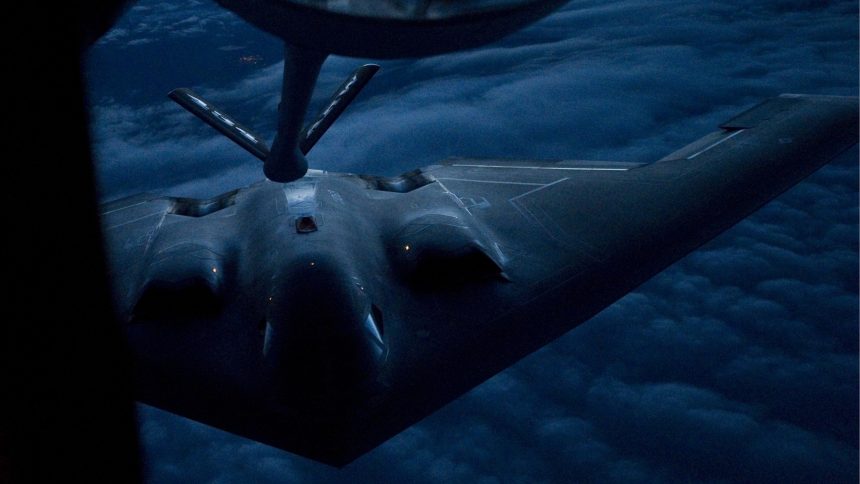
Radio communications on ATC frequencies revealed that four B-2A Spirit stealth bombers flew a round trip mission from CONUS for night strikes on Iranian targets.
As expected, the U.S. Air Force employed the B-2A Spirit stealth bomber during the first night of the strikes against Iranian targets as part of Operation Epic Fury. Four bombers were reportedly heard speaking with air traffic control on standard air traffic control (ATC) frequencies while on the way back to the U.S. at the end of the mission.
B-2 Mission
The four aircraft, part of the PETRO41 flight, were flying over the Strait of Gibraltar, similarly to previous missions such as last year’s Operation Midnight Hammer. Their flight was supported by a number of KC-46 tankers, of which one confirmed that the PETRO41 flight included four aircraft.
The B-2s are on their way back to Whiteman AFB as PETRO41 flight. They checked in earlier this morning with SEVILLE CONTROL over the Straight of Gibraltar just like Op Midnight Hammer. I love how the Spanish controller say’s to them, “Adios” 😎🇺🇸💪 pic.twitter.com/IuiTAxkrf5
— Thenewarea51 (@thenewarea51) March 1, 2026
It is worth noting that the PETRO callsign is often associated with tankers. The KC-46s are said to have used the RCH, or Reach, callsign for this mission. The combination of these callsigns might have been an intentional choice to avoid attracting attention to the bombers, another aspect in common with Midnight Hammer.
Earlier today 4x(?) KC-46A left from Lajes (LPLA) at 1530Z#AE5E08 – 17-46027 – ?#AE574E – 19-46008 – RCH249#AE63BE – 20-46082 – RCH068?
Miscoded hex, pretty sure RCH065?
Could possibly be a hand-off to 2x KC-135R out of Rota (LERT) at 1640Z#AE04CA – 60-0360#AE0594 – 58-0128 https://t.co/wVobHp23DW pic.twitter.com/stpTnzMDjC
— Aux OSINT (@AUX_OSINT) February 28, 2026
The tankers were captured in a video showing a 30 seconds Minimum Interval Take Off from Lajes Air Base in the Azores. A total of five KC-46s departed the base, with one possibly being a spare.
Five take-offs in three minutes: USAF KC-46´s taking off from Lajes AFB, filmed by a Portuguese news team. This was about one hour ago. pic.twitter.com/s99CYNLIdl
— Air Safety #OTD by Francisco Cunha (@OnDisasters) February 28, 2026
This would be another aspect which reflects previous round trips from Whiteman Air Force Base, Missouri, and back. In fact, tankers are often staged at Lajes or Naval Air Station Rota, Spain, from where they are launched to meet the bombers during their crossing of the Atlantic Ocean.
#USAF United States Air Force – Middle East Activity
28 February / 1 March
Four Northrop Grumman B-2 Spirit stealth bombers from Whiteman Air Force Base are conducting a round-trip bombing sortie to Iran, and are currently on their return journey home. They were caught returning… https://t.co/J8p9DkWa5p pic.twitter.com/zzivwVz8d3
— Armchair Admiral 🇬🇧 (@ArmchairAdml) March 1, 2026
The Pentagon has not yet officially confirmed the use of the B-2 as part of Operation Epic Fury. However, an unnamed U.S. official confirmed to Fox News’ Jennifer Griffin that four B-2s “dropped dozens of 2,000 lb bombs on underground ballistic missile sites in Iran.”
NEW: 4 B2 bombers flew round trip from the US- dropped dozens of 2000 lb bombs on underground ballistic missile sites in Iran: US defense official tells me.
— Jennifer Griffin (@JenGriffinFNC) March 1, 2026
It should be noted that the use of the B-2 for the strikes in Iran don’t necessarily meant that the GBU-57 Massive Ordnance Penetrator (MOP) was needed. In fact, the bomber can transport a payload of over 40,000 lb (18,000 kg), which could include either up to 80 500 lb GBU-38 Joint Direct Attack Munitions (JDAM), 16 2,000 lb GBU-31 JDAM or 16 AGM-158 Joint Air-to-Surface Standoff Missiles (JASSM), just to mention some.
#OperationEpicFury #FreeIran
“OPERATION EPIC FURY” BOMBER MISSION
At last, I can confirm that overnight a flight of 4 B-2A “Spirit” bombers flew non-stop from the United States to Iran to attack targets belonging to the regime.
I am releasing this information now as the bombers… pic.twitter.com/5mmiU4QXl4
— DefenceGeek 🇬🇧 (@DefenceGeek) March 1, 2026
The mention of underground sites would point to the use of the GBU-31(V)3/B JDAM. This variant of the JDAM bomb is based on the 2,000 lb BLU-109/B bunker buster.
Second Day of Epic Fury/Roaring Lion
As we move into the second day of the joint Israeli/U.S. operation against Iran, the U.S. Central Command (CENTCOM) announced that three U.S. service members have been killed in action and five are seriously wounded. The post on social media mentioned that several others sustained minor shrapnel injuries and concussions, thus possibly linking the casualties at the Iranian attacks against U.S. bases in the region.
CENTCOM Update
TAMPA, Fla. – As of 9:30 am ET, March 1, three U.S. service members have been killed in action and five are seriously wounded as part of Operation Epic Fury.
Several others sustained minor shrapnel injuries and concussions — and are in the process of being…
— U.S. Central Command (@CENTCOM) March 1, 2026
CENTCOM also responded to the claims by the Iranian Islamic Revolutionary Guard Corps (IRGC) that ballistic missiles struck the USS Abraham Lincoln (CVN-72) aircraft carrier. The command says the vessel was not hit, and “the missiles launched didn’t even come close.”
🚫Iran’s IRGC claims to have struck USS Abraham Lincoln with ballistic missiles. LIE.
✅The Lincoln was not hit. The missiles launched didn’t even come close. The Lincoln continues to launch aircraft in support of CENTCOM’s relentless campaign to defend the American people by… pic.twitter.com/AjaeHMemtA
— U.S. Central Command (@CENTCOM) March 1, 2026
Images and videos released by CENTCOM showed the capabilities which were employed throughout the first day of combat operations. Among them appears to be the U.S. Army’s new Precision Strike Missile (PrSM), launched from an M142 High Mobility Artillery Rocket System (HIMARS).
The Iranian regime was warned. CENTCOM is now delivering swift and decisive action as directed. pic.twitter.com/nNDoDexH6g
— U.S. Central Command (@CENTCOM) March 1, 2026
Other capabilities include, as we mentioned in our previous reporting, the RGM-109 Tomahawk Land Attack Missile (TLAM). Notably, one the TLAMs appears to be painted in a glossy black coating, reminiscent of the one used on the AGM-158C Long Range Anti-Ship Missile (LRASM).
First published image of a black Tomahawk.
I am guessing a classified low observable coating of some form has been applied to the missile. https://t.co/RgN9J1sREr pic.twitter.com/50ZxPxUDss
— John Ridge 🇺🇸 🇺🇦 🇹🇼 (@John_A_Ridge) February 28, 2026
Another recently introduced capability is the AGR-20F-armed F-15E Strike Eagle. An image, part of a video released by CENTCOM, shows a Strike Eagle taking off with four LAU-131 A/A rocket pods, each capable of carrying seven AGR-20F Fixed Wing, Air Launched, Counter-Unmanned Aircraft Systems Ordnance (FALCO) rockets, in addition to four AIM-9X Sidewinder and four AIM-120C/D AMRAAM air-to-air missiles.
First 24 hours of Operation Epic Fury:
“The President ordered bold action, and our brave Soldiers, Sailors, Airmen, Marines, Guardians, and Coast Guardsmen are answering the call,” – Adm. Brad Cooper, CENTCOM Commander pic.twitter.com/McrC7xeM0A
— U.S. Central Command (@CENTCOM) March 1, 2026
Other images released by CENTCOM show the F-35C Lightning IIs of the U.S. Marine Corps’ VMFA-314 aboard the USS Lincoln. Interestingly, the photos clearly show the discoloration caused by the oxidation of iron-based particles in the jet’s RAM coating, although, as we noted, it does not affect the aircraft’s LO (Low Observability).
This image also released by CENTCOM shows the discoloration even better. https://t.co/h66slBqpry pic.twitter.com/LmoGU8uY0q
— The Aviationist (@TheAviationist) March 1, 2026
During the night between Feb. 28 and Mar. 1, both sides continued their attacks. Notably, UK forces based at RAF Akrotiri intercepted two Iranian missiles that were flying towards Cyprus, said UK’s Defence Secretary John Healey.
Interestingly, RAF Akrotiri is currently taking part in operations with a detachment of U.S. Air Force U-2S Dragon Lady spy aircraft. In fact, a U-2 was heard speaking to ATC while recovering at the British base, which is often used by the aircraft.
SNOOP 01 (U-2 spy plane) just called NICOSIA ATC descending out of FL600 aka 60,000 feet for recovery back into RAF Akrotiri, Cyprus. 😎🤙 pic.twitter.com/Yg5azqtGZs
— Thenewarea51 (@thenewarea51) February 28, 2026
Iran state media confirmed that the Supreme Leader Ali Khamenei has been killed in the strikes of Feb. 28 on his compound in Tehran. Iranian officials announced 40 days of mourning, while vowing vengeance against Israel and the U.S.
This was followed by the claims of the attack against the USS Lincoln, denied by CENTCOM, as mentioned earlier. Additionally, Iranian state media published a video of the Islamic Republic of Iran Air Force’s F-4E Phantom II fighter jets, saying they will be used to bomb U.S. bases in the region.
Later, the IDF released footage of airstrikes showing F-4 and F-5 fighters being destroyed on the ground at Tabriz airfield, in western Iran. Unverified reports mention that F-14 Tomcats might also be among the aircraft destroyed on the ground.
Israeli Air Force airstrike on an Iranian F-4 Phantom at Tabriz Airport this afternoon. https://t.co/4pmeS1z8Nw pic.twitter.com/y2bjxPu0IP
— OSINTtechnical (@Osinttechnical) March 1, 2026
Preparing for the Second Night of Strikes
As the conflict moves into its second night, new updates have been provided by CENTCOM, starting with a post to officially confirm the employment of the B-2A Spirit. As mentioned earlier, CENTCOM said that Iran’s hardened ballistic missile facilities were struck by 2,000 lb bombs, likely referring to the GBU-31(V)3 JDAM bombs with the BLU-109 bunker buster warhead.
Last night, U.S. B-2 stealth bombers, armed with 2,000 lb. bombs, struck Iran’s hardened ballistic missile facilities. No nation should ever doubt America’s resolve. pic.twitter.com/6JpG73lHYW
— U.S. Central Command (@CENTCOM) March 1, 2026
Satellite photos show damage to Tabriz’s missile base, which was reported to be among the targets of the B-2s. The tunnels’ entrances appear to be collapsed.
New before/after satellite imagery of Iran’s Tabriz North Missile Base. Images 1-2: February 23. Images 3-4 March 1. @planet says the latter two images show collapsed tunnels. pic.twitter.com/3vzjVg8Are
— Mike Eckel (@Mike_Eckel) March 1, 2026
CENTCOM also published the full list of the assets being employed in combat, ranging from airborne assets to surface and maritime assets. Unspecified “special capabilities” that CENTCOM “can’t list here” were also mentioned, although it could be a reference to cyber capabilities which were also employed recently in Venezuela.
Operation Epic Fury: The first 24 hours pic.twitter.com/VRcoc5G1Hd
— U.S. Central Command (@CENTCOM) March 1, 2026
Iranian attacks against neighboring countries continued throughout the day. Among the locations hit is the French naval base Camp de la Paix in Abu Dhabi, which was established in 2009 as part of an agreement between France and the United Arab Emirates. No casualties have been reported.
Iran attacked a naval base of the French Navy in Abu Dhabi. pic.twitter.com/hFDFsjX5Zz
— 𝔗𝔥𝔢 𝕯𝔢𝔞𝔡 𝕯𝔦𝔰𝔱𝔯𝔦𝔠𝔱△ 🇬🇪🇺🇦🇺🇲🇬🇷 (@TheDeadDistrict) March 1, 2026
Un hangar de notre base navale mitoyenne de celle des Émiriens a été touché dans une attaque de drones qui a ciblé le port d’Abu Dhabi.
Les dégâts ne sont que matériels et limités. Aucun blessé n’est à déplorer.
La vigilance de nos forces est maximale face à une situation qui…
— Catherine Vautrin (@CaVautrin) March 1, 2026
Few hours later, French television announced that the Charles de Gaulle aircraft carrier would interrupt its deployment to the Baltic Sea and immediately sail towards the Eastern Mediterranean. French officials said the carrier will ensure “regional stability and protection of French interests.”
https://t.co/epJGRbvJBj https://t.co/9sAhSB7D4h
— OSINTtechnical (@Osinttechnical) March 1, 2026
The UK’s Ministry of Defense also disclosed that its Typhoon FGR4 fighters deployed to Qatar with the joint British-Qatari No. 12 squadron are being employed for defensive counter air (DCA) patrols. During one of these patrols, a Typhoon shot down with an air-to-air missile an Iranian drone that was headed towards Qatar.
Today, a Royal Air Force Typhoon operating from Qatar as part of the joint UK–Qatar Typhoon Squadron, successfully took out an Iranian drone heading towards Qatar. pic.twitter.com/1WQTRk61gN
— Ministry of Defence 🇬🇧 (@DefenceHQ) March 1, 2026
RAF Typhoons are also flying DCA missions off the coast of Cyprus, where RAF Akrotiri is located. As mentioned previously, Iranian missiles headed towards Cyprus were intercepted earlier today.
#RAF Royal Air Force – Middle East Activity
1706z
Eurofighter Typhoon FGR.4 2x#43CAE8 ZK334 – RAMPANT 21
RAMPANT 22
Airbus KC.3 Voyager 1x#43C6F7 ZZ334 – ASCOT 9961
RAF Typhoons RAMPANT 21/22 are flying patrols off the coast of Cyprus, with support from ASCOT 9961.
Along… https://t.co/IGq75X2Ohk pic.twitter.com/h2CMaROAdI
— Armchair Admiral 🇬🇧 (@ArmchairAdml) March 1, 2026
In the evening, the UK, France, and Germany announced with a joint statement that they “will take steps to defend our interests and those of our allies in the region, potentially through enabling necessary and proportionate defensive action to destroy Iran’s capability to fire missiles and drones at their source.”
https://t.co/9va4o2eXD2 pic.twitter.com/dN8oQJoX8e
— OSINTtechnical (@Osinttechnical) March 1, 2026
UK’s Prime Minister Keir Starmer said the government has agreed to allow the U.S. to use British bases for strikes on Iranian missile sites. “The only way to stop the threat is to destroy the missiles at source, in their storage depots, or the launchers which are used to fire the missiles,” said Starmer in a video statement.
My update on the situation in the Middle East. pic.twitter.com/DvsOVcTDMy
— Keir Starmer (@Keir_Starmer) March 1, 2026
“The United States has requested permission to use British bases for that specific and limited defensive purpose,” he continued. “We have taken the decision to accept this request to prevent Iran firing missiles across the region, killing innocent civilians, putting British lives at risk, and hitting countries that have not been involved.”
Notably, Starmer said will the UK “will bring experts from Ukraine, together with our own experts, to help Gulf partners shoot down Iranian drones attacking them.” This followed a request from partners in the Gulf to “do more to defend them.”
Meanwhile, U.S. tankers that were staged at bases in Spain are now leaving and flying towards other bases such as RAF Mildenhall, UK, Istres Air Base, France, and Ramstein Air Base, Germany. Spain’s Prime Minister Pedro Sánchez previously condemned the U.S. and Israeli strikes on Iran, although it is unclear if the Spanish government denied the use of its bases.
BREAKING: Has Spain ordered the US tanker fleet there to leave? #FreeIran
— Operation LION & SUN / ROARING LION / EPIC FURY —
What started as possible move of around half a dozen tankers from Spain to Ramstein Airbase in Germany, now appears to be a full-on withdrawal of… pic.twitter.com/0wF2D8mQcb
— DefenceGeek 🇬🇧 (@DefenceGeek) March 1, 2026