Additional fighter and CSAR assets are being deployed to multiple bases across the Middle East as preparations for a potential attack on Iran appear to intensify.
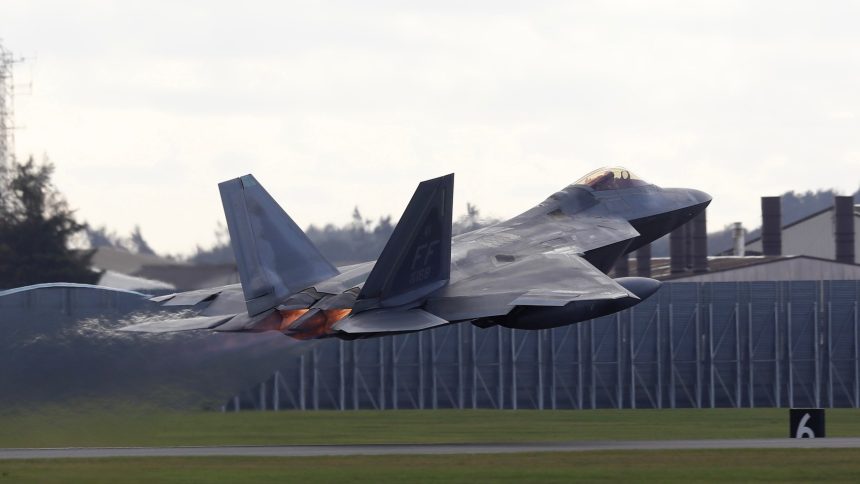
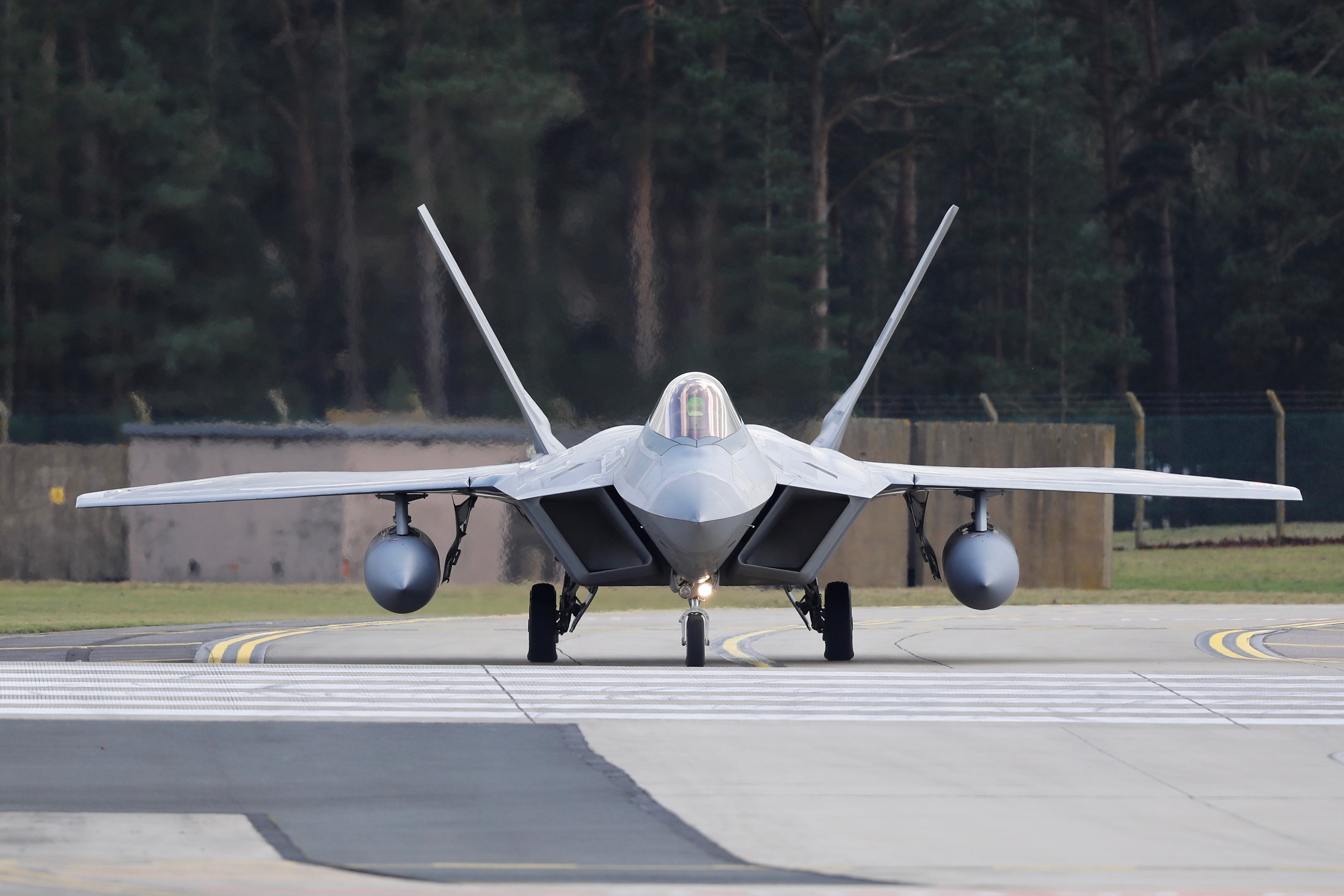
The last two days saw another influx of U.S. assets in Europe on their way to the Middle East, where they will join the buildup. In fact, between Feb. 24 and 26, a total of 38 fighters – 12 F-22 Raptors, 14 F-15E Strike Eagles and 12 F-35A Lightning II – arrived at RAF Lakenheath, UK, from where they are expected to move to their final destinations.
Just hours earlier, the first group of F-22s, which arrived at Lakenheath on Feb. 17, departed to the Middle East, and specifically at Ovda Air Base in Israel. Although 12 Raptors left the UK of Feb. 24, only 11 arrived at Ovda, as one had to return to Lakenheath for technical issues.
The Raptors Live!!
Twelve “FF” F-22A Raptors from Langley AFB finally departed RAF Lakenheath today for Ovda Air Base in Israel.#usaf #f22 #lockheedmartin #lakenheath #langley #canon #aviation pic.twitter.com/Qg77B05aAJ
— Havoc Aviation (@havoc_aviation) February 24, 2026
Raptors on the move at RAF Lakenheath. The F-22s are eventually deploying to the Middle East after several days in the UK. Interesting video by our friend @TallGlenn85 pic.twitter.com/OCYbNYTEyF
— The Aviationist (@TheAviationist) February 24, 2026
Latest Arrivals
Coronet missions have been continuously moving fighters from CONUS to Europe, where they are being staged before moving on towards the Middle East. Usually, Coronet East or West missions are ferry flights across the Atlantic or Pacific Ocean, respectively, of aircraft which are either deploying to a forward operating base or returning home at the end of a tour of duty, or on delivery to a customer (a non-US air force).
These missions are supported by one or more tankers, either flying along with the receivers or launched from overseas bases, that provide the fuel the fighters need to reach their final destination. In the current missions, each cell of six fighters is being accompanied by CONUS-based to halfway across the Atlantic Ocean and then picked up by tankers launched from RAF Mildenhall.
Also suggests there isn’t time to forward deploy tankers for these movements, so they make use of the 100ARW at Mildenhall. https://t.co/BOmJquGAnw
— Armchair Admiral 🇬🇧 (@ArmchairAdml) February 26, 2026
The first ferry mission to arrive in the UK was Coronet East 051, which saw a first group of six F-22s from Joint Base Langley–Eustis arrive on the evening of Feb. 24, followed by six more the next morning. These, once in the Middle East, would bring the total of the Raptors to 24 aircraft.
#USAF United States Air Force – Middle East Activity
25 February – Coronet East 051
Boeing KC-135 Stratotanker 5x#ADFF0D 62-3559 – GOLD 65 (RAF Mildenhall)#AE023B 57-1440 – GOLD 64 (RAF Mildenhall)#AE0655 58-0084 – GOLD 63 (Pittsburgh ARS)#AE0238 58-0074 – GOLD 62… https://t.co/LlTYyv8voo pic.twitter.com/YK8cs6Bc9q
— Armchair Admiral 🇬🇧 (@ArmchairAdml) February 25, 2026
On Feb. 25, Coronet East (CE) 045 also arrived at Lakenheath, with two F-15E Strike Eagles from Seymour Johnson AFB, North Carolina. It is unclear why only two fighters were part of this ferry cell, as the other flights typically included six fighters.
KC-135 #GOLD03 is out with only two F-15E (#TABOR61-62) from Seymour Johnson AFB for RAF Lakenheath on Coronet East 045. #GOLD07-08 provided initial support.#TABOR63-66 had to RTB over Nova Scotia as KC-46 #GOLD02 wasn’t able to get airborne from Bangor due to an engine issue. pic.twitter.com/RP7U9ZBFob
— EISNspotter (@EISNspotter) February 25, 2026
Another influx of fighters was noted on Feb. 26, with Coronet East 044, 046 and 047. The status of CE 046 is however unclear, as it appears it has yet to leave CONUS and the aircraft it will accompany are unknown.
#USAF United States Air Force – Middle East Activity
25 February – Coronet East 044/046/047
There are three active Coronet missions this morning. “MO” F-15Es being moved under CE 044, “HL” F-35As under CE 047, and CE 046 with unknown receivers. CE 045 resulted in two “SJ” F-15Es… https://t.co/KW8XMS6ee0 pic.twitter.com/nfw1Aw0iAa
— Armchair Admiral 🇬🇧 (@ArmchairAdml) February 26, 2026
CE 044 included the deployment of 12 F-15Es from Mountain Home AFB, Idaho, which were divided in two cells of six aircraft each. The Strike Eagles were stopped midway at Seymour Johnson AFB before crossing the Atlantic Ocean.
KC-46 #GOLD73-74 & KC-135 #GOLD82/87/88 are out on Coronet East 044 with “MO” F-15E #TABOR11 (x6) & #TABOR21 (x6) from Seymour Johnson AFB, where they arrived on Tuesday. KC-135 #GOLD75-76 & #GOLD85-86 from RAF Mildenhall will join up around 50W. pic.twitter.com/o74B3JQP0u
— EISNspotter (@EISNspotter) February 26, 2026
CE 047 was involved in the deployment of 12 more fighters, this time F-35As from Hill AFB, Utah, once again divided in two cells of six aircraft each. According to some reports, the F-35s were 14, however this is consistent with the presence of a spare aircraft for each cell, should one had a technical issue and need to be replaced before crossing the ocean.
A busy afternoon for movements, these are the tracks of the CLEAN & GOLD tankers collecting x12 F-35A🇺🇸 and x12 F-15E🇺🇸 into RAF Lakenheath 🇬🇧 earlier. pic.twitter.com/ZxK9x1ZBRp
— Saint1 (@Saint1Mil) February 26, 2026
In these two days, the increased movements of cargo aircraft also continued, with both U.S. Air Force C-17 and C-5 aircraft and “Camber” charter flights under the U.S. Transportation Command. A number of tanker aircraft was also moved from the U.S. to bases in the Middle East.
24 hours of flight activity visible on @flightradar24 for U.S. Air Force Air Mobility Command flights using the “RCH” call sign prefix and U.S. Transportation Command charter aircraft using the “CMB” call sign prefix. pic.twitter.com/G7kKOoeVlu
— OSINTdefender (@sentdefender) February 26, 2026
Completing the required lineup of capabilities in the region, four CV-22 Osprey tiltrotors were deployed from RAF Mildenhall. These arrived to an unknown base in the Middle East after stops in Marseille (France), Naples (Italy) and Souda Bay (Greece).
14:17z ROOSTER 81 flt x4 USAF CV-22 Osprey’s
(11-0058/09-0045/14-0072/14-0071)
Departed from Souda bay/Chania #LGSA towards Israel after a night stop on Potential deployment to the Middle east.#ROOSTER81 (No Mode-S) checks in with Nicosia control. pic.twitter.com/LU0BwM5SEk
— Andy (@Andyyyyrrrr) February 24, 2026
Earlier this week, six F-16CMs Block 50 were deployed from Misawa Air Base, Japan, to the Naval Support Facility Diego Garcia. It is unclear if they will be followed by six more fighters to reach the standard 12 aircraft seen in every deployment.
High-definition satellite imagery reveals the deployment of the US Navy’s Burke-class destroyers, US Air Force F-16 fighter jets, as well as C-17, C-5, and KC-135 aircraft at Diego Garcia. Via Mizarvision #OSINT https://t.co/je3PKRO2ea pic.twitter.com/Axj2VOpnFB
— GEOINT (@lobsterlarryliu) February 26, 2026
Potential Strike Scenario?
Over the past several days, this wave of geographically dispersed U.S. military deployments has drawn growing attention from defense analysts and open-source intelligence observers. This appears to be one of the most significant American force postures related to Iran in years, and has already been defined as the largest deployment of U.S. forces in the region since the Gulf War.
Another dozen transports in the air over Europe or preparing to take off currently. pic.twitter.com/wrwyMbycEo
— Evergreen Intel (@vcdgf555) February 26, 2026
Aircraft have been moved to forward positions across the entire Middle East, with most being in Jordan and Israel. Notably, the latest deployments saw a shift from some of the long-standing U.S. bases in the area, such as Al Udeid Air Base in Qatar and Al Dhafra Air Base in the UAE, choosing instead bases that were less frequently used by U.S. aircraft.
📍🛰 Ovda Air Base, February 25th, 2026, Mizarvision.
11 x F-22A Raptors. https://t.co/iUgyz6eCMP pic.twitter.com/eovqgqopQy
— MenchOsint (@MenchOsint) February 26, 2026
While U.S. officials have not confirmed that a strike will happen, the scale and composition of these movements appear to point to Washington ensuring credible military options remain on the table as negotiations with Tehran reach a sensitive phase. Tehran has signaled openness to a possible accelerated deal in nuclear talks, although the terms are still highly debated as they reportedly include the dismantling of the entire Iranian nuclear program.
During a press briefing yesterday, U.S. Secretary of State Marco Rubio said that the indirect talks happening today between Iran and the U.S. will largely be focused on their nuclear program. However, he caveated the statement by saying that Iran’s unwillingness to negotiate on… pic.twitter.com/qkvU7JrYcr
— OSINTdefender (@sentdefender) February 26, 2026
The Broader Posture
The aircraft moving in the last two days join an already large lineup of aircraft in the region, with dozens more aircraft deployed in recent weeks. In addition to the F-22 Raptors now forward-deployed to Israel, the most recent Atlantic crossings saw the arrival of additional F-16CMs Block 52 of the South Carolina Air National Guard, specialized on Suppression/Destruction of Enemy Air Defenses (SEAD/DEAD) and notably equipped with the Angry Kitten electronic warfare pods.
Just noticed that all 12 SCANG Block 52 Vipers transiting LPLA were carrying Angry Kitten EA/EW pods en route to the Middle East. Fairly noteworthy for a lot of reasons. Can’t ever recall seeing EKs on jets potentially heading into ops, likely the first instance? 📸 Kurt Mendonça pic.twitter.com/JQWZlCN31A
— Abd (@blocksixtynine) February 19, 2026
Meanwhile, the U.S. Navy’s USS Gerald R. Ford (CVN-78) aircraft carrier has crossed into the Mediterranean and, after a stop in Souda Bay, is continuing to sail east. The Navy’s newest carrier would add another layer of strike capability, joining the USS Abraham Lincoln (CVN 72) already in the area.
According to the @Jerusalem_Post, the USS Gerald R. Ford is due to dock in Haifa, Israel on Monday. https://t.co/AMTJQUeq6z https://t.co/t0Xi9YLA9f
— TheIntelFrog (@TheIntelFrog) February 26, 2026
While the most noted movements were related to fighter aircraft, one of the most revealing aspects of the current buildup is the deployment of a large number of the U.S. Air Force’s aging E-3 Sentry Airborne Warning and Control System (AWACS). These aircraft are critical for orchestrating complex air operations, such as would be an attack on Iran.
Recent satellite imagery of Prince Sultan Air Base in Saudi Arabia, by the Shanghai-based Chinese intelligence company MizarVision, shows 6 E-3G “Sentry” Airborne Early Warning and Control (AEW&C) Aircraft and at least 15 KC-135R/T “Stratotanker” Aerial-Refueling Tankers, with… pic.twitter.com/Xd3RPGolbb
— OSINTdefender (@sentdefender) February 25, 2026
The presence of these aircraft would allow sustained situational awareness and battle management, which are essential parts of any modern combat scenario. Their role however would not be limited to coordinating an attack, but would also be critical to defend against a possible Iranian retaliation.
Historical Parallels
The current posture echoes a previous crisis, the one that led to Operation Midnight Hammer. A big difference in this case is represented by the size of the force that is being assembled in the region.
As we previously reported at The Aviationist, U.S. force posture adjustments in the Middle East have increasingly emphasized networked operations, integrating fighters, ISR assets, and naval aviation into a single operational picture. The same pattern can be noted in the most recent deployments, with many advanced capabilities being deployed in addition to fighters and tankers.
We also previously highlighted how Diego Garcia has re-emerged as a critical hub for bomber and fighter support missions, particularly as access to certain Middle Eastern bases becomes politically sensitive. However, because of this role, the base is considered to be one of the main targets for a possible retaliation.
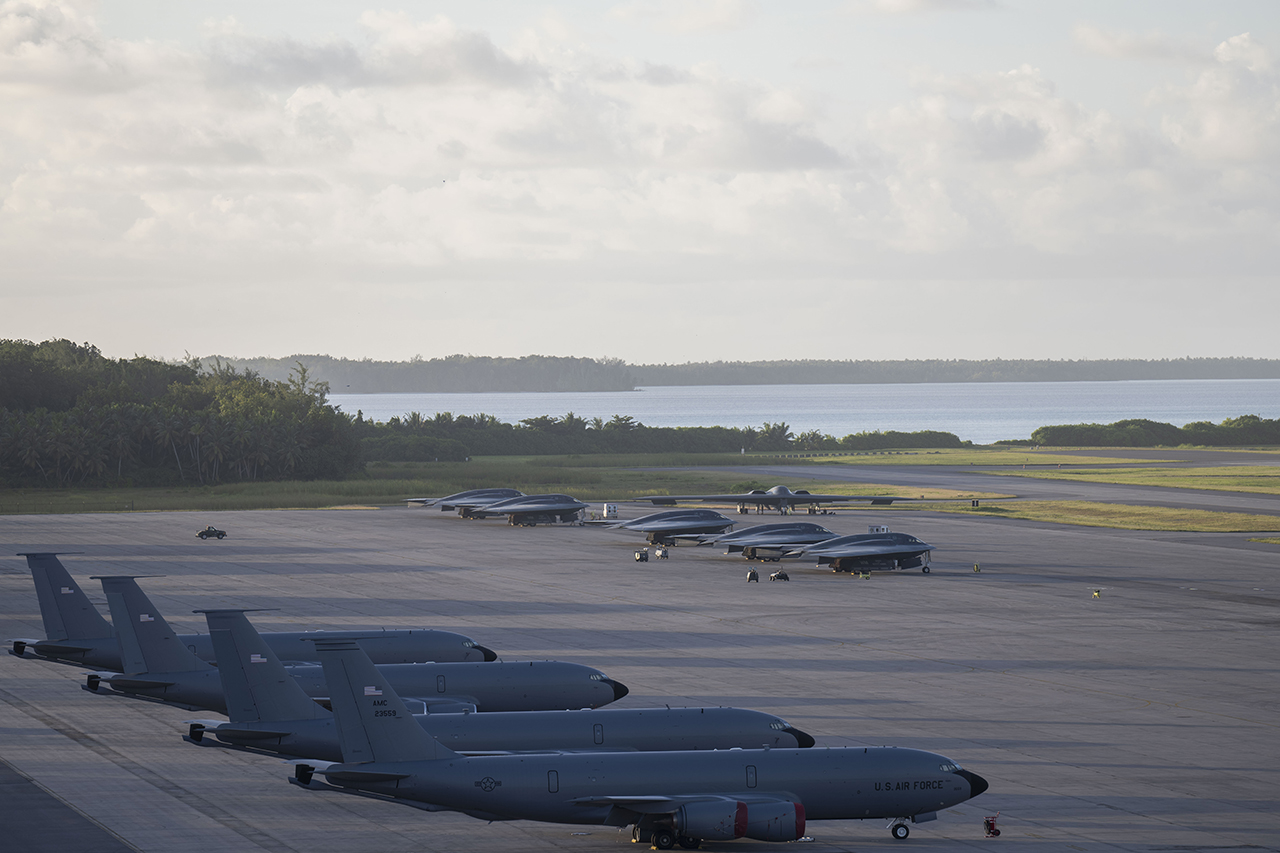
This context helps explain why recent movements appear to be structured around redundancy and geographic dispersion. Also, with controversy related to the UK possibly blocking the use of Diego Garcia, some capabilities might have to be moved to different locations to avoid last-second planning issues.
In June 2025, the arrival of F-22s and additional F-35s represented the last piece to the puzzle, leading to the green light for Midnight Hammer. Multiple media outlets in the region, now that these assets have once again arrived, signal that the strike order might be imminent.
However, at present, there is no public evidence of this order being really imminent. Sure, the infrastructure of capabilities required for such an operation appears to be now in place, making sure all options are ready on the table.